- Friday, 22 May 2026

Snow blankets Bhairavkunda, drawing more visitors
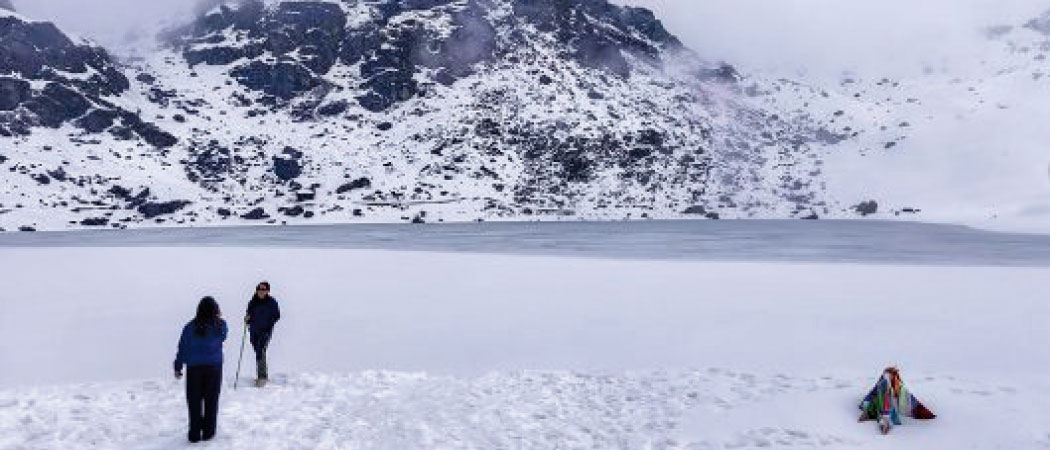

By Chitra Kumar Mijar, Sindhupalchok, Apr. 21: Fresh snowfall has turned Bhairavkunda, a high-altitude lake in Bhotekoshi Rural Municipality, into a striking white landscape, attracting a growing number of visitors.
The renowned lake, located in the upper reaches of Sindhupalchok District, has been covered in thick snow after several years, giving it the appearance of shimmering silver. As a result, both domestic and foreign tourists have begun flocking to the area.
Situated at an altitude of 4,124 metres above sea level, Bhairavkunda spans around 84,193 square metres. Above the lake lies Furbi Ghyachu Pass at 6,567 metres. The lake and surrounding pass offer stunning views. The area is home to the Sherpa community, who worship the lake as “Ama Chhyumen” in their language. Bhairavkunda holds religious significance for both Hindu and Buddhist devotees.
According to the Survey Department, the depth of the lake has not yet been measured. Water flowing from the lake forms the nearby Bhairavkunda Waterfall, the second-highest waterfall in the country at 198 metres, adding to the area’s beauty.
The lake, waterfall and mountain pass together create a captivating destination. The Jugal mountain range can be seen directly from Bhairavkunda, enhancing its scenic appeal.
Raju Lama, ward chairperson of Bhotekoshi Rural Municipality-1, said that during snowfall, more than 100 domestic and international tourists visit the site daily.
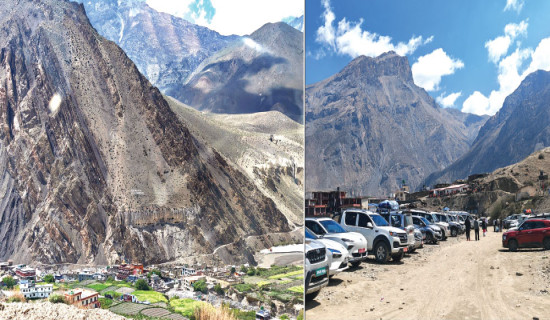
Bhairavkunda lies about 109 kilometres from Kathmandu along the Araniko Highway. From Larcha near the Tatopani border point, it takes about an hour by vehicle to reach a monastery, followed by a one-and-a-half to two-day trek to the lake. Local hotels and homestays are available for overnight stays. The site sees particularly large crowds during Janai Purnima.
Historically, in 1854 BS, during the Nepal-Tibet war, Jung Bahadur Rana built Duguna Gadhi fort below Bhairavkunda, which was used in military operations. The area also offers views towards Khasa in Tibet.
There is a belief that Bhairavkunda is the abode of Lord Shiva and Parvati. Bhairav, a fierce form of Shiva, is regarded as the destroyer, and the lake is considered a divine playground of the deity. Nearby lies Deudhunga, another tourist site in Bigu, Dolakha, located along the border of Sindhupalchok and Dolakha districts. Many visitors undertake a religious pilgrimage to both sites.
Devotees believe that wishes made at Bhairavkunda with a pure heart are fulfilled. This belief draws pilgrims and tourists from Nepal, China, India, Europe, America and Japan. The cool climate further enhances the experience.
The Bhairavkunda area is rich in biodiversity, with a variety of medicinal herbs such as yarsagumba, sunpati, panchaule, chiraito, jatamasi and others. Wildlife found in the region includes tigers, bears, leopards, wolves, snow leopards, wild boars, Himalayan tahr, ghoral, pheasants, deer and pangolins, making it an important habitat for rare species.
Reaching Bhairavkunda can be challenging. Visitors must cross steep cliffs, forests and rivers, and may need to stay in yak sheds along the way. There are no shops en route, so travellers are advised to carry sufficient food and supplies. The trekking route is difficult in parts.
Tourist inflow is highest between August and October, and again from March to May.