- Wednesday, 13 May 2026

Capital spending stalls at 24% as FY nears end
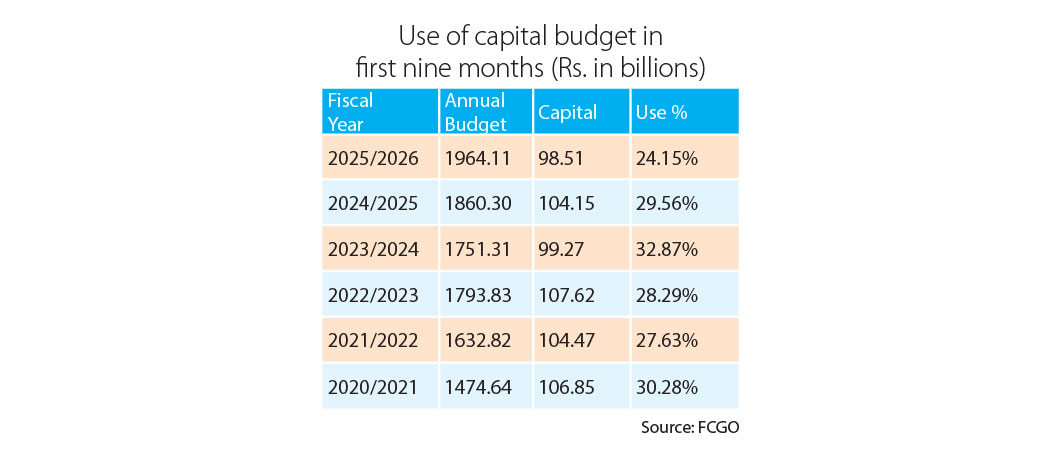

Kathmandu, Apr. 19: Mobilisation of the development budget in the past more than nine months of the current Fiscal Year 2025/26 has remained meagre at just 24.15 per cent, creating a challenge for the government to spend a large chunk of the budget expediting the projects.
Rs. 98.51 billion of the Rs. 407.88 billion earmarked for capital expenditure has been mobilised so far, while less than three months remain to utilise the remaining funds. The size of this year’s budget is Rs. 1964.11 billion.
However, this year is not exclusive to this trend. Analysis of the past six years' capital expenditures showed that it remained at or below 30 per cent, with just one exception. The government has continuously failed to utilise the budget earmarked for construction and development.
According to the statistics published by the Financial Comptroller General Office (FCGO), the government could mobilise 29.5 per cent in the first three quarters of the last FY 2024/25, about 28.3 per cent in 2022/23, above 27.6 per cent in 2021/22, and 30.2 per cent in 2020/21.
It was FY 2023/24, when the capital expenditure reached almost 33 per cent. That year, the government had downsized the annual budget to Rs. 1751.31 billion from the Rs. 1793.83 billion in 2022/23. But the Gen Z movement and the damage caused to the private businesses and multiple changes in the government further affected budget mobilisation. Thus, the performance remained much below that of the COVID-19 period in 2021 and 2022.
However, the recurrent expenditure has remained above 60 per cent in the first three quarters of the past three years after the COVID-19 pandemic.
Economists said that the poor mobilisation of the development budget has remained one of the major causes of sluggish economic growth in the past several years. While the National Statistics Office has projected a growth of 4.05 per cent in the second quarter of this year compared to the same period last year, the World Bank estimated that annual growth this year would remain 2.3 per cent. The country has failed to achieve all of its targets for expenditure, revenue and economic growth in the past several years. Ironically, the government failed even to meet the revised targets in revenue and expenses.
Economist Dr. Resham Thapa said that it is unfortunate that no governments tried to find a solution to this malady that has been troubling the nation for more than three decades. “If the government couldn’t mobilise the development budget well, it would impact the progress of multi-year projects, causing delay,” he said, while adding that a robust administrative and procedural reform should be implemented to utilise the allocated financial resources.
However, Dr. Thapa maintained that since Nepal’s economic growth is largely dependent on government expenditure, it will have less impact on that aspect. Stating that the assurance of political stability might create a favourable scenario in development work, he suggested initiating reforms in the public procurement sector and forming a special parliamentary committee or an authority to manage it.