- Tuesday, 2 June 2026

Scrutinising Press Freedom In Nepal

On BS 1958, Baishakh 24th, Nepal witnessed the first publication of a newspaper. The publication of the Gorkhapatra newspaper as a weekly commenced that day. Therefore, Baishakh 24th is celebrated as the national Press Day in Nepal every year. May 3 is observed worldwide as World Press Freedom Day. This year too, the day was marked in Nepal and across the globe with discussions on the importance of free and independent media. However, as the world advances both technologically and politically, press freedom is facing increasing attacks not only in physical spaces but also, more dangerously, in the digital sphere. In today’s world, protecting press freedom has become essential for safeguarding human rights, transparency, and democracy.
Global press freedom has reportedly declined to its lowest level in 25 years, with journalists in many countries working under difficult or extremely dangerous conditions. Reporters Without Borders (RSF) has been publishing the World Press Freedom Index since 2002. This year, RSF once again ranked 180 countries based on media pluralism, independence, journalists’ safety, and the legal, economic, and socio-cultural environment in which the media operates.
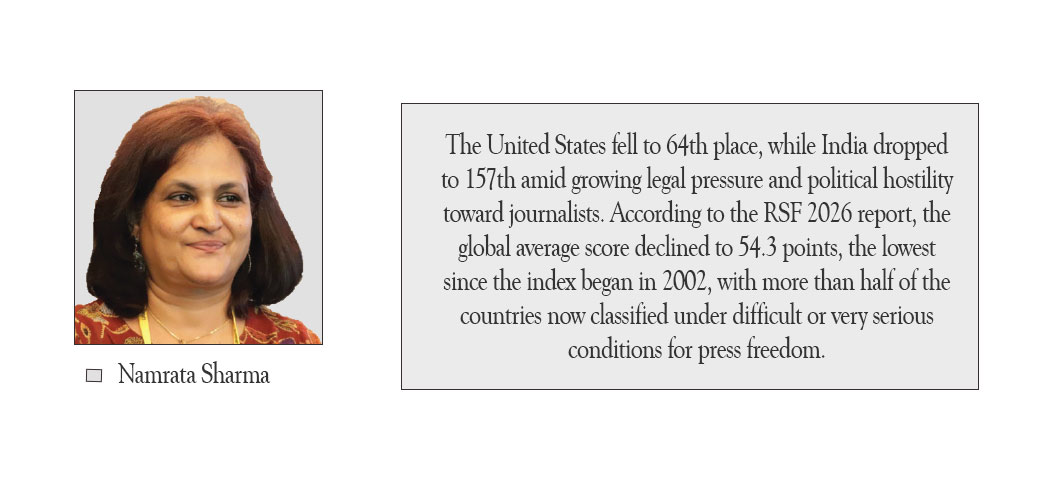
Norway topped the index with a score of 92.72, while Eritrea ranked last. Even some of the world’s oldest and largest democracies showed alarming declines. The United States fell to 64th place, while India dropped to 157th amid growing legal pressure and political hostility toward journalists. According to the RSF 2026 report, the global average score declined to 54.3 points, the lowest since the index began in 2002, with more than half of the countries now classified under difficult or very serious conditions for press freedom.
Nepal's ranking impressive
European countries continue to dominate the top positions in global press freedom rankings, with Norway remaining at the forefront. Nepal ranks 87th out of 180 countries and currently enjoys the highest press freedom ranking in South Asia. During regional conferences attended by South Asian human rights activists and media professionals, Nepal is often acknowledged, alongside Sri Lanka, as one of the few countries in the region where issues related to democracy and human rights can still be openly debated.
RSF ranks India at 157th, Pakistan at 153rd, Bangladesh at 152nd, Bhutan at 150th, and Sri Lanka at 134th. Afghanistan has fallen to 175th place due to severe restrictions imposed by the Taliban regime on journalists and media institutions. Therefore, the perception among many activists that Nepal remains a relatively safer space for democratic dialogue and free expression is true to some extent. However, it is equally important to reflect on whether Nepal should merely celebrate its comparatively better ranking or critically examine the subtle and emerging threats that may gradually weaken press freedom and democratic institutions from within.
Two organisations, Media Action Nepal (MAN) and Freedom Forum (FF), publish annual reports on the state of press freedom in Nepal around May 3 every year. According to the report Press Freedom in Peril: Rising Violence Against Media in Nepal 2026 released by MAN, Nepal witnessed a worrying rise in attacks against independent journalism and freedom of expression between May 4, 2025, and May 2, 2026. The report documented 71 incidents of press freedom violations. Most of these incidents occurred in Kathmandu district of Bagmati Province, while Saptari, Dhanusha, and Rautahat in Madhesh Province were identified as high-risk areas for media professionals.
The report highlighted coordinated attacks on media outlets in September 2025 and linked violence against journalists in March 2026 to political unrest. Documented cases included physical assaults, arson attacks, state-led criminalisation, judicial overreach, and institutional interference. Journalists were reportedly attacked with knives, belts, and helmets, while major media houses, including KMG, Nagarik, NTV, and Radio Nepal, suffered damages worth billions of rupees due to coordinated arson attacks. The report also notes the misuse of the Electronic Transactions Act (ETA), particularly Article 47, to arrest and prosecute journalists over reporting and social media posts.
The MAN reports that state actors, political groups, and government officials were among the primary violators. Several cases were documented in which mayors and municipal chairpersons allegedly used their authority to intimidate journalists investigating local corruption and irregularities. Gender-based violence and harassment against female journalists were also reported. Additionally, many journalists interviewed by MAN stated that they were not paid on time by media houses and were sometimes removed from their jobs without proper notice.
Decline
The report concludes that the period between May 2025 and May 2026 marked a decline in Nepal’s press freedom. Although no journalists were killed during the reporting period, there were two arrests, one equipment seizure, eight incidents of information blockage, 50 threats, six cases of harassment, and ten instances of misuse of laws affecting 78 journalists and 10 media outlets or news platforms. Similarly, the report Eroding Press Freedom 2026, published by Freedom Forum, documented 97 incidents of press freedom violations between May 1, 2025, and April 30, 2026. These incidents directly affected 145 media professionals, including 123 male and 22 female journalists, as well as 20 media houses. The report identified seven major forms of violations, including 28 threats—among them death threats—18 incidents of arson targeting media organisations and their properties, and four cases of arrest and detention.
Therefore, although Nepal stands relatively higher than other South Asian countries in the RSF index, the condition of press freedom within the country cannot be considered entirely healthy. The current government, which emerged partly as a public response against widespread corruption, must give serious attention to protecting independent journalism and democratic institutions to safeguard democracy.
(Sharma is a senior journalist and rights advocate. namrata1964@yahoo.com X handle: NamrataSharmaP)