- Monday, 8 June 2026

Fire damage outpaces control, communities at high risk

By A Staff Reporter
Kathmandu, Apr. 13: Fire-related disasters have emerged as the single greatest threat to lives and property in the country over the past year, with newly released figures painting a stark picture of growing vulnerability amid the dry season and limited public awareness.
According to the National Disaster Risk Reduction and Management Authority (NDRRMA), a total of 7,648 disaster incidents were recorded nationwide between mid-April last year and early April this year. Of these, fires, both structural and forest, accounted for the largest proportion, significantly outpacing other forms of disaster.
The data not only reveal the scale of the problem but also point to deeper systemic gaps in preparedness, prevention and public behaviour. Officials say the persistently high number of fire incidents highlights an urgent need for coordinated action from government bodies, local authorities and communities alike.
A year marked by flame
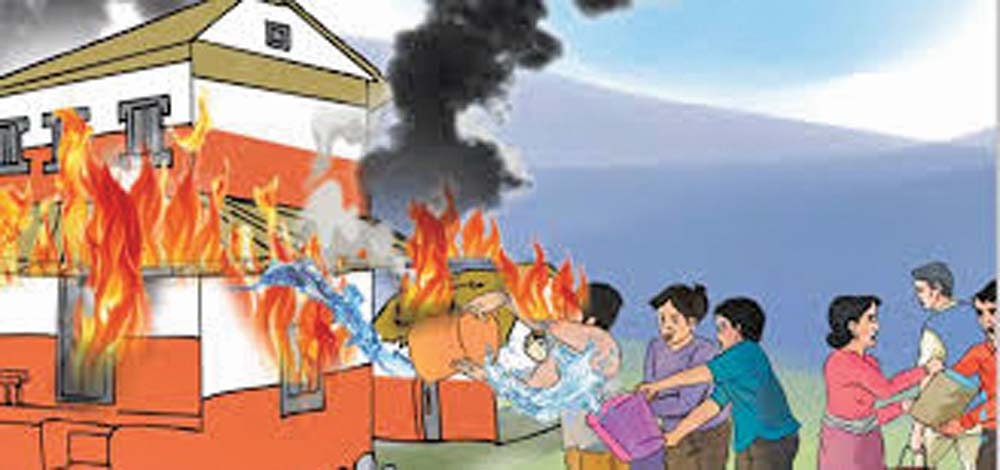
Within the reporting period, 3,720 fire incidents were documented across the country, claiming 105 lives and leaving 571 people injured. The human toll has been accompanied by widespread disruption to livelihoods, with 4,260 families directly affected.
Wildfires, though fewer in number, have also contributed to the crisis. A total of 328 wildfire incidents were recorded, resulting in two deaths, three injuries and damage affecting 58 families. While these figures may appear comparatively modest, authorities warn that wildfires often have far-reaching environmental consequences, including deforestation, biodiversity loss and increased risk of landslides in the long term.
Sundar Prasad Sharma, a prominent forest expert who works under the NDRRMA, attributes the high incidence of fires to a combination of factors. Chief among them are a lack of public awareness, inadequate precautionary measures, and the common practice of burning dry vegetation and waste, particularly during the dry season, when conditions are highly conducive to the rapid spread of flames.
Behavioural risks and preventable losses
Sharma stresses that many of the incidents could have been avoided. The widespread handling of flammable materials without adequate safety measures, coupled with negligence in both rural and urban settings, has amplified the risks.
“Carelessness and limited awareness remain key drivers behind the loss of lives and property,” Sharma said, emphasising that even small sparks can escalate into major disasters under dry and windy conditions. The data suggest that fire incidents are not only frequent but also clustered during particular times of the year. The dry season, typically spanning late winter to early spring, consistently records a spike in such events.
A snapshot of escalation
In a striking illustration of the trend, the Authority reported that within just 24 hours, from the morning of April 10 April to the morning of April 11, 2026, 19 disaster incidents occurred nationwide. Of these, 16 were fire-related, underscoring how rapidly such events can escalate within a short timeframe.
“This concentration of incidents has raised concerns about response capacity, particularly in remote areas where access to firefighting resources remains limited. Delayed response times often exacerbate damage, turning manageable incidents into large-scale emergencies,” said Sharma.
NDRRMA has urged citizens to adopt basic safety measures, such as keeping flammable materials away from ignition sources and refraining from open burning in vulnerable areas. Public awareness campaigns have also been identified as a critical tool in reducing risk. Officials argue that long-term behavioural change—rather than reactive measures—will be key to reversing current trends.
Meanwhile, Dr. Maheshwar Dhakal, Joint Secretary and Spokesperson for the Ministry of Forests and Environment informed that the Ministry has mobilised its agencies to strengthen monitoring and control efforts, particularly in forested regions prone to wildfires. Increased patrols, early warning systems and rapid response teams are among the measures being deployed.
This year, the NDRRMA has identified nine districts at high risk of forest fire and they include Banke, Bardiya, Chitwan, Dang, Kailali, Kanchanpur, Parsa, Salyan and Surkhet districts.
Likewise, Achham, Arghakhachi, Bara, Dadeldhura, Doti, Gorkha, Jajarkot, Kapilbastu, Makawanpur, Nawalpur, Pyuthan, Sindhuli and Udayapur also face the risk of forest fires. The Authority has said that effective measures, including preparedness, surveillance and warning system have been applied to mitigate the risks of forest fire in the districts.
Such measures are in place to make them more effective and result-oriented based on cooperation and coordination of the three tiers of government.







-original-thumb.jpg)