- Monday, 25 May 2026

Biska Jatra Of Bhaktapur
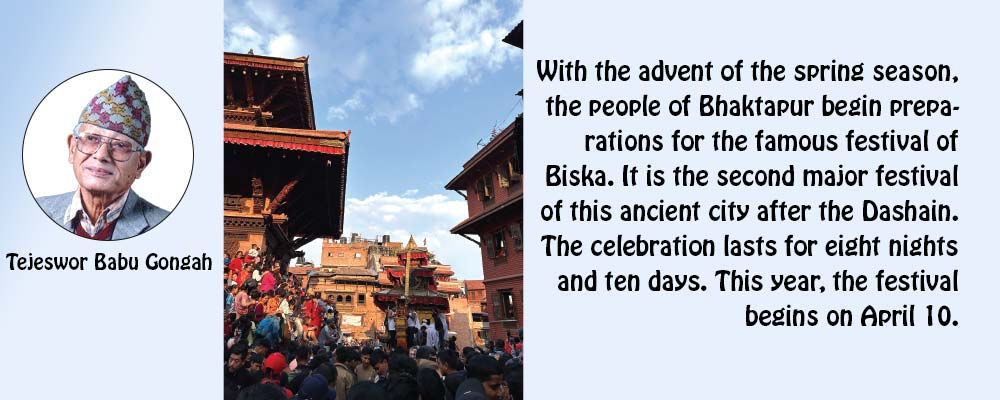

With the advent of the spring season, the people of Bhaktapur begin preparations for the famous festival of Biska. It is the second major festival of this ancient city after the Dashain. The celebration lasts for eight nights and ten days. This year, the festival begins on April 10. A huge crowd gathers to celebrate the annual event, sometimes so large that it turns violent, occasionally resulting in the deaths of revellers. The administration mobilises police in large numbers to avert such unwanted incidents.
Mystic ideas
Biska, the name of the festival, suggests demolishment. In Nepal Bhasa, 'Bi' means serpents, while ‘Shyaka’ represents demolishing – in other words, putting an end to, i.e., killing. The question remains: how and why were snakes brought to an end? A piece of hearsay related to this festival goes like this: An energetic young girl of royal blood in the Malla dynasty was to be guarded by a youth from each household. However, he would never return home alive, which became a miserable fate for his family. This tragic pattern continued for quite a long time.
Once in the outskirts of Bhaktapur city, a prince from an adjoining principality lost his way while hunting. With no better option, he sought shelter in a humble hut. In the night, the hunter awoke after hearing disturbing noises. Wondering whether he had caused any inconvenience to the owner of the hut, he approached the host. The family explained that it was their son's turn to guard the daughter of the king, and there was no chance of his returning alive. Hearing the news, the young hunter offered to take the boy's place and went to guard the princess.
At midnight, the energetic princess sneezed. Two tiny little creatures emerged from her nostrils. In the blink of the eye, those tiny creatures turned into poisonous serpents. The brave youth swiftly seized them by the neck and killed them. The next morning, courtiers arrived as usual, expecting to carry away the guard's body. But to their surprise, they found the princess and the youth happily conversing. Later, the two were married. This is one of the popular stories associated with the Biska Jatra. My mom, grandparents and others used to tell us this tale during the festival when we were young.
Symbols are the predominant forms of life and its journey forward. We need to understand profoundly, meticulously and sincerely. Devotion and dedication lead to expected outcomes in all ways and by all means. Such dedication approach is how I have made myself capable of reading the pages of books by diligent authors.
Professional painters portray triple eyes on the wheels of gigantic wooden Bhairab and Bhadrakali chariots. They have learned, earned, and maintained these skills until now. The land-grant system established and maintained by the Malla rulers supports and backs their hereditary professionalism. Land grants were the basic building blocks of the then-agrarian period. The system remained quiet for many centuries.
Religion cannot be delimited within the framework of worshipping images, icons and visiting shrines – idols and statues made or carved or embossed upon the metallic plates. Divinity is omnipotent and omnipresent. They always reside within human conscience. Divinity is everlasting and imperishable. Ideas prevail forever. I am focused on what I am trying to achieve, in tune with the Biska Jatra that occurs during the spring season.
Conjugality has remained the predominant feature of creative action and interaction. That's what we mean by creative force prevailing with Mother Nature.
Ancestral heritage
Human beings have learned and earned quite a lot from nature. For that reason, we have referred to nature as Mother Nature. It has for all ages been addressed as mother nature. She is the perennial source of creation. Every creative force, regardless of any other factors, originates from within nature. There are living creatures in the waters, in the air, in the greenery, in the jungles, and in the darkness of the night. It's rampant in every nook and corner of nature. Nature has imbibed all possible phenomena for sensitive living beings on earth. Nothing is exempted from it. Science, technologies, man's traits – every bit of object has deep roots. Why should one need to doubt and cast disagreement and suspicion upon the habitual fact. Biska Jatra is an essential part of this sensitive matter.
Symbolism plays a vital and major role in the objects of Jatra and festivals. The chariots, carvings, triple-tiered roofs, the images/idols of Bhairab and Bhadrakali, the linga (yosin), every object of the Jatra used and applied on the occasion are quite a few symbols. The seasons of the year themselves represent habitual phenomena of nature. Whenever and wherever natural phenomena are shaken, gigantic upheavals occur. No one can remain exempted from that. Natural calamities are embedded in the womb of our planet. Volcanic eruptions, giant floods, landslides, and soil erosions are quite a few examples of natural calamities. There remains unforeseen, unexperienced havoc and calamities in the womb of the earth. However, we pray there will be no misfortune. There's no certainty; it may or may not happen.
During the process of pulling the Bhairab and Bhadrakali chariots, youth sing the monotonous melodies. Each and every participant gets tired of losing their physical strength and stamina. The whole bunch of mass gets relaxed and regains physical strength.
A couple of minutes of singing is gainful for reviving physical stamina. It's a magical treatment and trick.
The central idea behind the fifty-five-foot-long yosin—the wooden pole—is quite mysterious. The gigantic pole is symbolically phallic in nature.
Raising a pole represents mating between the earth and the firmament – the sky, in other words, as I conceive it. This phenomenon is because the Bisyakaya / Biska festival is observed in the mid-spring season.
It is only natural to celebrate a pole-raising festival during this season. The mid-spring season is overwhelmingly influential in arousing sexual temperaments. However obscure they may be, habitual facts and temperamental emotions intertwine. Meticulous handling will be necessary for many other events, regardless of their nature.
(The author is a senior literateur.)




-original-thumb.jpg)
-original-thumb.jpg)