- Friday, 29 May 2026

Migratory Eagle In Kapilvastu
 Rajesh Dhungana
Rajesh Dhungana
Rajesh Dhungana
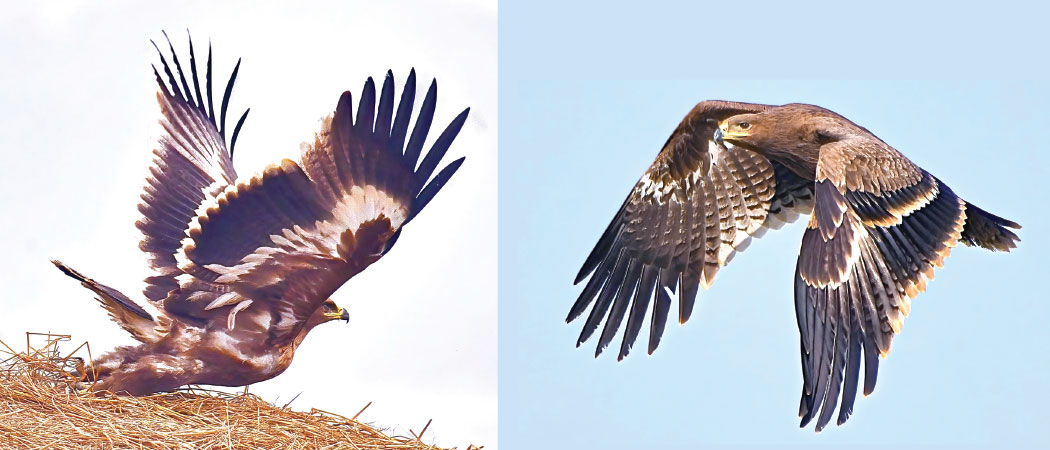
The steppe eagle is a large migratory bird of prey that visits Nepal during the winter months. The bird comes to Nepal from Europe, Kazakhstan, Mongolia, China, and Russia. The bird inhabits Kapilvastu District, a historically rich area with diverse ecosystems ranging from the lowland Terai plains to the Chure Hills. The Jagdishpur Reservoir in Kapilvastu is the largest man-made wetland, where there are many lakes and agricultural fields to provide migratory birds with suitable feeding sites.
The steppe eagle prefers to hunt in open habitats, including grasslands, rice fields, wetlands and semidesert areas. In Nepal, observers often spot eagles perched on straw piles or standing on the ground in search of prey. They mostly eat small mammals, such as rodents, hares, and ground squirrels, as well as birds, reptiles, and carrion. The eagle is known for its excellent eyesight and flying at high speeds, using thermal air currents to soar vast distances and then using high levels of speed when diving to catch its prey. From a physical aspect, the steppe eagle is one of the largest raptors, with a length of 60 - 89 cm and wingspans up to 2.6 m. They are dark brown except for the lighter neck. They also have large, hook-shaped beaks.
The scientific name of the steppe eagle is 'Aquila nipalensis'. Aquila shows that the eagles are in the Accipitridae family, and nipalensis is from Nepal, where Brian Houghton Hodgson first identified it in 1833.
The steppe eagles breed in Central Asia from April to August, where they lay one to three eggs in their nests. The steppe eagle represents an important ecological niche and also has significance as a cultural and symbolic creature in various countries. In Kazakhstan, the steppe eagle is the national symbol of strength and liberty, while in Egypt, it is also important as a symbol of national identity.
Despite the species' hardiness and the long migratory route that traverses the Himalayas, the steppe eagle is in serious danger due to habitat loss from agricultural development, the decline of prey species, pesticide use, electrocution by power lines, and wildlife trade, among others. It was because of these factors that the International Union for Conservation of Nature declared the species endangered in 2015. The return of the steppe eagle to Nepal on an annual basis is not only a treat to the eyes of nature but also reminds us of the interrelatedness of the world's ecosystems, as well as the importance of conserving this magnificent migratory bird.
(The author is a wildlife photographer. The photos used in this article are by the author.)