- Sunday, 19 April 2026

We endured everything and steered country to peace: PM
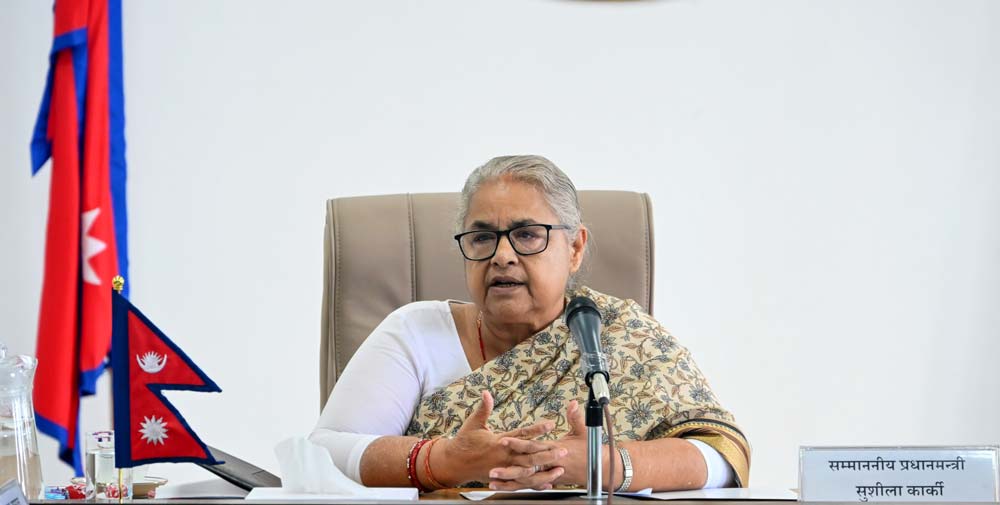

The election to the House of Representatives was conducted peacefully. As the Prime Minister, you led the process successfully. How do you feel ?
I do not feel anything extraordinary. However, everyone was concerned about the country. Amid uncertainty, the election has completed peacefully. Those who care about the nation and wish for its well-being are happy. I am happy as well. The government was entrusted with the responsibility of conducting the election, and we managed to accomplish that duty on time. That gives me a sense of satisfaction.
You assumed the role of executive head during a difficult time in the country. Since this was after the Gen Z movement, there must have been many challenges in the early days. How do you recall those challenges ?
There were many challenges when I took the leadership. At times, I myself wondered whether we would be able to accomplish the task. We had only six months. On top of that, we faced a flurry of attacks and deep distrust. All the established political parties stood against us. Those claiming to represent the Gen Z movement immediately demanded that we step down and accused us of hijacking their movement.
There were very few people willing to support us. The members of the Cabinet encouraged one another and continued working. Even when meeting foreign diplomats, they would ask, ‘Is this even possible?’ We did not receive much sympathy or encouragement from any side.
We did not have a large organisation or a strong support base behind us. We were just a handful of people in government. During that time, there were many assaults and little public confidence in us. On top of that, there were remarks about me being a woman. But I listened with one ear and let it go from the other. I never stopped doing my work.
In such a difficult situation, where did you find the courage and confidence to say, ‘I can lead ?’
The confidence came from within. Before becoming Prime Minister, I had not anticipated this situation. But I felt that I had the energy and strength of someone aged 16 or 18. People often suffer health problems due to high blood pressure, especially under stress. Newspapers were filled with criticism of me everywhere. But instead of my blood pressure increasing, it actually decreased. Even my doctor was surprised.
I was not easily frightened. I had already experienced difficult situations in life. In politics, there are values and principles, and people in the judiciary also face many pressures. I had gone through difficult times before.
Another reason is that since childhood I was taught to endure and not panic. I always believed that if one works with courage, anything is possible. I had a strong self-confidence.
I also prayed to God many times. Sometimes people spoke about the Maoist armed conflict, about killings and violence. I wondered how long Nepalis would continue to lose their lives. I prayed, asking God to protect the country.
Personally, I feel fulfilled in life. I have been Chief Justice and Prime Minister. I have a family, children, grandchildren, and a home. I have nothing more to ask for personally. I prayed that my country be protected.
Interestingly, the weather also remained favourable during the election. I had said it should not rain that day, and it did not. I had said it should not snow, and it did not. Of course, that may have been a coincidence, but I also thanked nature.
While leading the country, was there ever a moment when you felt the situation was too difficult to handle ?
Yes, a number of times. One day the parents of martyrs from the Gen Z movement came to Baluwatar and cried in front of me. It was heartbreaking. Newspapers constantly wrote that the government would fail.
Some Gen Z activists even asked why we were doing the work they believed should have been theirs. Earlier, some people could not even tell the President they were capable of leading. Later, as the government’s term was coming to an end, they came asking to be appointed ministers.
But they were young people. Some individuals even tried to pull down the government in order to become Prime Minister themselves. Political parties also suggested that even if I became Prime Minister, the Cabinet should be formed with ministers from established parties.
It seems the position of Prime Minister holds great attraction in this country. For me, it is not something invaluable. Even today, I prefer being called Chief Justice. I enjoy the judicial environment more. But many people seem drawn to the position of Prime Minister.
Some even said, ‘If Sushila can do it, why can’t we?’ They used abusive language and made rude comments about my clothes, the bangles I wore, and even the way I walked. But no matter how much criticism there was, it did not make any difference to me. It is their perspective.
At what point did you become confident that the election would definitely take place ?
I was appointed Prime Minister on September 12 last year. The next day was Saturday, and from September 14 the Election Commission started its work.
First, we focused on the families of those who were martyred during the Gen Z movement. We listened to their concerns and responded accordingly. After that, we focused on the election.
We also requested assistance from neighboring countries. The police lacked vehicles. Friendly countries such as India and China provided support.
We concentrated mainly on the election and facilitated everything requested by the Election Commission. We also discussed the matter with the President to create a favourable psychological environment.
Around 21 or 22 groups emerged in the name of Gen Z. Each group had different demands. Some demanded an executive prime minister, some an elected prime minister, and some demanded constitutional amendments, even proposals that were not possible under the constitution. But we could not ignore what the young people were saying either.
Political parties said that the government’s only job was to conduct the election. Meanwhile, Gen Z activists said we should accomplish everything because the government had emerged from a movement. We had to listen to both sides.
Despite many ups and downs, a historically peaceful election was held. Do you feel this is the greatest achievement of your life ?
I do not feel it that way. Life is like passing examinations. One passes one class, then another, and eventually completes higher studies. Life presents tests at different stages.
If you ask honestly, this was one battle in life. The country experienced relief. At the beginning, I had said that no one should die during the election and not even a drop of blood should be shed. Ultimately, the election was peaceful.
I would like to thank the general public. The Nepali Army, Nepal Police, Armed Police Force, National Investigation Department, and temporary police personnel all made significant contributions to the successful election. As the Prime Minister, I would like to thank them all.
Who contributed to the success of the election and the government?
The main responsibility of the government was to conduct the election. I would give 50 per cent credit to the Election Commission. Acting Chief Election Commissioner Ram Prasad Bhandari and two other commissioners made contributions that history will not forget.
Although the commission should have had five officials, only three carried out such a major responsibility. As the Prime Minister, I sincerely thank them and the entire commission.
Among the Cabinet members, I would especially like to thank Home Minister Om Prakash Aryal, who worked tirelessly day and night. I also thank the other ministers. The chiefs of the four security agencies played a crucial role by preparing and implementing an integrated security plan.
Two individuals who worked closely with me, press adviser Ram Bahadur Rawal and chief personal secretary Adarsh Kumar Shrestha, made invaluable contributions that I will never forget. Rawal is not only a journalist but also an honest person with a strong desire to help others.
Chief personal secretary Shrestha is a court employee with a long experience in the judiciary and expertise in IT and law. He has served several Chief Justices and earned everyone’s trust. At my age, I would say that 75 per cent of my success is due to Adarsh’s contribution.
Previously, the Prime Minister’s secretariat had around 40-50 staff members. But these two individuals worked as if they were equal to 20-25 people. I express my heartfelt gratitude to them.
Similarly, Nepali Army officers Major Balamukunda Bista and Major Suraj Ojha are highly knowledgeable. They regularly kept me updated about developments around the world. Captain Goma Budhathoki looked after me like a daughter.
There was controversy regarding your secretariat at one point. What actually happened ?
My residential area is predominantly Newar. For managing household affairs, I brought a few people from the Newar community whom I knew personally to assist at the Baluwatar residence. Their work had nothing to do with official government duties; they were only helping me with personal matters.
However, people later said they were Adarsh’s relatives and accused us of nepotism. In reality, they were people I knew.
I did not think that criticism was fair. Eventually, I removed many of them, even those who cooked meals. For a few days, I cooked my own food, with the help of security personnel. It is surprising because previous prime ministers had up to 90 people in their secretariats, and no one spoke of nepotism. But at the age of 73, I was forced to do everything myself. Even so, today I thank those who criticised me.
What were the major challenges in conducting the election ?
There were around 125 to 130 political parties in the country with different ideologies. Some appear polite but carry hidden agendas. Some run parties mainly to collect money. There are communists, royalists, and those who support the former king.
Whoever becomes Prime Minister, very few people talk about building the country. Many are only interested in holding power.
Holding office alone cannot build the nation. If people truly want to serve the country, they can contribute within their own fields.
We held discussions with leaders of all major political parties, including Sher Bahadur Deuba, KP Sharma Oli, Prachanda, and leaders of the Rastriya Swatantra Party, as well as representatives from all 125 parties.
There were many struggles. One Inspector General of Police even scolded me during a meeting. We had to tolerate all of that.
Old bureaucrats were still loyal to old political parties. New leaders tried to introduce new ideas. We endured everything and eventually brought the country to a peaceful situation.
Sometimes I held up to 14 meetings in a single day. Many discussions continued until 2 or 3 in the morning. Every day I met numerous people. All of this was done to create an environment for elections.
There were also tensions in various places related to religious and communal issues. We managed to avert those conflicts.
The National Investigation Department, which had previously been inactive under the Prime Minister’s office, was brought under the Home Ministry and made active. Its intelligence played an important role in preventing major incidents.
Major political parties had even gone to the Supreme Court demanding the reinstatement of the dissolved House of Representatives. Eventually, however, everyone agreed to hold elections. How was this possible ?
The government was determined to hold elections at any cost. We repeatedly engaged in dialogue and discussions with all political parties. We worked continuously to steer the entire country toward the election process. In the end, that effort was successful.
In the election, the new party achieved a victory close to a two-thirds majority, while the old established parties appeared weak. How do you interpret this result ?
The current election results largely reflect the voices of young voters. They are also an effect of the Gen Z movement and the public’s desire for change. However, the old parties should not panic, and the new parties should not become arrogant. Even we did not expect such a result.
I never imagined that KP Oli would lose. That is a place where he had been active in politics for 30-40 years, where he has many supporters and close associates. When I last met him, I told him that in politics things often work like this: even in my own family there are people who belong to the Congress party. They criticise the party all year long, but when it comes time to vote, they still vote for the same party. I told him people would likely vote for him as well. I too believed something like that would happen.
We must respect the mandate given by the people. The votes received by the Rastriya Swatantra Party must also be respected. Even if the opposition has received fewer votes, the RSP must respect them. In politics, before the election there are different parties competing with one another, but after the election the winners must not ignore those in the minority.
The new party should respect the older parties. If the ruling side makes mistakes, the opposition should raise its voice. Politics is essentially social service. In India, Indira Gandhi once lost an election in a similar way but later returned to power. Mature leaders in Nepal will not be forgotten by the people. What we are seeing today is a wave.
In line with the spirit of the Gen Z movement of September 8 and 9, what steps has the current government taken to ensure good governance and control corruption ?
We made every possible effort to ensure good governance and control corruption. Unlike previous governments, we did not spend recklessly. I myself did not take a salary. I live in Baluwatar, and that is all I take. I do not take anything else. The use of a bulletproof vehicle and a Nepali Army helicopter during official travel is mandatory. Some ministers have also not taken salaries, although a few had to because they have no other sources of income.
We cut unnecessary expenses. The total cost of the election was about Rs. 32 billion, but much of that spending went toward the police, the army, and security equipment, materials that will continue to be useful in the future. Only essential expenditures were made. The Election Commission also minimised its spending and maintained strict financial discipline. For example, the National Assembly election was estimated to cost Rs. 40 million, but it was completed with only Rs. 20 million.
Some ministers and I did not even take red passports. We did not add any burden to the state treasury by making foreign visits. We only traveled to a few districts to assess the election situation and encourage the personnel deployed there. In my opinion, no previous government practiced such austerity.
When making appointments and promotions in the civil service and security agencies, we ensured that there was no room for manipulation. Seniority and competence were the main criteria. This helped strengthen the long-term morale of those institutions.
We also respected academic institutions such as universities. We did not interfere in their appointments. In the governing bodies of 19 universities, we did not submit lists of people saying ‘these are our nominees,’ even though up to 45 positions could be filled there and traditionally those positions were given to members of the ruling party. We did not appoint any relatives.
Some people even commented that the heads of security agencies had the surname Karki, implying favouritism. But they are not related to me, and even our clan lineage does not match.
When appointing the Chief Secretary, we also followed the principle of seniority. Similarly, institutions such as the Commission for the Investigation of Abuse of Authority, Nepal Police, and the Central Investigation Bureau worked with unprecedented professional independence. I highly appreciate the heads and officials of these institutions.
Officials of the commission formed to investigate the Gen Z movement events also said that during this government’s tenure they did not face any political pressure.
Departments such as the Department of Money Laundering Investigation and the Revenue Investigation Department were moved from under the Prime Minister’s Office to their respective ministries.
Currently, the Prime Minister is the chancellor of 19 universities. We tried to amend this system, but it was not possible to introduce an ordinance. Such positions should be filled based on expertise, not arbitrarily.
The commission formed to investigate the incidents of September 8 and 9 has already submitted its report. There are growing demands for the report to be made public and implemented. What is the government doing about it ?
The commission has submitted its report. We do not have much time left now because a new public mandate has already been given. The new government will certainly move forward with the remaining process.
What message would you like to give to the new government ?
The new government must first fulfill the three main demands raised by the Gen Z movement: good governance, corruption control, and employment opportunities.
The biggest problem in the country is unemployment. Even where opportunities exist, nepotism is rife. This must come to an end, and the economic situation must improve.
Corruption must be controlled openly. Major reforms are needed inside Singha Durbar. Bureaucratic inefficiency has seriously affected government work.
Projects are rarely completed on time. It is painful to see such situations in our own country.
You have made history as the first female Prime Minister of the country. What will you do after leaving office ?
I fulfilled the responsibility entrusted to me during a difficult period. Now I will return to my previous private life.
There has also been a discussion about you becoming President. What do you say ?
I have no such ambition. There are many capable people who have not yet had the opportunity.
Finally, is there anything you would like to say about your tenure as Prime Minister ?
The government was given the responsibility of conducting elections, and we accomplished that task. Some efforts were also made in the development sector.
The new government must create employment opportunities for young people and create an environment where they can stay in Nepal rather than going abroad and returning in coffins. Education reform is also necessary.
Nepal is an extremely beautiful country with abundant natural resources. There should be no more conflict or tension. People should live together in harmony.
I believe Balen's election campaign sent a message that the Tarai, hills, and mountains can unite. I have faith in him and hope that something positive will happen.
-original-thumb.jpg)

-original-thumb.jpg)