- Sunday, 10 May 2026

Rural farmers drawn to sugarcane farming and jaggery production
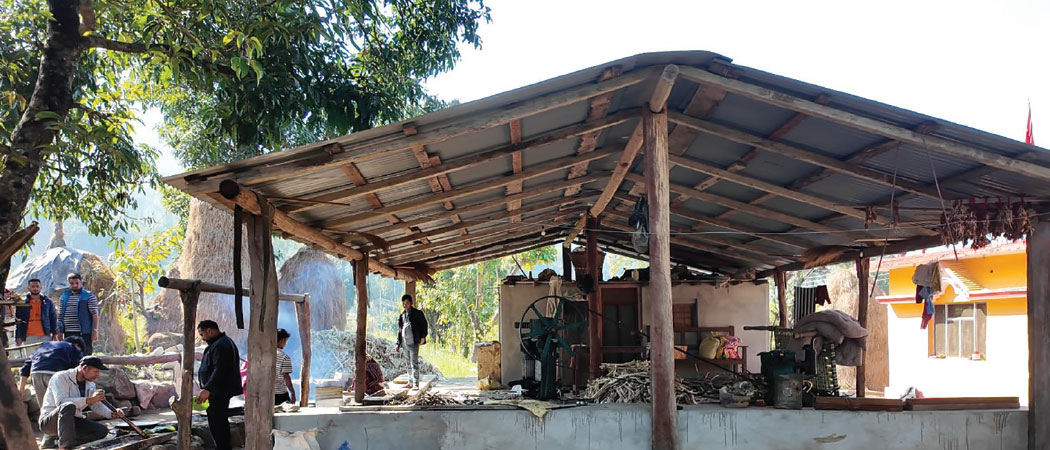
Photo: Pushkar Bhandari Locals producing jaggery using a mill installed in Jamarani village, Parashuram Municipality-8.

By Puskar Bhandari,Dadeldhura, Apr. 19: Farmers in the rural areas of Dadeldhura have been increasingly attracted to sugarcane farming and the production of jaggery.
As jaggery can be stored and sold for years and is preferred by locals over commercially produced varieties, many farmers are turning towards this traditional yet profitable practice.
Unlike vegetables and other cash crops, which often face market shortages during peak production periods, jaggery does not suffer from such problems. Sugarcane farming also avoids the issue of rapid decay seen in vegetables.
According to Narendra Paneru, chief of the Agriculture Knowledge Centre in Dadeldhura, jaggery production has started to provide good profits for farmers. He said that as jaggery can be stored at home and sold even after several years, the centre has been supporting farmers with various subsidy programmes for sugarcane cultivation and jaggery production.
Narendra Bista, a young farmer from Jamarani village in Parashuram Municipality-8, said he has modernised his family’s traditional occupation of producing jaggery. He has established a jaggery production unit by installing a sugarcane processing mill in the village.
“We have taken forward the traditional work of our forefathers in a modern way,” he said. “Our family settled in this village around 1975 (2032 BS). Since then, there was a traditional ox-driven mill used to crush sugarcane.
It could process only about 200 to 300 litres of juice a day and was quite laborious. Now, we use a diesel-powered machine, which can process thousands of litres in a single day. It has made the work much easier.”
He said around Rs. 1 million has been invested in setting up the mill, including the machine, cooking utensils for making jaggery, and a shed to house the equipment. Half of the investment was supported through subsidies from the agriculture branch of Parashuram Municipality and the Agriculture Knowledge Centre.
Bista has cultivated sugarcane on about five ropanis of land and plans to expand further. “Other farmers in the area are also growing sugarcane. There is solid demand for jaggery from markets such as Jogbuda and Laldhunga, so we have not faced any difficulty in selling it so far,” he said.
However, he added that as production increases in the coming years, farmers will need to explore larger markets.
Similarly, Chitradevi Singh, a commercial farmer from Tatapani in Parashuram Municipality-6, has been cultivating sugarcane on around 12 ropanis of land since last year. “We used to grow vegetables only for household consumption. Now, I want to move into commercial farming,” she said.
Last year, she produced around 200 to 300 litres of sugarcane juice, which yielded jaggery. She received support from a local organisation called Rural Women Development and Unity Centre (RUDUC), which provided a sugarcane crushing machine.
“This year, after expanding cultivation, we produced about 2,000 litres of juice,” she said. “We have also started preparing our own sugarcane seedlings and plan to expand cultivation further.”
According to her, one batch of juice produces around 9 kilograms of jaggery. With jaggery selling at around Rs. 250 per kilogram directly from home, farmers are earning a good income.
However, she added that the machine provided by RUDUC has now broken down due to lack of technical knowledge. “We did not know that the machine should be operated gradually. Running it continuously throughout the day caused the damage,” she said.
Farmers in Tatapani are hopeful after Paneru recently visited the village and informed them that the Agriculture Knowledge Centre would provide sugarcane crushing machines at a 50 per cent subsidy next year. Locals are now preparing to complete the required procedures in the hope of receiving the machines.
According to Singh, around 32 farmers in Tatapani have been cultivating sugarcane for the past two years. She said that access to higher-capacity machines would greatly benefit farmers and increase jaggery production.