- Sunday, 19 April 2026

Sundial becomes Rapti Shanti Udhyan's attraction
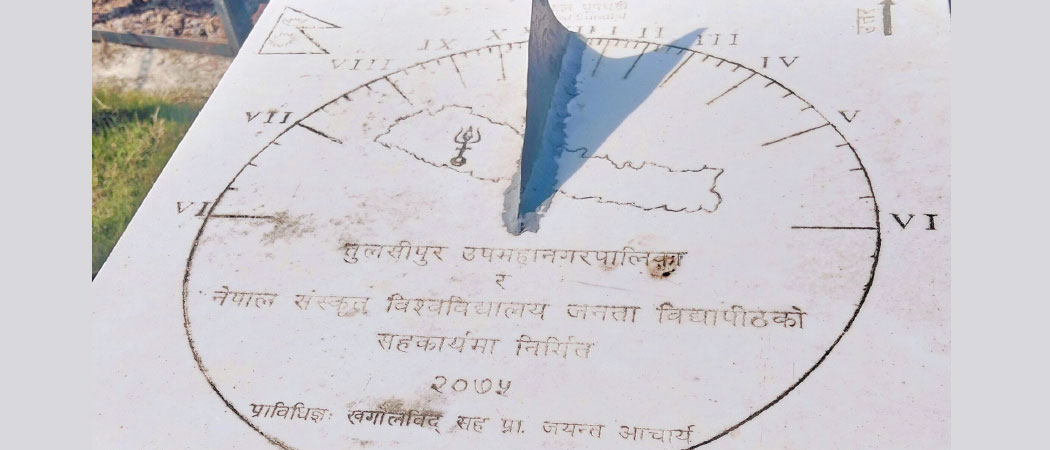

BY GOKARNA PAUDEL,Tulsipur, Apr. 19: A large statue of Gautama Buddha stands inside Rapti Shanti Udhyan, located in Ward No. 7 of Tulsipur Sub Metropolitan City. Established in the former Rapti Zone, once the origin point of the Maoist insurgency, the park was created to promote peace. Beyond spreading a message of harmony, it also preserves a traditional sundial used by ancestors to tell time.
According to Associate Professor Jayanta Acharya of the Balmeeki Campus under Nepal Sanskrit University, the oldest known timekeeping device in Nepal dates back to the Lichhavi period and is located at Swayambhunath. Sundials are also found at Hanuman Dhoka Durbar and Ghantaghar, although all three are currently in a deteriorated condition. He added that while a sundial is on display at the museum in Chhauni, little attention has been paid to its preservation.
A new sundial has been installed at Rapti Shanti Udhyan in Tulsipur-7 through collaboration between Janata Campus Bijauri and Tulsipur Sub Metropolitan City. There are also plans to install another sundial at the donor memorial area of Nepal Sanskrit University’s central office. University Registrar Professor Madhav Adhikari stated that site management work was ongoing and the sundial would be installed once preparations were complete.
Former chairperson of the Shanti Udyan Committee and head of the Ganesh Community Forest, Dilli Bhandari, said that visitors to the park were particularly interested in the sundial near the Buddha statue. Many were surprised to find that the time shown on the sundial closely matches the time on their wristwatches.
Sagar Regmi from Tulsipur-19, Doghare, who visited the park, said it was his first time seeing a sundial and said that the time it showed matched his own watch.
According to its designer, Associate Professor Jayanta Acharya, the sundial costs over Rs. 100,000 to construct. So far, only Tulsipur Sub-Metropolitan City and Nepal Sanskrit University have shown institutional interest in such projects. The sundial installed in Tulsipur measures 18 inches. It is designed so that a copper gnomon casts a shadow onto a specially prepared granite surface, allowing the local time to be determined from the position of the shadow.
Acharya informed that while modern clocks in Nepal were calibrated based on the position of Ganesh Himal, sundials determine time using the position of the North Pole, making them scientifically accurate. A sundial can indicate time from sunrise to sunset.
Jharedra Kharel, head of the Culture and Tourism Promotion Section of Tulsipur Sub-Metropolitan City, said that information about the sundial and its historical significance had been included in the local curriculum to raise awareness among younger generations.




-square-thumb.jpg)

-original-thumb.jpg)