- Wednesday, 3 June 2026

A Philosophical Turning Point for Higher Education
.jpeg)
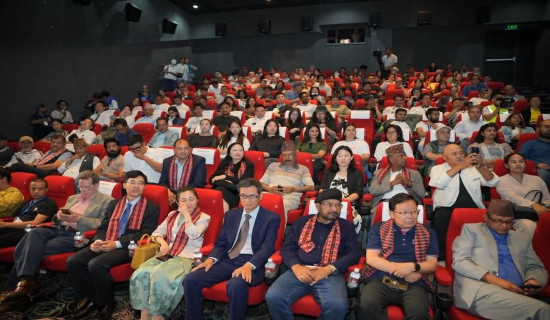
 The International Conference “Envisioning the Himalayan Future: Pathways to Sustainability and Development”organized by Purbanchal University deserves appreciation not only as an academic gathering, but as a moral and intellectual statement. It reminds us that a university is not simply a place that distributes degrees. At its best, a university is a society’s conscience—its space for truth-seeking, meaning-making, and long-term responsibility.
In a time when higher education is pressured by political interests, rapid digital change, and shifting youth expectations, this conference signals something deeper: the possibility of returning the university to its real purpose. It suggests that the university can again become a place where society learns to think beyond immediate emotions, beyond short-term power, and beyond the comfort of slogans.
This is why the conference matters. It is not only about the Himalayas. It is also about the “inner Himalayas” of a nation: the strength of institutions, the discipline of knowledge, and the dignity of human development.
The Himalayas as a Mirror of Responsibility
The Himalayas are not only mountains. They are memory—of civilizations, climates, and cultural journeys. They are also warning—because what happens in the Himalayas reflects what is happening in our values. When glaciers melt, it is not only a scientific fact; it is also a sign that modern development has often lacked ethical balance.
To “envision the Himalayan future,” therefore, is not only to plan policies. It is to ask a philosophical question: What kind of development is worth pursuing if it destroys the conditions of life? And equally: What kind of education is worth building if it produces skilled people without moral depth?
A sustainability conference becomes meaningful when it does not stop at data, but reaches the level of purpose.
Sustainability as Institutional Character
We often define sustainability in environmental terms: climate change, biodiversity, and risk. But inside a university, sustainability first means character—institutional character.
A university is sustainable when it has continuity of purpose, intellectual autonomy, and internal moral discipline. It becomes fragile when academic priorities change with every political shift, when research depends only on a few individuals, or when campus life is weakened by constant conflict.
In this sense, sustainability begins inside the institution. A university cannot teach sustainability to society if it cannot practice stability, fairness, and integrity within itself. This conference highlights that truth: a resilient nation needs resilient universities—and resilient universities need a stable academic soul.
A Network of 100+ Colleges: A Distributed Mind
Purbanchal University is more than a central campus. It is a network of more than 100 affiliated colleges. This matters philosophically. It means the university is not a single building—it is a distributed mind.
A distributed system can become either fragmented or connected. It can remain a set of isolated colleges, or it can become a shared intellectual community where ideas travel, practices spread, and research becomes normal.
This conference represents the second possibility. If its spirit reaches affiliated colleges, the university can evolve into a knowledge ecosystem: not a center that merely commands, but a network that learns. When knowledge spreads through shared practice, a conference begins to resemble a movement.
The Weight of Participation: Nearly 200 Papers and Many Keynotes
The scale of participation carries its own meaning. With nearly 200 research papers and more than a dozen keynote addresses, the conference reflects a collective willingness to think seriously. It shows that many scholars and practitioners are prepared to step beyond routine teaching and move toward knowledge creation across disciplines—engineering, environmental science, management, law, education, health sciences, and more.
This matters because research is not only a technical activity; it is a discipline of truth. It teaches patience, humility, and intellectual honesty. It is the opposite of propaganda. It trains the mind to accept complexity, to test assumptions, and to respect evidence.
This initiative also deserves appreciation for the visionary leadership that made it possible. Organizing a conference of this scale requires strategic foresight, institutional courage, and strong coordination. Such leadership signals confidence in the university’s academic potential and a sense of responsibility toward national development. When leadership invests in research culture and international dialogue, it creates a foundation for transformation and resilient higher education.
Education as the Building of Inner Power
The deepest question of higher education today is not only “What should students know?” but “Who should students become?”
This generation does not seek education only for certificates. Students want identity, purpose, and inner strength. They want education to help them think independently, act ethically, and contribute meaningfully. In that sense, education is the cultivation of “inner power”: the ability to hold values under pressure, to sustain discipline, and to serve society without losing oneself.
This conference supports that deeper expectation. By giving space to research, dialogue, and interdisciplinary thinking, it repositions students from passive receivers to active contributors—co-creators of meaning, not merely consumers of content.
Student Life: From Instrument to Intellectual Agency
Student politics in Nepal has carried both idealism and disorder. Civic engagement is valuable. But when student energy becomes an instrument for external power struggles, the university’s purpose weakens and academic life becomes fragile.
A philosophical university does not reject politics; it elevates it. It turns politics into civic responsibility and critical thinking. It trains students to debate with reason, to disagree with dignity, and to lead through service.
This conference points to that possibility: students can be known not for disruption, but for contribution; not for faction, but for inquiry. When student leadership becomes intellectual leadership, campus culture gains social cohesion. Cohesion is not silence—it is shared respect.
AI and the Question of What Makes Us Human
Artificial Intelligence is forcing higher education to face an uncomfortable question: if machines can produce information and text, what is the role of human learning?
The answer is philosophical. AI can generate content, but it cannot generate conscience. It can process patterns, but it cannot carry responsibility. It can imitate language, but it cannot live the consequences of decisions.
Therefore, education must shift from memorizing information to developing wisdom: critical thinking, ethical judgment, reflection, creativity, and contextual understanding. A resilient university in the AI era is not the one that fears AI—it is the one that strengthens the human capacities technology cannot replace.
Continuity as an Ethical Duty
Nepal has seen many good academic initiatives that faded after initial momentum. The real test of this conference is continuity.
A philosophical institution understands that continuity is an ethical duty. If research is important, it must be institutionalized. If dialogue matters, it must become regular. If sustainability is a shared value, it must appear in long-term systems—research groups, publication routines, interdisciplinary platforms, and mentorship.
Transformation is not a moment. It is a habit.
Toward Resilient Higher Education
This conference reflects more than appreciation for the Himalayan region. It signals the possibility of resilient higher education—institutions that stay stable in values even when the world is unstable in politics and technology.
Resilience does not mean rigidity. It means rootedness. It means a university stands like the Himalayas: not because storms are absent, but because foundations are deep.
If sustained in spirit and structure, this initiative can help Purbanchal University—and Nepal’s higher education—move toward that deeper foundation: a culture of truth, responsibility, and human development. That is why this conference deserves appreciation—not only for what it organized, but for what it makes possible.
Dr. Pralhad Karki