- Saturday, 30 May 2026

My Days With Gorkhapatra
New Benchmark Of Glorious Legacy
Gorkhapatra is now in its 125th year of publication. Few public institutions have such a long and uninterrupted history. In our context, it has almost become a norm for public institutions to be established and then shut down over time. However, Gorkhapatra Corporation, carrying a legacy of 125 years, has not only sustained its historical continuity but has also made distinct contributions to society through its diverse publications, each with its own unique identity.
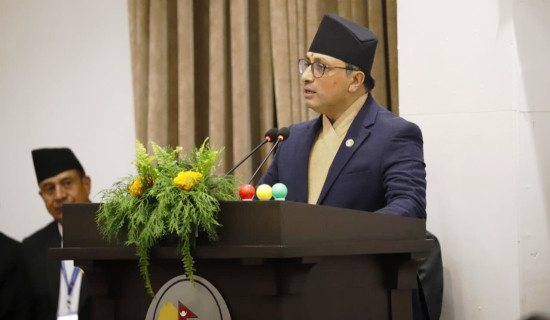
Alongside Gorkhapatra, a benchmark of Nepali journalism, our journalism sector is celebrating a century-long journey. From the perspective of a professional journalist, this moment is personally significant for me as well. After two decades of active engagement in journalism, I had the opportunity to lead Gorkhapatra Corporation, an institution with a prestigious history in Nepali media. Taking on such a distinguished responsibility at a relatively young age, in the country’s oldest and most respected media institution, was both an opportunity and a challenge.
Perhaps for the first time in the institution’s history, I became the youngest person to assume the role of General Manager. Although I earned this responsibility through competition, in a society where leadership transition and generational change are often weak, it is appropriate to view this not merely as a personal achievement but as a matter of public significance. I believe this responsibility should be seen as a test of public accountability and social responsibility.
There is still much to be done to reform and strengthen Gorkhapatra Corporation. Various initiatives have been undertaken by the management to enhance infrastructure, boost employee morale, and strengthen the institution’s reputation. Leadership, along with journalists and staff, has played a crucial role in these efforts. As my four-year tenure as General Manager comes to an end, I feel it is my duty to reflect on these positive efforts and share my experiences. The results achieved, especially through tireless work over the past six months, have brought a sense of satisfaction. Many positive developments have taken place in the interest of the institution and the professional growth of its employees.
After nearly eight years of inertia, the process of career advancement (promotions) and recruitment has finally begun. Recommendations for staff promotions have been completed, and new recruitment is being carried out through the Public Service Commission. For the first time, an Organisation and Management (ONM) survey has been prepared, approved, and implemented. Without such a survey, defining the organisational structure would not have been possible. Despite various challenges, a new organisational framework has been established. Building this institutional structure was not only my responsibility but also my duty, and I take pride in fulfilling it.
Similarly, workforce and staffing structures have been managed without creating additional financial burdens. The previous total of 547 positions has been reduced to 442. This restructuring has provided a policy basis for promotions and new recruitment. The absence of recruitment and promotion for a long time had adversely affected daily operations.
There was a lack of clear term of reference according to levels, and as employees retired or left through other processes, new employees were not being inducted. This led to operational disruptions and an imbalanced workforce structure. Now, more than 150 employees across various levels have been promoted, and recruitment for 91 positions through open competition has begun. This has not only energised journalists and staff but also boosted their morale.
To ensure that contract and daily-wage journalists and employees do not leave empty-handed and to provide professional security, they have been enrolled in the Social Security Fund in accordance with the Contribution-Based Social Security Act, 2017. A total of 178 such employees have been included, enhancing both motivation and job security.
Previously, the Working Journalists Act, 1993 had not been implemented in the institution, meaning that even a government media house was not following the law. This caveat has now been addressed by establishing minimum wage standards for journalists and contract-based staff as per the Act.
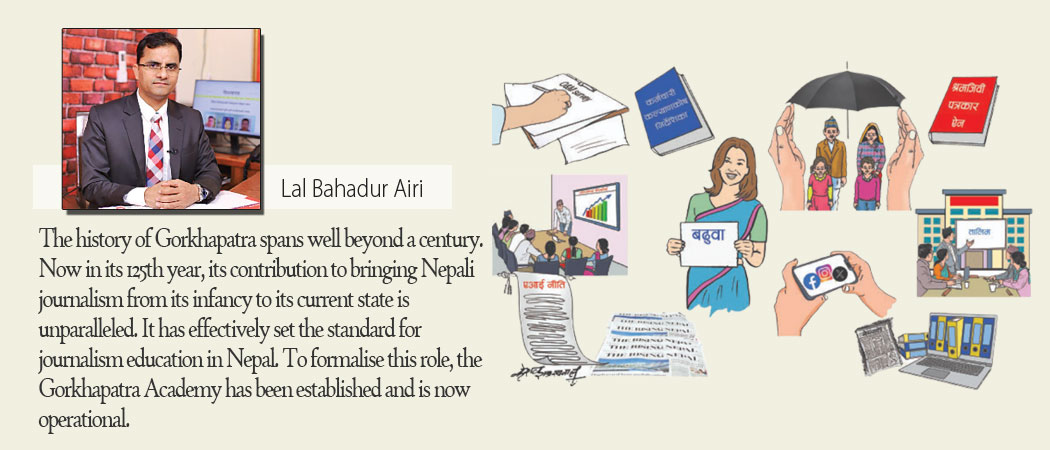
The history of Gorkhapatra spans well beyond a century. Now in its 125th year, its contribution to bringing Nepali journalism from its infancy to its current state is unparalleled. It has effectively set the standard for journalism education in Nepal. To formalise this role, the Gorkhapatra Academy has been established and is now operational.
This academy aims to develop institutional capacity, enhance the quality of journalism, and contribute to research and studies in the field. It is the first initiative of its kind by a media house in Nepal. The academy will conduct academic research, promote innovation, and strengthen the capacity of journalism professionals. It also aims to provide curriculum-based training programmes and create new revenue streams for the institution.
The academy has announced fellowships for postgraduate, MPhil, and PhD research to explore contributions in journalism and beyond. Training programmes have also been initiated for journalists and staff outside the institution.
Journalists today must go beyond reporting news and opinions; they must actively shape public discourse and contribute to policymaking. Embracing this dimension of constructive journalism, the institution has initiated policy dialogues under the banner of ‘Gorkhapatra Discourse.’
These dialogues aim to facilitate discussions on public priorities and policy issues. On December 18, 2025, a programme titled ‘Gorkhapatra Discourse on Recovery and Resilience’ was organised to foster dialogue between the government and the private sector. Following the Gen Z movement protests held on September 8 and 9, this initiative helped create an environment for economic reform through broader engagement. It also contributed to increased revenue, better promotion of publications, expanded public relations, and new professional roles for staff. Such public discourse is a first in the institution’s history.
The Employee Welfare Fund, which had been inactive for eight years due to unclear structure and benefits, has now been revived. This has benefited both current and retired employees.
Technologically, improvements have also been made. The web printing machine capable of printing eight pages in colour is now fully utilised. Previously, only four pages of The Rising Nepal were printed in colour; now all pages are coloured, enhancing quality and appeal.
With advancements in information and communication technology, new dimensions have been added to media. The introduction of artificial intelligence (AI) has brought innovation but also challenges. In response, the institution has formulated and implemented an AI usage policy for its publications, ensuring structured and responsible adoption of new technologies.
Historically, Nepal’s first printing technology was the ‘Eagle Press’ (Giddhe Press), which was also used to print Gorkhapatra. This press had long been kept at Chhauni Museum. Recognising its archaeological significance, it has now been brought back and preserved within the institution, with efforts under way to restore or replicate its missing parts.
In line with constitutional inclusivity, content is now published in 46 different languages spoken in Nepal, fostering a sense of ownership among diverse linguistic communities.
Efforts have also been made to digitise archives of Gorkhapatra (107 years), The Rising Nepal (61 years), and Madhuparka (46 years), making them accessible through a server system. This digital archiving will preserve these publications for future generations.
To enhance staff capacity, a ‘learning by doing’ training series has been introduced, improving digital literacy and cybersecurity awareness among employees.
To expand readership, content is now being distributed directly to audiences through social media platforms like Viber and Messenger. Public Service Commission preparation materials are also being shared with young aspirants through these channels.
Gorkhapatra has long faced criticism of being merely a government mouthpiece. However, by prioritising citizens’ voices over official narratives, the institution has disproved this perception. With a focus on quality content, its editorial and publication style has gained wide appreciation. This is a matter of pride.
The publications of Gorkhapatra and The Rising Nepal are now recognised for their relevance, accuracy, and professionalism. They present factual content, praise government achievements, and offer constructive suggestions for improvement. Gorkhapatra has established itself as a popular and trusted publication, with its layout also widely praised.
To improve distribution, a Sales and Distribution Directive, 2025, has been implemented, making circulation more effective and boosting market reach. Despite economic challenges, the institution’s business has nearly doubled, strengthening its self-reliance. It has become one of the leading media organisations contributing taxes to the government, and reports from the Ministry of Finance show consistent profitability over the past three fiscal years.
A draft law has also been prepared to transform the institution into a state communication house, aligning with constitutional provisions. Technology-friendly infrastructure has been developed to support this vision.
Gorkhapatra is an organisation with a proud and historic legacy. Preserving and strengthening this legacy is our collective responsibility. Even amid a sluggish national economy, the institution remains profitable, which is a matter of pride for me as a leader. I hope that in the days ahead, with continued support and collaboration, the institution will uphold and protect its historic and prestigious standards.

He is General Manager Of Gorkhapatra Corporation