- Sunday, 24 May 2026

Silence Before Storm: Forest Fire Management in Nepal
Manoj Neupane and Sushil Subedi

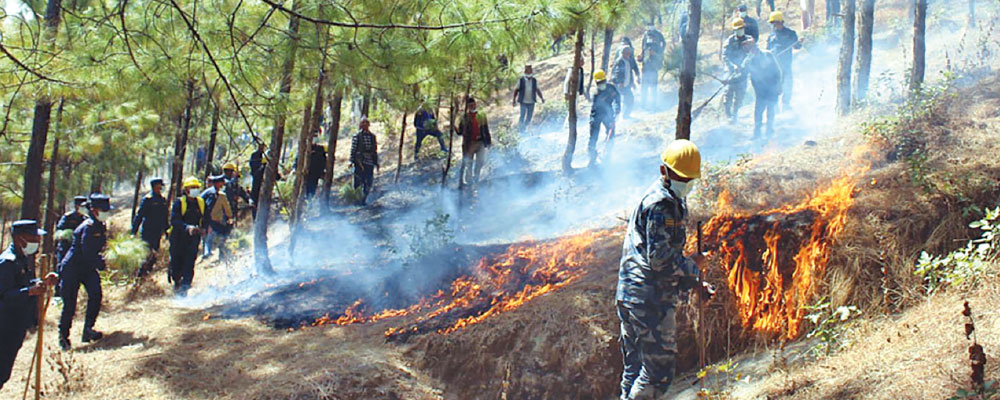
Department of forest research and training center forest resource assessment data indicate more than two thirds of the forest in Nepal are impacted by forest fire. Nepal is most affected in between March and June and we are approaching the dry season and havoc of forest fire are knocking our doors of forest conservation. The year 2026 is projected as being devastating in terms of forest fire with increasing temperature and prolonged drought. This silence phase is shortly turning to the loudest storm in days to come and there is dire need to focus our efforts on forest fire management and this article tries to delve into the issues and suggest way forward for the optimum management of the fire.
Fire was our oldest friend which later turned to be a foe as well by expressing its wrath at interval. Fire is a good servant but a bad master. Fire played a pivotal role to usher human from Stone Age to the cradle of civilization. During the industrialization fire was tipping point as it provided heat energy for both steam and combustion engines and rest is the history. Forest fire has emerged as the major problem in forest conservation in the world and in Nepal. Ministry of Home Affairs data depicts there were more than 1700 incident of forest fire and 21 death toll whereas 753 household were impacted by forest fire in last two year whereas ICIMOD illustrates around 6000 forest fire incidence in 2021 and 6000 in 2024.
What causes fire? - Fire triangle and ground reality
Fire requires three essential ingredient- fuel, oxygen and heat. These three ingredients form the triangle and this combination is must for fire. Dry leaves, needles, fallen twigs, small branches, litter and duff like materials that catches fire and sustain combustion comprises fuel. Similarly, oxygen is needed for ignition and its continuity. Normal concentration of oxygen in dry is around twenty percent and combustion generally stops when oxygen level plummets to below sixteen percent. Furthermore, heat is required for raising the temperature of the forest fuels to ignition temperature and to sustain the forest fires.
With every decade being hotter than previous and each year recorded as hottest in recorder history, wrath of nature is being felt around the globe. Experts converge on the ideas that almost 99 percent of the forest fire are human induced and lighting and rubbing of the stones like natural causes contributes less than one percent. Further, data depicts that about 64 percent of the fire is caused by negligence and carelessness and 32 percent is deliberative whereas 4 percent is of unknown cause.
As per the National plan for forest fire preparedness and response 2026, major incentives for the herders to ignite the forest is the hope that it would help sprout of grass, which contributes to almost one third of the forest fire. Smoking contributes another 15 percent. Similarly, igniting forest to force wildlife to move in certain directions for the illegal hunting contributes another 7 percent. Furthermore, playing children, camping adults, illegal tree feller, forest encroacher, non-timber forest collectors also contributes significantly. Consultation with the local users also gave light to the fact that the forest is set on fire to clear the ground for forest product collection such as that of Maduca trees and even to get rid of ticks and as a tools of revenge and vengeance.
Relevance and prominence of forest fire
Forest fires existed with the evolution of vegetation and subsequent increase in atmospheric oxygen to ignition level. Fire caused by lightning changed the ecosystem even before human first appeared on earth. Fire was human's servant and it catered human needs of land clearing and agriculture land expansion through slash and burning. It further helped for hunting. In these ways, it was more seen as a tool than a problem to humans. Germany pioneered scientific forestry during the latter part of the 18th century and timber was taken as an economic resource and forest fire was seen as its hindrance which lead to the introduction of fire exclusion policies throughout the world in 19th century. Great fire of 1871 with the death toll above 2 thousand in USA showed wrath of fire. Further, great fire of 1910 in USA and its neighbor- Canada acted as a tipping point in taking forest fire as a prominent disaster. Later unprecedented change in climate triggered temperature rise and drought which led to the mega-fires in Australia, Amazon and in California which gave relevance and prominence in the 21st century. Mega-fires such as that of Los Angeles and California can cause billions of dollars in damage which highlight importance in preventive approach.
Damage and incidence of forest fire in Nepal
Nepal disaster report 2024 published by ministry of Home Affairs documented 19,593 incidents of fire and 593 death toll in the last six year. Other data of longer horizon of fire showed loss of 80 people per year. Similarly, National disaster risk reduction and management authority (NDDRMA) data shows the 2159 cases of forest fire in the last 5 year with the expected loss of 92 crore. 2009 Ramechhap forest fire is considered as one of deadliest forest fire in Nepal with the death toll of 49 people including 13 army personnel. Forest fire not only damages forest, it has long term impact in public health. In recent years, the air quality of Kathmandu have gone above 400 for days in some parts owing to its bowl-shaped geography, which is considered lethal by health professional which has plausible link with the forest fire. It had stopped airport such as of Pokhara for days and filled pulmonologists clinics in Kathmandu valley. Further, spreading of forest fire to settlements and industries can further exacerbate the situation. Based on NDDRMA data, 9 district including Banke, Bardiya and Chitwan falls under high risk zone whereas 13 district including Arghakhanchi, Bara and Udaypur comes under medium risk zones.
Experience from Australia
Our visit to Australia drastically changed the perception of fire. Earlier, we used to believe, like most of us, forest fire is something to get prevented, it should be avoided to the extent possible. We were half- right but our visit lighten the second half. Just like Iron cuts iron, controlled and planned fire prevents destructive and disastrous forest fire. Fire when deployed as servant serves well. We were amazed to hear Indigenous ranger in Bunya Mountain National park, Queensland, Australia shared that they regularly set the forest on fire to reduce the fuel load of the forest. They further implied shedding of the leaf by species such as Eucalyptus as their call to set the forest to controlled fire. Regular, controlled and planned fire reduces the fuel load significantly which lowers the risk significantly. Similarly, they have standby helicopter for the response with dedicated teams to control forest fire. Develop countries also deploys helicopter to apply chemicals to lower oxygen level below 15 percent to inhibit combustion.
Way forward: Preparedness and Response
There is a silence before the storm and there will be bang with the wrath of nature. Being March- May the most critical time which sees more than 80 percent of the total forest fire in Nepal. It is crucial that our work should focus on preparedness and response. Government agency should focus on preventive measure such as sensitization of herders and other stakeholders highlighting its socio-economic and ecological impact. Zoning, prioritization and fuel load management complemented by field gears and rapid response is crucial. Similarly, formulation of ward level or forest area based rapid fire response team with dedicated vehicle comprising different stakeholders including Nepal army, armed police force and Forest officials with due coordination is must to achieve efficiency and effectiveness in forest fire management. Public can also help control forest fire by notifying through Toll-free disaster emergency hotline of 1149. Similarly, broader community mobilization for fuel load reduction, fire line maintenance and use of leaf litters and twigs for the organic manure production and its commercialization will have two pronged benefit. We are in crunch time and proper preparedness and response based on prioritized district in National plan for forest fire preparedness and response 2026 and forest fire control strategy 2010 will preserve our forest and people from forest fire.
(Neupane is Senior Forest officer, Ministry of Forests and Environment, Lumbini Province and Subedi is Senior Forest officer, Division Forest office, Banke)









-original-thumb.jpg)