- Monday, 4 May 2026

Interviews No Shouting Matches

As experience tells us, the professional ideals that much of the mainstream media pledge and the claims they make do not always line up well. What is dished out as news and views day in and day out portrays a story differently. Variation in story angling might be accepted as a treatment rather than just a more-of-the-same. A declaration of a profound motto might sound like a stirring promise, whereas matching its delivery is a glowing reiteration in action—something that is not aboard contemporary newsrooms of many media groups.
Two months after completing his five-year tenure as India’s 13th president, in August 2017, Pranab Mukherjee got angry at India Today TV anchor Rajdeep Sardesai: “Let me complete. … I am sorry to tell you and remind you: you are interviewing the former president of India. Be happy and [show] courtesy. Don’t interrupt. The chastened anchor responded rightly, “Absolutely, Sir.” Mukherjee had not finished: “I am not eager to appear on the screen. You have invited me. Firstly, you cannot raise your voice.”
The subdued anchor responded in conformity with the situation, “My apologies.” It was a professionally dignified approach to handling an embarrassing situation. The incident taught a lesson to not only wannabe media anchors but also to veterans who turn interviews into shouting matches, putting up arguments rather than querying with probing questions and without lowering a respectful approach to interviewees for the required balanced cool.
No to shouting match
The depiction and description of people, places, personalities and events make or mar media material quality and, with it, their credibility. Nepali visual media landscape, of late, is witness to a disgraceful taste of highlighting in short clips the questions asked and not the answers given. Answers given with hesitation are focused on scoring points for the interviewer. That is ethically unsound. It is like asking the question, “Have you stopped beating your wife?” and persisting with the undignified way: “Say, yes or no?”
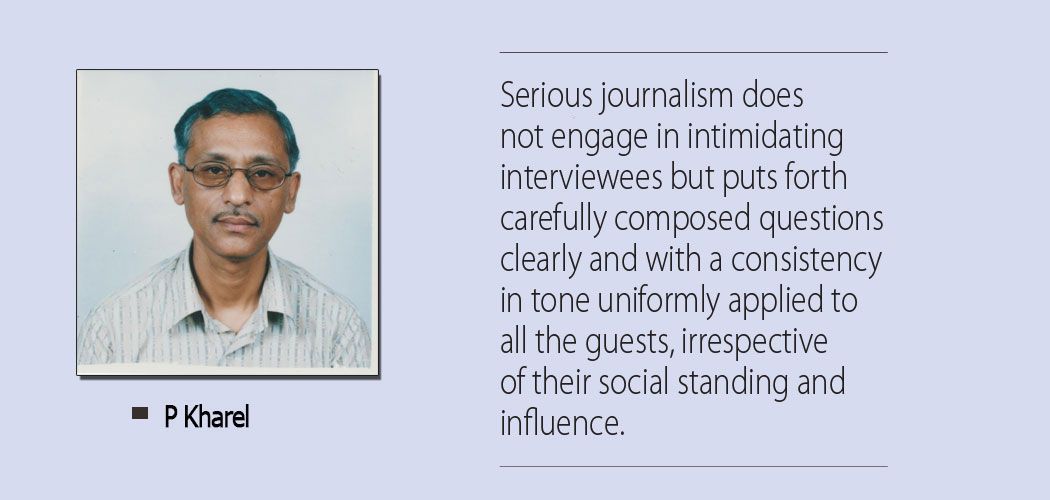
Serious journalism does not engage in intimidating interviewees but puts forth carefully composed questions clearly and with a consistency in tone uniformly applied to all the guests, irrespective of their social standing and influence. The guest should not be bullied or bulldozed with a volley of intimidating questions based on sheer rumours. It is not just the content of a question but how it is asked and whether enough time is given for answering. Professional practice declares itself dead if a talk show anchor shouts down or humiliates a guest. Unfortunately, this practice is gaining ground in South Asian broadcast news programmes today.
An extortionist tactic will not work, or, at least, should not be allowed to work. Even if pre-recorded answers are short, sharp, and quick-witted, an honest anchor will air it all, unmindful of an embarrassment briefly experienced. In the end, professionalism wins, the journalist gets lifted, and audiences have the return for their attention. Sanitised versions of news stories mislead mass audiences, whether of broadcast variety or print type. Fake news always existed, except that fewer outlets were doing so in a non-digital age. Selective journalism is the antithesis of accountability journalism.
A recent headline of the National Broadcasting Corporation in the United States, carried American Vice-President JD Vance’s warning to Iran: “Don’t try to play the US in peace talks, Vance warned Iran.” Factually, the headline content might have been accurate. But here the question is the missing balance. A counter-question automatically arises: How did the Iranians react? Were their heads hanging down in shame or cowering in fright? Is the same degree of zeal shown to Iran’s similar warnings to the superpower that, in partnership with Israel, fights a war it triggered on February 28, declaring it would end within a few days?
An honest basic principle of professional practice would be to show consistency in the treatment of stories, whatever their origin, with a fair degree of priority for content selection. The taste of the media response is in how an interview session is conducted. Shirking responsibility elicits no convincing answers. Needling of audiences with exaggerated headlines does not necessarily produce substantive revelations; rather, it puts off many minds who scent acrobatic presentations as ill-conceived stunts landing with a thud.
Professional unity
Partisan press is a perverse sense of loyalty to a particular individual or institution, forsaking the basic rules of the profession claimed to be religiously honoured. It invites professional sanctity being perversely flouted for naked greed of power and monetary profits on the part of organisational operators. South Asia’s media are, by and large, on financial life support. Many of the “big ones” maintain their balance sheets above the red through methods that used to be summarily disdained as a malpractice in the old days of the 1980s or during the post-World War II decades.
The beauty of journalism is in its professional practice. Qualities like accuracy, balance, credibility, content angling and fairness account for the common ground of professional unity. News energises audience attention and informs the mind. Those constitute qualities, maintained in all items drawn from various news elements within an organisation’s declared scope and objectives. This heightens the prospects of earning widespread respect in terms of content choice and sustained credibility not guaranteed by more inflow of commercial advertising.
Theoretically, booking space or air time for commercial advertising space and available news holes are in many ways interrelated. That is not the last word on news value, professional practice and audience appreciation. The two compartments are expected to supplement and complement each other independently without interference or undue influence. Audience interest depends on content, not the commercial advertising a news outlet carries. The more the readers, listeners and viewers, the greater are the prospects for advertisers lining up for advertising bookings with choice space and spots.
(Kharel writes on int'l affairs & media.)