- Sunday, 24 May 2026

Artificial smell technology being used to reduce human-wildlife conflict
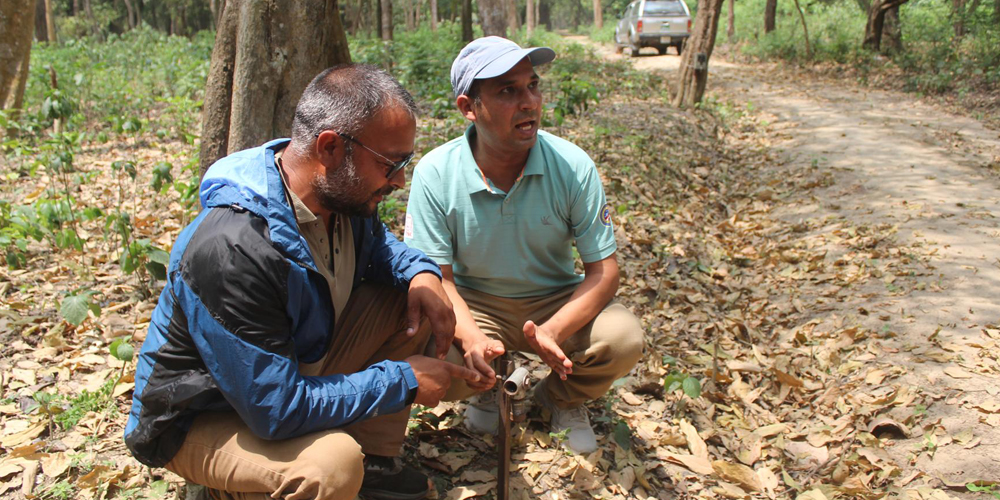

Bhairahawa (Rupandehi), May 4: A new technology has been tested to reduce the increasing human-wildlife conflict in the buffer settlements of the Tarai. 'Artificial smell signals' have been introduced with the aim of preventing wild animals like tigers and leopards from entering human settlements.
This technology, which was launched last year under the Tarai Arc Landscape Program, aims to create an 'invisible boundary' based on the natural behavior of wild animals, according to Bharat Bhatta, the program manager TAL programme. According to him, tigers and leopards use urine or claws to mark their territory and leave scent marks. Following this, when artificial scents are used, the animals feel that another competitor has entered their territory and they move away from there.
“Cameras and special dispensers have been installed at 30 strategic locations to prevent wildlife from entering human settlements,” Bhatta said. “These devices force the animals to return by spreading a specific odour.”
The odours used are not harmful in any way and do not affect both humans and wildlife. Bhatta informed that in the test conducted last year, two types of odours were found to be effective in deterring leopards, two in deterring tigers, and one in deterring both species. Currently, four to five more types of odours are being tested.
According to Program Officer Pratik Shah, this research-based project has been launched for five years. “If this technology is successful, a permanent ‘invisible border’ can be established between humans and wildlife in the future. The damage caused to human settlements by wildlife will decrease. Investment in structures like fences will also be reduced.”
The activities of wildlife and their reactions are continuously monitored through automatic cameras installed at 30 locations in the Khata corridor area. The data obtained from this is expected to help evaluate the effectiveness of the technology.
Once a chemical is placed in a ‘T’-shaped pipe, the smell remains for a month. Khagendra Thapa, a technician at the Khata Community Forest Coordination Committee, said that this technology has sent a positive message at the local level. “We have been involved in camera trapping since 2014,” he said. “The cameras currently being used are very sensitive, which can capture up to 30 seconds of video and even faint noise.”
According to him, such technology can provide a sense of security to local residents in areas where human-wildlife conflict is high and can guide them towards long-term solutions. If successful here, this model can be expanded to other affected areas of the country.
In recent years, the incidence of tigers, leopards and wild animals entering settlements in various districts of the Tarai has increased, causing human casualties. The TAL Program run under the World Wildlife Fund to reduce conflict through the use of this developed technology on a scientific basis is a long-term initiative covering the Tarai regions of Nepal and India. Activities for biodiversity conservation, wildlife habitat management and human-wildlife conflict reduction are being carried out through this initiative.
According to Rajan Rijal, the project's Kohalpur program co-manager, various programs are being implemented to strengthen the ecosystem and security management of the national parks.
Within the Bardiya National Park, wetlands have been constructed and grasslands managed to improve the habitat of wildlife, solar energy-based pumps have been installed to provide easy access to drinking water for wildlife in areas with water shortages, and 'spike cameras' have been installed to control and strengthen monitoring of illegal activities, he said. (RSS)

-square-thumb.jpg)







-original-thumb.jpg)