- Monday, 4 May 2026

Once neglected, blacksmithing thrives in Bardiya
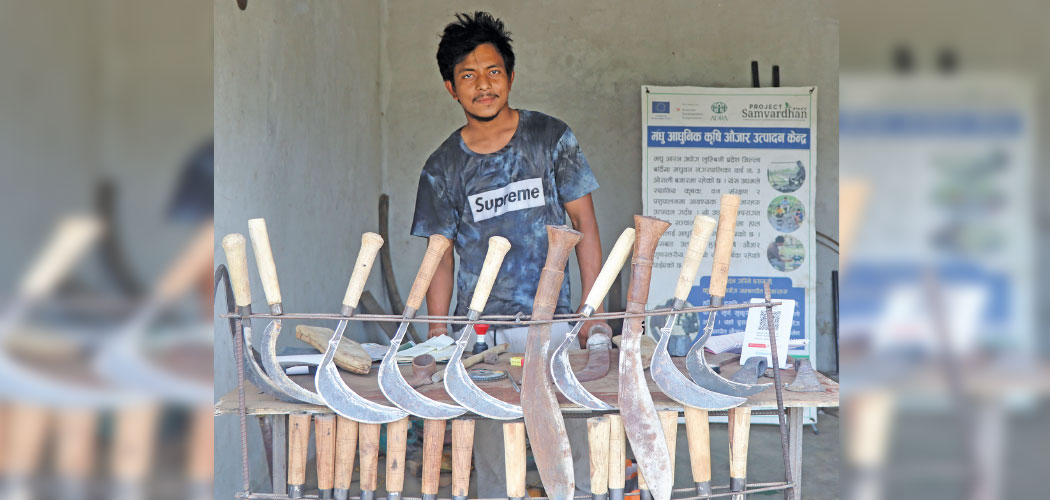

By Yagya Prasad Sapkota, Bardiya (Gulariya), May 4: Until a few years ago, Madhu BK worked beneath a peepal tree at Oraali Bazaar, repairing household and farm tools in the same way his forefathers had done for generations.
Today, the resident of Madhuwan Municipality–3 has transformed that modest roadside forge into a growing enterprise, Madhu Aran Industry — breathing new life into a fading ancestral trade.
What was once a struggle for daily survival has evolved into a story of resilience and reinvention. Madhu inherited his blacksmithing skills from his father and grandfather, but for years the income from repairing tools barely sustained his household. “It was difficult to make ends meet,” he recalls. “The earnings from mending tools were just enough to get by.”
Forced by financial hardship to end his education after completing his School Leaving Certificate (SLC), Madhu spent several years travelling across Nepal for manual labour. Yet, whenever he returned home, he continued learning the craft from his father—gradually mastering the art of forging agricultural and household tools.
Driven by a determination to build a future within Nepal, Madhu set up a small forge three years ago under a tree in his village. For a long time, he relied solely on repairing customers’ tools. But six months ago, a turning point arrived: he upgraded his traditional blacksmith shop into a modernised industry.
With the introduction of machinery capable of producing tools more efficiently, his productivity, and income, has increased significantly. He now purchases raw iron himself and manufactures a wide range of implements, including sickles, spades, hoes, axes, knives and traditional khukuris.
“My tools are used in households, farms, and even by community forests for constructing fire lines,” Madhu explains. The growing demand for locally made, durable equipment has helped expand his customer base beyond Madhuwan to neighbouring municipalities such as Rajapur and Thakurbaba.
The transformation has not only improved his own livelihood but also created employment opportunities for others. What began as a one-man operation now employs four people, including his own brother, whom he encouraged to return from abroad. “I want to expand the business further and create more jobs,” he says.
Madhu claims that even after paying wages, he manages to save around NPR 80,000 each month—a remarkable shift from his earlier financial struggles.
For his 55-year-old father, Sher Bahadur BK, the change is both emotional and inspiring. “Earlier, we had to hammer everything by hand,” he says. “Now, with machines, we can do twice the work without exhaustion—and much faster.”
Madhu credits part of his success to support from a local enterprise promotion project, which provided training in entrepreneurship development and business planning. The initiative also assisted with business registration and facilitated access to machinery through the Federation of Community Forestry Users Nepal.
As demand for locally produced tools continues to rise, Madhu’s journey reflects a broader narrative, how traditional skills, when combined with modern technology and support, can revive livelihoods and strengthen rural economies.
From a humble forge under a tree to a thriving small-scale industry, Madhu B.K.’s story is not just about preserving heritage, it is about shaping a sustainable future.