- Friday, 22 May 2026

Cross-border pollution reaches hills, impacts daily life
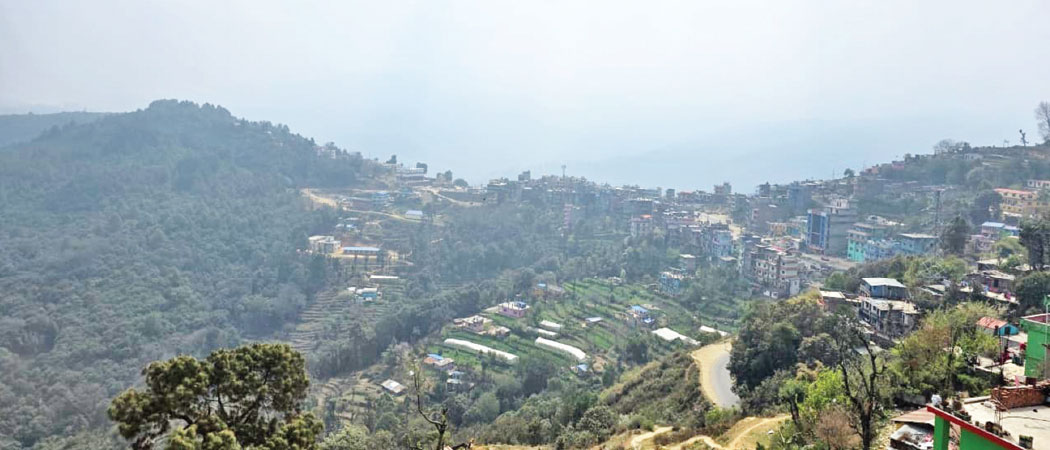
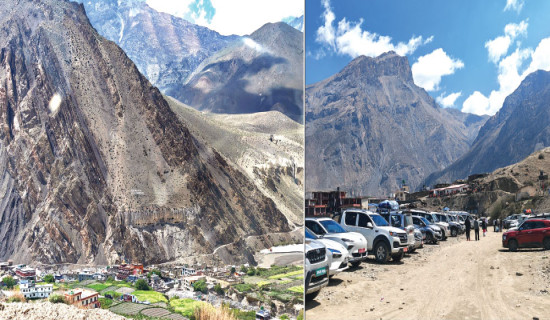
Photo: Pushkar Bhandari The latest condition of green Dadeldhura, where about 74 per cent of the area is covered by forests.

By Puskar Bhandari,Dadeldhura, Mar.10: Air pollution originating in India and Nepal's Tarai has spread across the hills, affecting visibility and air quality in Dadeldhura district.
The unusual weather conditions have already begun affecting the region.
Since Sunday, it has become difficult to see from one hill to another in Dadeldhura, where the snow-capped Himalayas standing to the north are usually clearly visible at this time of year.
According to reports, a weather system that entered the hills through Butwal of Lumbini Province early Sunday morning has darkened the skies across the western hills during the daytime, while its impact has been more visible in the Tarai.
Meghraj Sharma, assistant meteorologist at the Dadeldhura Field Office of the Department of Hydrology and Meteorology, said the haze was caused by pollution drifting into the hills from factories in the Tarai and India. He added that the ongoing severe conflict in the Middle East could also be a contributing factor.
Even in hilly districts like Dadeldhura-where about 76 per cent of the total land area is covered by forests-the Air Quality Index (AQI) reached 153 on Monday afternoon, which is considered unhealthy.
Although air quality is generally regarded as unhealthy when the AQI exceeds 200, a level above 150 in the hill areas is also worrying. The pollution has been affecting people’s breathing and causing irritation to the eyes.
Nepal does not have its own independent weather system, and its weather is often influenced by atmospheric systems formed in the neighbouring countries.
Sharma said that increasing population density and industrialisation in the Indian states bordering Nepal, such as Bihar, Uttarakhand, Uttar Pradesh and West Bengal, have been influencing the plains of India, Nepal and Bangladesh since the 1980s.
During winter, thick fog commonly covers the Tarai, while dust and smoke often darken the sky during this season. In a sense, this is strong evidence of climate change for scientists, although little discussion has taken place so far.
Dust particles and smoke emitted from industries increase pollution when they mix with otherwise clean air. Sharma said the impact of the pollution is likely to decrease as light rainfall is expected until Tuesday.
The pollution is also aggravated by dust from development and construction activities, as well as smoke from agricultural fields. Children and elderly people are the most affected during this period.
To clear the pollution, strong winds or rainfall are needed. Sharma said a weather system capable of bringing light rain to Karnali Province on Monday and Sudurpashchim Province on Tuesday has already developed.
Dr. Hema Joshi of Dadeldhura Hospital said that around 20 to 30 patients with respiratory problems have been visiting the hospital daily. She noted that respiratory illnesses usually increase during the cold season.