- Tuesday, 5 May 2026

EC struggles with social media misuse
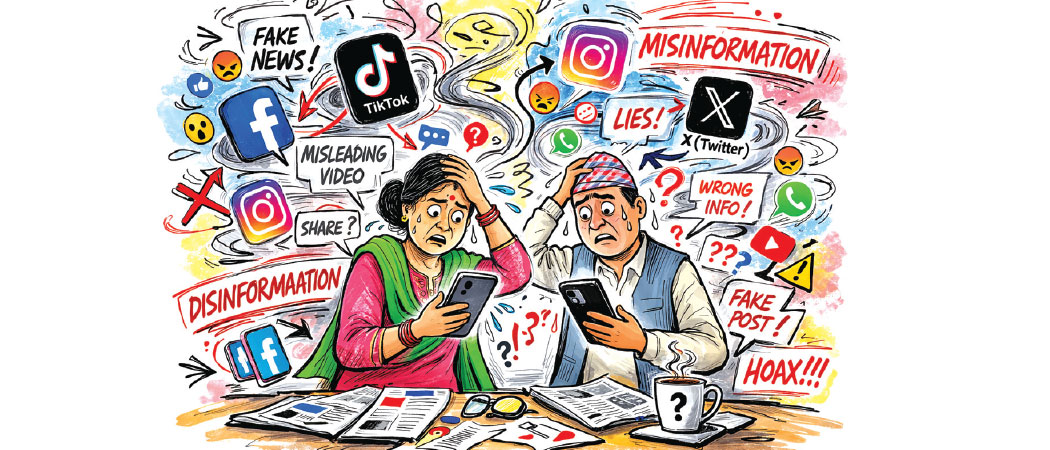

Kathmandu, march 1: A video of Gagan Thapa, President of the Nepali Congress and candidate from Sarlahi Constituency No. 4, has gone viral in recent days. In the video, President Thapa appears to portray indigenous peoples negatively.
As the video circulated, many social media users posted negative comments about it. However, the reality was quite different. In the full video, President Thapa was criticizing another leader at a programme in Rolpa. He mentioned a leader by name and condemned him for insulting the indigenous community.
In fact, Thapa was criticizing the other leader for verbally defaming indigenous youths. However, the video was misleadingly circulated on social media, with the name of the other leader edited out, creating the false impression that Thapa himself had insulted indigenous youths.
Thapa is not the only one being defamed on social media through misinformation. Many leaders, political parties, and candidates have been victimized by the misuse of social media.
On Friday evening, several online portals, including some well known ones, published a news report titled “Ravi-Balen’s Power Grab Before the Elections: Jointly Signed Letter to Modi.” The report did not align with the basic facts of such a serious diplomatic issue, yet it was published with a byline. The concerned party immediately and officially labeled it as “fake.”
Deluge of misleading content
As the House of Representatives election scheduled for March 5 approaches, the spread of misinformation, disinformation, and fake news on social media is accelerating. Even at a glance, hundreds of misleading posts can be seen circulating daily.
According to experts, the Election Commission (EC) has failed to effectively monitor the misuse of social media during the run up to the election. The measures adopted by the EC are considered insufficient. Compared to the 2022 election, the EC appears less capable of controlling social media misuse.
Five years ago, the EC introduced a policy titled “Policy on the Use of Social Media in Election Management,” outlining its commitments and challenges. However, experts argue that instead of addressing those challenges in the current election, the commission has become even weaker amid the deluge of harmful information.
According to Ujjwal Acharya, a media researcher and director of the Centre for Media Research, who is currently fact-checking election-related content, the EC’s social media monitoring mechanism has weakened compared to previous elections.
“The EC has initiated efforts to control toxic content on social media to ensure a fair election. However, these efforts are not sufficient, as misinformation continues to spread daily. Compared to the 2022 election, most candidates and political parties previously used social media mainly to promote themselves positively. In the current election, however, many are using it to defame their opponents,” Acharya stated.
He also pointed out that the misuse of social media in the current election is increasing at an alarming and sensitive rate, with many users defaming others for personal or political gains.
Acharya expressed concern that such activities on social media could influence voting outcomes in certain areas.
“In the current election, certain castes, religions, and communities are being targeted through social media. This could push Nepal’s diverse society toward division in the long term, which is very serious,” he said.
The EC shares similar concerns. Commissioners and officials have identified social media misuse as one of the major challenges in this election.
In the early days of election preparations, Sagun Shamsher Rana, one of the EC commissioners, said in an interview with The Rising Nepal that social media misuse would pose a greater challenge than the physical capture of polling booths in this election.
EC officials have acknowledged that the challenges observed in the early stages of the election have persisted as polling day approaches.
EC Spokesperson Narayan Prasad Bhattarai stated at a regular press conference on Friday that the challenge of social media misuse has not diminished.
“Nevertheless, our efforts continue. We have collaborated with some social media operating companies. These companies are attempting to prevent misuse by establishing dedicated election units,” Bhattarai said.
Meanwhile, studies conducted by various organizations, including UNDP and the Nepal Law Society, indicate that social media is one of the major challenges in the current election.
According to a report released by the Nepal Law Society, 32 per cent of Gen Z voters stated that social media content has a significant influence on their voting decisions.
“Social media has been shown to influence voters, especially young voters, in their decision-making process. It has been found that young people consider social media their primary source of election-related information, along with mass media,” the report stated.
The report also suggests that election propaganda spreads more effectively and widely through social media than through traditional media. “Many have expressed doubts about the possibility of effectively monitoring and preventing the misuse of information technology and social media,” the report added.
EC’s efforts to prevent toxic content on social media
The EC has established an Information Ethics Promotion Unit to prevent toxic information and monitor social media misuse. The unit includes representatives from various bodies such as the Cyber Bureau, Press Council, Advertisement Board, legal and media professionals, and has also collaborated with TikTok.
The team members are authorized to remove videos and content that violate the code of conduct or contain toxic information from social media platforms, including TikTok.
According to Sita Pun Shrees, Assistant Spokesperson at the EC, although social media remains a major challenge, the ratio of toxic information has decreased in recent days.
“Our team members are continuously working to prevent toxic information. After establishing this unit and beginning active monitoring, the ratio of toxic content has decreased,” she stated.
As of February 27, the EC had received 612 complaints regarding toxic content. Of these, 545 pieces falling under the Electronic Transactions Act, 2063 BS, were forwarded to the Nepal Police, and 121 pieces falling under the Election Code of Conduct, 2082 BS, were sent to the Central Code of Conduct Monitoring Committee.
Similarly, 74 pieces of content falling under the Press Council Act, 2048 BS, were sent to the Press Council, and one piece of content under the Advertisement Regulation Act, 2076 BS, was referred to the Advertisement Board for action.
So far, Nepal Police has taken action on 132 cases (39 per cent), the Central Code of Conduct Monitoring Committee on 90 cases (74 per cent), and the Press Council on 32 cases (43 per cent).
Despite these efforts, Acharya argued that they are still insufficient to effectively curb toxic information. He also criticized social media companies for not taking adequate responsibility.
“In the context of Nepal’s elections, if social media companies had at least identified AI-generated content, more than 80 per cent of social media abuse could have been prevented. In this sense, social media companies have neglected their responsibility regarding Nepal’s elections. For example, they could simply tag AI-generated videos and content as ‘AI-generated.’ This would be very effective,” Acharya suggested.
-original-thumb.jpg)