- Thursday, 4 June 2026

PM, EC officials discuss election code enforcement
.jpg)

Kathmandu, Jan. 10: Prime Minister Sushila Karki is concerned about the progress made by the Election Commission regarding the election scheduled for March 5.
Meeting with senior Election Commission (EC) officials along with her cabinet ministers, Prime Minister Karki on Friday discussed preparations made for issuing the code of conduct for the House of Representatives (HoR) elections.
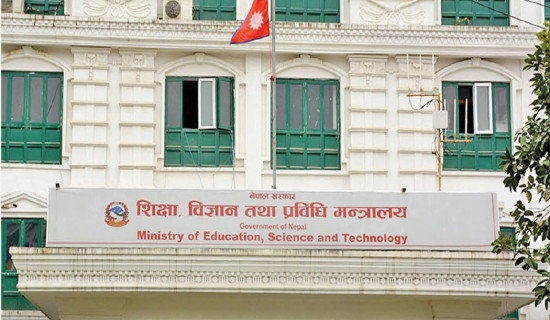
Finance Minister Rameshwor Khanal, Law Minister Anil Sinha, Education, Science and Technology Minister Mahabir Pun, Chief Secretary Suman Raj Aryal, Chief Election Commissioner Ram Prasad Bhandari, along with other commissioners and senior officials, attended the meeting at Baluwatar on Friday.
Meanwhile, EC officials updated their weekly work progress at a press meet on Friday.
According to EC spokesperson Narayan Prasad Bhattarai, the EC has printed one million sample ballots to promote voter education for the upcoming elections. Of these, half a million ballots were printed for the proportional representation (PR) election system, while the remaining half a million were for the first-past-the-post (FPTP) election system.
According to EC officials, the sample ballot for the PR election system features black print on a white background, whereas the sample ballot for the FPTP election system displays red print on a white background.
The EC has also started printing real ballots for the PR election system. Senior EC officials informed about this progress during the weekly press meet. According to Spokesperson Bhattarai, the commission began printing real ballots on Friday. The ballot for the PR election system includes a total of 58 symbols from the 64 parties that submitted closed lists. Approximately 20 million ballots for the PR system will be printed based on the number of voters.
Similarly, the EC has appointed Chief Electoral Officers and Electoral Officers in all 77 districts. The newly appointed officials will be assigned from January 16 and will receive orientation training.
EC’s correspondence with social media operating companies
Meanwhile, EC officials have held dialogues with representatives from social media operating companies such as Meta and TikTok to discuss ways to prevent fake news, false accusations, and hate speech that could affect the election. Similarly, the EC has issued letters to TikTok, X, and Meta this week regarding potential security issues on social media.
Furthermore, the Information Ethics Promotion Unit under the Election Information Dissemination and Coordination Centre (EIDC) has begun its work related to information dissemination. The EC has also launched its Social Media Monitoring Tool to prevent the spread of false information and fake news during the election.
Spokesperson Bhattarai stated that the EC has issued letters to political parties requesting corrections to their closed candidacy lists. “During the verification of nominations submitted by political parties, when the EC found errors such as duplicate candidate names, incomplete candidate qualifications, mismatched surnames and addresses, and mismatched citizenship certificates, we provided seven days to correct these errors and resubmit the closed lists,” Bhattarai said.
Meanwhile, the Code of Conduct Monitoring Committee held a meeting this week to ensure its proper implementation. During the meeting, members advised the EC to adopt both awareness and punitive approaches, along with coordination with service providers, to prevent potentially harmful activities on social media.
Spokesperson Bhattarai also informed that EC officials had conducted a series of dialogues with security agencies regarding election security. Likewise, EC officials have held meetings with chief secretaries and secretaries overseeing internal affairs in all seven provinces.
Additionally, EC officials have been reviewing constituencies that recorded a high number of invalid votes in previous elections. According to Bhattarai, this review is expected to help promote targeted voter education in those areas.





-original-thumb.jpg)