- Saturday, 2 May 2026

All parties commit to health agenda, but fail to allocate adequate budget
.jpg)
Kathmandu, Feb. 25: Ahead of the election for the House of Representatives, almost all political parties have addressed health issues in their manifestos. Free health services, health insurance, and other fundamental health concerns are commonly mentioned in nearly every manifesto.
However, this is not the first time political parties have committed to providing free health services and health insurance. They have repeatedly made such promises in every election, yet they have failed to deliver on these commitments.
In fact, the Constitution of Nepal clearly stipulates that no one should be deprived of basic and emergency health services. Providing free basic health services is the responsibility of the state. The government has also adopted a policy of covering treatment beyond basic care through health insurance.
Although every party includes these agendas in its manifesto, none has taken effective initiative to implement them. Not only in the current election but also in the 2022 election, health insurance was a major agenda of all parties.
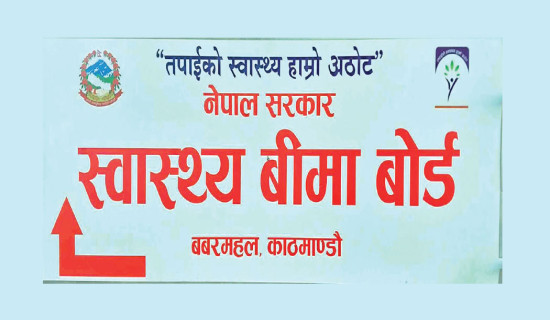
In reality, the health insurance programme is now on verge of collapse. Several major hospitals are demanding billions of rupees in outstanding dues from the Health Insurance Board. Some hospitals have even suspended insurance services.
Meanwhile, the Ministry of Health and Population has stated that it does not have sufficient funds to clear these payments. If the Ministry of Finance fails to provide the previously committed budget, the insurance programme may be discontinued.
This situation has developed over the past few years, despite many political parties committing during the 2022 election to expand health insurance coverage up to one million rupees. This clearly demonstrates that major parties have failed to address the insurance issue and are, in fact, responsible for its current uncertain condition.
Experts and rights activists argue that although manifestos include significant health-related commitments, there remains a wide gap between promises and implementation—an issue that almost all parties tend to ignore.
For the current election, CPN-UML has included several health agendas in its manifesto, stating that it will increase the health budget to 8 per cent within five years. The party has also committed to covering all treatment expenses through health insurance. Free public health services and progressive health insurance are also included in its manifesto.
However, for voters who have reviewed UML’s previous manifestos, these commitments are not new. Over the past five years, UML has been in government three times and has led the Ministry of Health on three occasions, yet it has shown little willingness to implement its earlier commitments.
Similarly, the Rastriya Swatantra Party (RSP) has pledged in its commitment paper to provide comprehensive and free health services through health insurance. One of its key agendas is “100 per cent insurance.” However, the party has not clarified how this model would be implemented, especially when the existing insurance programme itself is struggling to survive.
Likewise, the Nepali Congress has committed to expanding health insurance coverage from the current Rs. 100,000 to Rs. 1 million. It has also stated that it will make necessary policy and structural arrangements to integrate all social health security programmes into the insurance system, so that all health services beyond basic care are provided through insurance.
Experts also point out that in the three years since the 2022 election, CPN-UML, Nepali Congress, RSP, and RPP have each taken turns in the government. However, none has made concrete efforts to fulfill their manifesto commitments.
One recurring question concerns the increase in the health budget. No government has managed to raise the health sector budget even to 8 per cent. According to World Health Organization standards, governments should allocate at least 10 per cent of their total budget to the health sector.
During the COVID-19 pandemic, the health sector budget was increased to 6.5 per cent in total.
Dr. Shri Krishna Giri, former Chief of the Policy and Planning Department at the Ministry of Health and Vice Chairman of the Medical Education Commission, stated that all political parties should agree on increasing the health budget.
Talking to The Rising Nepal, Dr. Giri said that political parties must develop a clear health model, as many health issues are common across parties.
“Since we share common concerns in the health sector, all political parties should assess available resources before including commitments in their manifestos. They should also discuss possible resources while formulating specific health models and financial strategies,” he said.
Dr. Shambhu Acharya, a global public health professional and advocate, also suggested that prioritizing the commitment to Universal Health Coverage, led by the World Health Organization, is essential, as Nepal has signed the Political Declaration.
“As a signatory, Nepal should prioritize how to achieve these commitments when engaging with the United Nations. Regardless of which government is in power over the next one or two years, implementing sound policies, mobilizing human resources within a clear timeframe, and securing financial resources are essential,” Dr. Acharya said.
-original-thumb.jpg)
-square-thumb.jpg)