- Tuesday, 2 June 2026

OPD insurance limit set at Rs. 25,000

Kathmandu, Feb. 3: The Health Insurance Board has revised its policy on providing health insurance services, deciding that beneficiaries can now receive OPD services up to Rs. 25,000 only.
Board officials said the decision followed months of review, and the revised scheme came into effect on February 2.
The Board stated that the move was necessary to control financial expenditure, as major hospitals have been urging the government to clear overdue payments.
Speaking to The Rising Nepal, the Board’s Information Officer, Bikesh Malla, said the decision was taken to address the recent financial situation, which has placed immense pressure on OPD services.
According to available data, the largest portion of the Board’s total expenditure has been spent on OPD services. Malla stated that around 71 per cent of payments to service providers go to OPD services, 19 per cent to IPD services, and 10 per cent to emergency services.
“The Board has taken this decision as a short-term measure to relieve financial pressure,” Malla said.
Newly appointed CEO of the Board, Dr. Krishna Paudel, said the new provision would help sustain insurance services during a critical period.
Dr. Paudel told The Rising Nepal that the Board introduced the new policy to manage excessive expenditure occurring in OPD services.
“We introduced this policy as a solution to the current situation. The highest expenditure has been on OPD services, which created significant financial pressure on the Board. By reducing the burden of OPD expenses, the insurance programme will be able to cover costs for other treatments,” said Dr. Paudel.
Malla clarified that the Board has not reduced services under the new policy. Instead, it aims to allocate resources to spend beyond OPD services. He added that the OPD ceiling was introduced to make the insurance programme sustainable by controlling the rising financial burden.
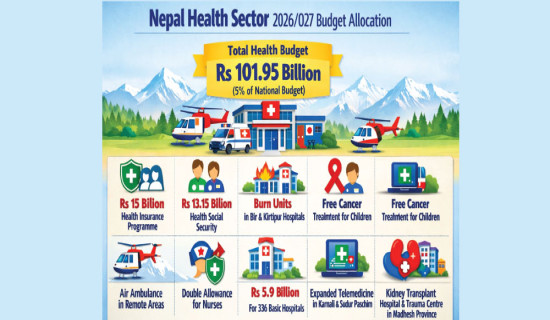
Currently, the Board must pay more than Rs. 2 billion to service providers every month, amounting to an annual expenditure of over Rs. 24 billion. However, the government has provided an annual grant of only Rs. 10 billion for the current fiscal year.
Data also show that around Rs. 4 billion has been collected from insurance premiums. This means the Board’s total average income stands at about Rs. 14 billion, while its annual expenses exceed Rs. 24 billion.
Due to this imbalance, the Board has been facing a severe financial crisis. Amid pressure from major hospitals and service providers, former CEO Raghu Kafle resigned last week after differences with the Ministry of Health and Population. Following his resignation, Dr. Krishna Paudel was appointed the new CEO.
Meanwhile, Minister for Health and Population Dr. Sudha Sharma Gautam has emphasised the need to reform the health insurance programme. The new policy is considered part of her six major reform agendas.
Despite the introduction of the new policy, many experts argue that the Board has not yet overcome the crisis. They claim that imposing a ceiling of Rs. 25,000 on OPD services could negatively affect beneficiaries.
Additionally, the Board continues to face difficulties in clearing overdue payments to service providers. Major hospitals and health institutions have already warned of suspending services if payments are not released.
To address the crisis, the Board has requested additional funding from the Ministry of Finance. However, the Finance Ministry has rejected the request, stating that the previously allocated budget has already been provided.
In response, the Ministry of Health and Population has attempted to arrange funds independently to clear outstanding dues, Malla said. He added that Minister Dr. Gautam is planning to mobilise resources from various sources to settle payment issues.
Malla urged stakeholders not to view the new provision as a reduction in insurance coverage. He clarified that the existing Rs. 100,000 coverage for serious illnesses will remain unchanged, and the OPD limit will not be applies in such cases. Similarly, for families with more than five members who pay an additional premium, the OPD limit per person will increase by Rs. 5,000.



-original-thumb.jpg)