- Wednesday, 15 April 2026

Justice With Posthumous Dignity

Protecting the victim, especially of sexual offences, from digital exposure has become very crucial. Regardless of various laws enacted to protect the victims and to ensure their privacy, they do not seem to be respected to the utmost level. Exposing the incidents, explicitly mentioning the victim’s name, address, family, educational background, and much more, incites curiosity among society. This leads towards unnecessary naming, shaming, and blaming of the victim and their family members.
Although efforts are being made to protect the privacy of victims in real life as guaranteed by the Constitution of Nepal and Muluki Criminal Code, 2074, along with the Right to Privacy Act, 2075, there exists a certain lacuna. It can be stated that the privacy of the deceased victim seems to be protected in a fragile manner. Incidents such as that of Nirmala Panta, and the current investigation going on of Inisha B.K. expose the details of the victim and their family, as well as those of the minor accused.
Privacy and dignity
It is essential to note that the privacy and dignity of the victim remain of crucial importance even after their death. This is a matter of ethics and morality, along with the guidance of law. The dignity of a dead person is recognised in the Muluki Civil Code, 2074, in Sections 37 and 38, limiting its jurisdiction to the civil context. Any person, while s/he is alive, may specify the procedure of cremation, obsequies rites, or funeral acts to be carried out after their death.
Further, any person may express in writing his or her will to donate, after his or her death, his or her corpse or any organ of the body or any part thereof to a person for the purpose of using, or causing to be used, such corpse or organ for a particular work. However, there is no significant contribution regarding posthumous dignity in the Muluki Criminal Code, 2074, nor in the Victim Protection Act, 2075, nor in the Right to Privacy Act, 2075.
While the Universal Declaration of Human Rights protects and exists for the living, there is no such thing for the deceased. As a matter of individual dignity and human rights, it is essential to protect posthumous dignity. Since the dead deserve respect and protection, it can be said that respect and protection are duties, especially the duties regarding posthumous privacy and reputation.
The investigation process should not lead to defamation of the dead. The investigation and media reporting can be done without naming and shaming them. The photographs and name of the victim should be removed from all the news and social media platforms. The posthumous dignity does not confine itself to the civil law, but it grows to intersect with criminal law, constitutional law and human rights law and media ethics. Hence, it is necessary to protect the dignity of the deceased during the investigation, prosecution and adjudication of any crime.
As in the ongoing investigation of the rape and murder case of Birendranagar-1, Surkhet, the name of the deceased victim and her family members should be represented with an anonymous name rather than constantly highlighting the name of the victim in the headline of the news. The right to privacy not only refers to the living victim but, as a matter of human dignity, even the deceased victim holds the right.
Justice
Protests are being staged for the justice of the victim. On the one hand, we are legally and socially fighting for protecting the right of privacy of the rape victim, whereas on the other hand, we are clearly publicising the intimate events in detail. How convincing can this be? Is it not high time to address the legal and ethical dilemma? And act accordingly? The dignity of a person does not end with death; it continues through the respect society shows to their body, memory and the grief of their loved ones.
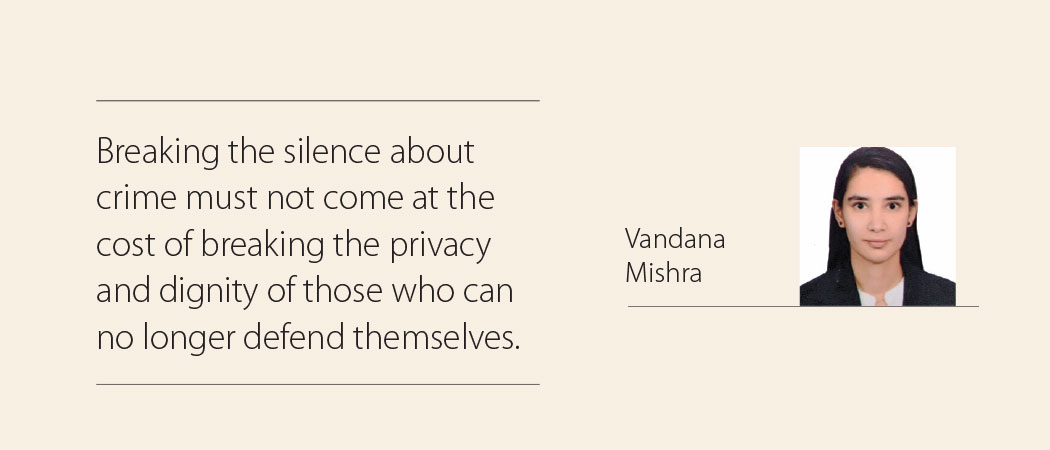
It is high time that the citizens should show civic sense and morality in such sensitive matters. Only enacting and promulgating laws and orders should not be the threshold to maintain a civic society. Hence, it is of utmost importance to protect the posthumous dignity. Silence about violence is harmful, but exposing the intimate details of a victim’s life is equally disgusting. Breaking the silence about crime must not come at the cost of breaking the privacy and dignity of those who can no longer defend themselves.
(Mishra is currently a Section Officer at the Kathmandu District Court.)
-original-thumb.jpg)

-square-thumb.jpg)
-square-thumb.jpg)