- Saturday, 30 May 2026

World Leaders Urged To End Wars
“This is called a headline, proud of you, Pakistan. Lots and lots of love,” Diep Saeeda, a Pakistani human rights activist, writes on her Facebook, referring to the headline ‘Pakistan Saves a Whole Civilisation’ published in The Express Tribune. Pakistan has indeed played a crucial role between Iran and the US over the last few weeks in restoring peace in the Middle East and saving a whole civilisation on 8th April 2026. However, it has not progressed the way it had been envisioned. Peace has not been restored in the Middle East, and the animosity between Iran and the USA seems to be still wide enough for the historic ceasefire to continue.
There are very few leaders who have the opportunity to shine in global history. Pakistani Prime Minister Shebaz Sharif and the Pakistani Chief of Army Staff and Chief of Defence Forces Field Marshal Asim Munir have inscribed their names among world leaders as peacemakers. Who gives anyone the right to wipe out a civilisation based on their country’s nuclear power? However, although there were bleak hopes of ending the war, this is yet to be seen.
Grave threat
President Donald Trump had threatened to wipe out a whole civilisation if Iran did not agree to his conditions and open the Strait of Hormuz at 8 PM ET on 8th April 2026. People all over the world spent restless and sleepless hours after Trump made this threat. The world was watching and definitely all heaved a sigh of relief when Trump posted on his social media that he had agreed to a two-week ceasefire with Iran after discussion with Prime Minister Shebaz Sharif and the Pakistani army chief Asim Munir. Immediately after this announcement from him, PM Shebaz posted on X that Iran and the US, along with their allies, have agreed to an immediate ceasefire everywhere, including Lebanon and elsewhere. He also invited delegates from both countries to Islamabad on 10th April to further negotiate for a conclusive agreement to settle all disputes.
Iranian Foreign Minister Abbas Araghchi expressed gratitude and appreciation for PM Sharif and Field Marshal Munir, whom he called his “dear brother,” for their tireless efforts to end the war in the region. Pakistan and Iran have a historic relationship, a shared border, and the two countries relate to each other as having “brotherly” relationships. Unfortunately, the peace talked failed, with the US imposing an economic blockade against Iran and the latter threatening retaliation.
The Strait of Hormuz is one of the busiest oil shipping channels on earth. Tehran had blocked this waterway after the US and Israel attacked Iran on 28th February 2026. According to the BBC, about 20 per cent of the world’s oil and liquified natural gas (LNG) usually passes through this strait. After Iran blocked this passage due to the attack on itself, an oil and gas crisis started impacting the global population, including countries like Nepal. Oil and gas prices started increasing after the war, but now, to the relief of the global population, they have fallen by 15 per cent shortly after the ceasefire was announced.
The Strait of Hormuz is only about 50 km wide at its entrance and exit areas and about 33 km wide at its narrowest point. This strait connects the Gulf with the Arabian Sea and is bounded by Iran to the north and Oman and the United Arab Emirates to the south. This strait is deep enough for the world’s biggest crude oil tankers and is used by major Middle Eastern oil and LNG producers and their customers. According to estimates from the US Energy Information Administration (EIA), in 2025 about 20 million barrels of oil products passed through the Strait of Hormuz per day. The BBC reports that this is nearly US $600 billion worth of energy trade per year. The oil comes from Iran, Iraq, Kuwait, Qatar, Saudi Arabia, and the UAE. LNG is gas turned into liquid, which takes up 600 times less space for transport; it is then turned back into gas at its destination to be used for heating, cooking, and power.
Greed to capture power
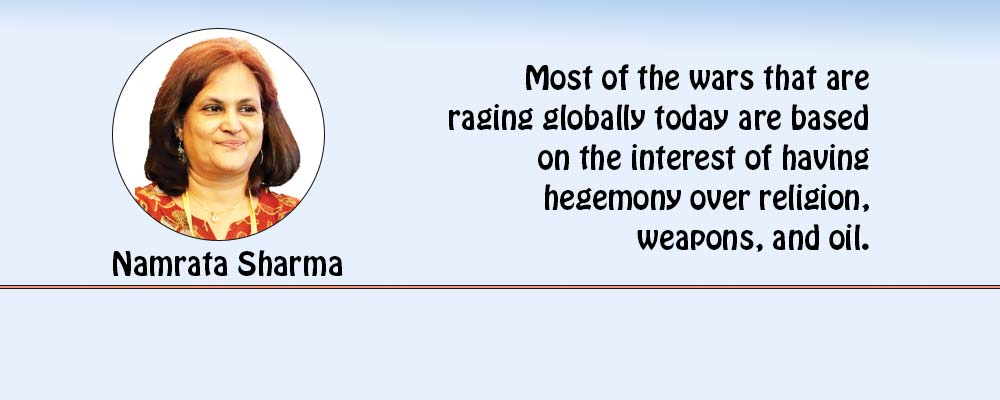
The Strait of Hormuz is also an important route for exports of fertilisers from the Middle East, where natural gas is heavily used in the production process. About one-third of the world’s fertiliser trade normally passes through the strait. Food, medicines, and technological supplies are also imported into Middle Eastern countries via this channel. Currently, world politics is revolving around the greed to capture power. Power is acquired by politicians based on how many weapons and how much control over the earth’s oil, gas, and natural resources they have. Most of the wars that are raging globally today are based on the interest of having hegemony over religion, weapons, and oil.
This greed has unfortunately trampled over the existence of innocent people globally who just want to complete their lifestyles by having a proper livelihood, sufficing an existence that is dignified and safe. Human rights values are being eroded every minute, while the world leaders are claiming to restore peace and justice. In all this chaos, instability, and price hike all over the world because of the closure of the Strait of Hormuz, the most affected are people who need to make a daily earning to suffice the needs of their families.
(Sharma is a senior journalist and rights advocate. namrata1964@yahoo.com X handle: NamrataSharmaP)