- Friday, 1 May 2026

Parties repeat past agendas, but unwilling to address structural issues
.jpg)
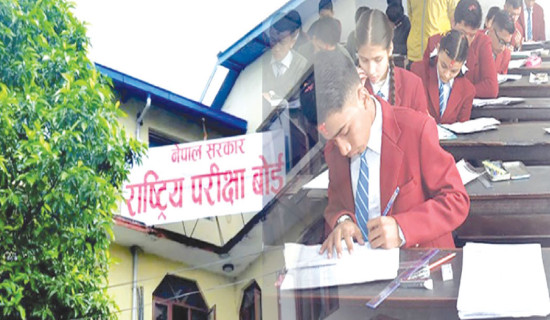
Kathmandu, Feb. 23: “Education is fundamental to a country’s development” is a phrase commonly echoed by political parties, especially during election times. They have reiterated this sentiment once again ahead of the House of Representatives election scheduled for March 5.
Major political parties have made public their election manifestos addressing economic, political, and other social issues, including the education agenda.
Analysts and independent writers argue that political parties, including new forces, appear confused about how to address education reform.
Although they have included appealing statements in their manifestos, no political party or candidate has engaged in a serious debate on education reform, even with only a few days remaining until the election.
Regarding the education agenda, the Nepali Communist Party (NCP) has stated that it will increase investment to ensure equal access to quality education. Similarly, the NCP has expressed its commitment to bringing the long-stalled Education Act within a year. Emphasizing the enhancement of public education, the party pledged to develop education as a service-oriented sector.
“The quality of community schools will be improved. Technology-friendly education and digital literacy will be expanded by implementing the concept of ‘one municipality, one smart school,’” the manifesto states. The party has also committed to making moral education compulsory from grades 4 to 8.
The Nepali Congress has also emphasized public education reform. In its commitment letter, the party stated that schools connecting learning from pre-primary to university level with technology and practical experimentation will be developed into centres that maximize and encourage student creativity and innovation.
However, in the 2022 election, the Nepali Congress had committed to introducing the Federal Education Act within a year. For the 2026 election, the party has not mentioned its previous commitments in the manifesto. Major leaders of the Nepali Congress have also not clarified how or why they were unable to fulfill their earlier promises.
Meanwhile, the Communist Party of Nepal (Unified Marxist–Leninist) has put forward several attractive and ambitious agendas regarding education.
However, it has abandoned some of its previous agendas and introduced new ones for this election. The party has neither clarified why it failed to implement earlier commitments nor presented a clear roadmap, including feasibility studies, for its new proposals.
The UML has introduced agendas such as distributing free menstrual pads to schoolgirls and including teachers in the Social Security Fund to help build human resources that contribute to national strength. It has also announced an end to children’s deprivation of education, which appears to be a repetition of previous commitments.
“We will develop Nepal as an international centre for peace studies, yoga, Ayurveda, meditation, mental health, and Eastern philosophy by reviving Nepal’s traditional education alongside modern education,” the manifesto states. This, too, repeats a previous agenda.
The manifesto further states that the education system will not focus solely on admissions and examinations but will aim to develop human resources that contribute to patriotism, entrepreneurship, social responsibility, innovative thinking, and national strength. Although presented as a new agenda, this statement appears more aspirational than practical.
The UML has also announced that it will reduce the trend of students going abroad for higher education through an ‘Earning While Studying’ programme. However, several institutions that implemented similar programmes in the past have discontinued them.
In the 2022 election, the UML announced plans to establish the ‘Vidushi Yogmaya Ayurveda University’ to promote traditional medicinal science, naturopathy, and yoga. It also pledged to reconstruct 9,500 schools. These commitments are not mentioned in the latest manifesto, nor does the party clarify how much progress has been made.
Previously, the UML had also promised to conduct an enrollment campaign targeting tens of thousands. This agenda appears again in the latest manifesto, though expressed in different language.
“The state will take care of those without parents. There will be a significant increase in school enrollment, retention rates, and literacy rates,” the 2022 manifesto stated.
Meanwhile, the Rastriya Swatantra Party (RSP) has announced what it describes as a radical change in public education in its latest manifesto, referred to as a “Civil Contract.”
The RSP has pledged to organize education as a service-oriented sector rather than a profit-driven one, ensuring equal opportunity, transparency, and social accountability. However, it has not outlined a clear strategy for achieving this ambitious plan.
The party has also committed to completely banning teachers and professors from engaging in politics and declared that all schools should be free from political activities.
“We will free universities and schools from being arenas for partisan political activities. We will completely prohibit the political affiliation of teachers and professors,” the RSP manifesto states.
The party has also committed to significantly increase investment in public education over the next two decades to bring radical improvements in quality, accessibility, and competitiveness.
Looking at the commitments made by the RSP in the 2022 elections, some promises have been repeated for the March 5 election, while new agendas have also been introduced. However, the party has not explained why its previous commitments were not fulfilled.
Similarly, the RSP had previously announced that it would provide opportunities for Nepali-origin professors and researchers working abroad to return to Nepal for a semester or permanently. Although this appeared to be a new agenda at the time, the party made no visible effort to implement it. The commitment has been included again in the latest manifesto, albeit in different language.
Most major political parties have abandoned some of the agendas they floated in the 2022 elections while introducing new ones. Some have simply repeated earlier commitments.
Analysts argue that major political parties have included similar agendas in their manifestos. Issues such as public education reform, depoliticizing the education sector, passing the Federal Education Bill, and ensuring free education are commonly mentioned.
However, the manifestos fail to address the reality that more than 15,000 of the country’s over 27,000 public schools have fewer than 100 students. Analysts criticize the absence of a clear policy on school integration.
Some experts argue that political parties themselves do not seem clear about how to develop strategies to achieve the ambitious plans outlined in their manifestos.
Dr. Bidhyanath Koirala stated that manifestos should contain measurable commitments. Political parties should clearly specify how much budget they plan to allocate to the education sector.
“The manifesto should have measurable commitments. How much is the budget? What will be done in five years? Who will take responsibility? How will we respond if we fail? These issues should be clear,” Dr. Koirala said.
Education expert Dr. Prem Fyak stated that major political parties have failed to generate public discourse on whether school education should be treated as a public service or a profit-making business.
Dr. Fyak further argued that political parties have surrendered to the participation and influence of private school operators while drafting necessary legislation to implement the constitutional provision of free school education.
He added that the Education Bill has been stalled due to the misconception among private school operators that making education non-profit would result in financial losses.
“The Education Bill could not be enacted due to the misconception of private school operators that making education non-profit would result in a loss of their investment,” Dr. Fyak said.
He also stated that structural issues have arisen due to conflicts between the local and federal governments. However, according to Dr. Fyak, political parties do not appear to have a clear understanding of these structural challenges.