- Saturday, 2 May 2026

Fighting Fake News
 Dixya Poudel
Dixya Poudel
Dixya Poudel
Scrolling through the phone on social media these days is a herculean task due to the vast quantity of AI (Artificial Intelligence) generated images, news and captions. Viewers on Facebook, Instagram, TikTok, and so on are constantly second-guessing themselves. Filed photos of prominent public figures long dead resurface with AI edits. Fake news proliferates. And in the comments, people keep questioning if it is AI-generated or not.
In a way, it is a breach of trust and reliance on the media, which is ideally supposed to provide authentic, genuine and fact-based news. But since the rise of AI slops, such media, including social media, is blurring the line between fact and fiction and truth and false. The fact is that information is key in today’s age, not only as statistics but also as valuable data for research, knowledge and reference. However, this deluge of fake news and AI-edited images is fooling people’s mind leading them to question news authenticity. Given that social media is largely a site for entertainment, communication and connection, it has unwittingly become a tool to spread false information.
There are three kinds of false information: misinformation, disinformation and malinformation. Misinformation is the inaccurate or false information that is shared by mistake with no intent to harm. Disinformation, on the other hand, is created and shared deliberately in order to deceive. So it is intentionally harmful and manipulative. Then the last one is misinformation, in which real information is used out of context to impose damage. It has the intent to harm, for example, leaking private information to ruin a person’s life.
The 21st century is an information age that profits from attention. Social media is run by an algorithm that favours high engagement. The more a post is shared, reposted, retweeted, saved, liked and commented upon, the more it spreads to an even larger audience. Unsurprisingly, viral posts that lead to the most outrage or fear travel faster than fact-based reports. Deepfakes are AI-generated audio and videos that test the viewers’ knowledge by making the fabricated clips impossible to distinguish from real to fake. Since people tend to live in an echo chamber where their existing beliefs are consolidated and not challenged, it makes them less likely to fact-check news.
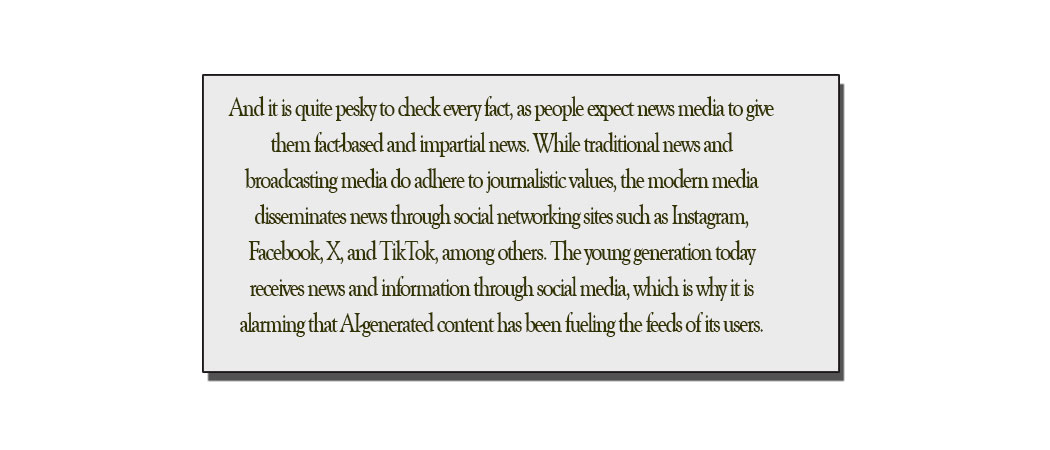
And it is quite pesky to check every fact, as people expect news media to give them fact-based and impartial news. While traditional news and broadcasting media do adhere to journalistic values, the modern media disseminates news through social networking sites such as Instagram, Facebook, X, and TikTok, among others. The young generation today receives news and information through social media, which is why it is alarming that AI-generated content has been fueling the feeds of its users.
If false information is so pervasive, then what can we do to fact-check the content? While it can be tedious to verify every post, it is essential to ensure that we aren’t being deceived. Firstly, we can check the source to see if it is reliable. Then we can verify the date and also carry out a reverse image search. In an AI age, information is still key, only it is a minefield of authenticity where truth may be valued but is increasingly elusive.


-square-thumb.jpg)