- Thursday, 16 April 2026

Mental health reforms face policy challenges
Kathmandu, Jan 2: Several policy hurdles regarding mental health have surfaced during the ongoing three-month campaign led by Dr. Sudha Gautam, Minister of Health and Population. These challenges have slowed progress on her plans. Since her appointment, Dr. Gautam has prioritised mental health among six key areas of focus, launching initiatives such as the establishment of Gen-Z units in 16 hospitals nationwide.
However, Minister Dr. Gautam herself is not happy with the achievements, as several policy complexities have emerged. Health officials, journalists, and stakeholders, alongside Health Minister Dr. Gautam, have engaged in a dialogue about policies hindering the implementation of the minister’s plans.
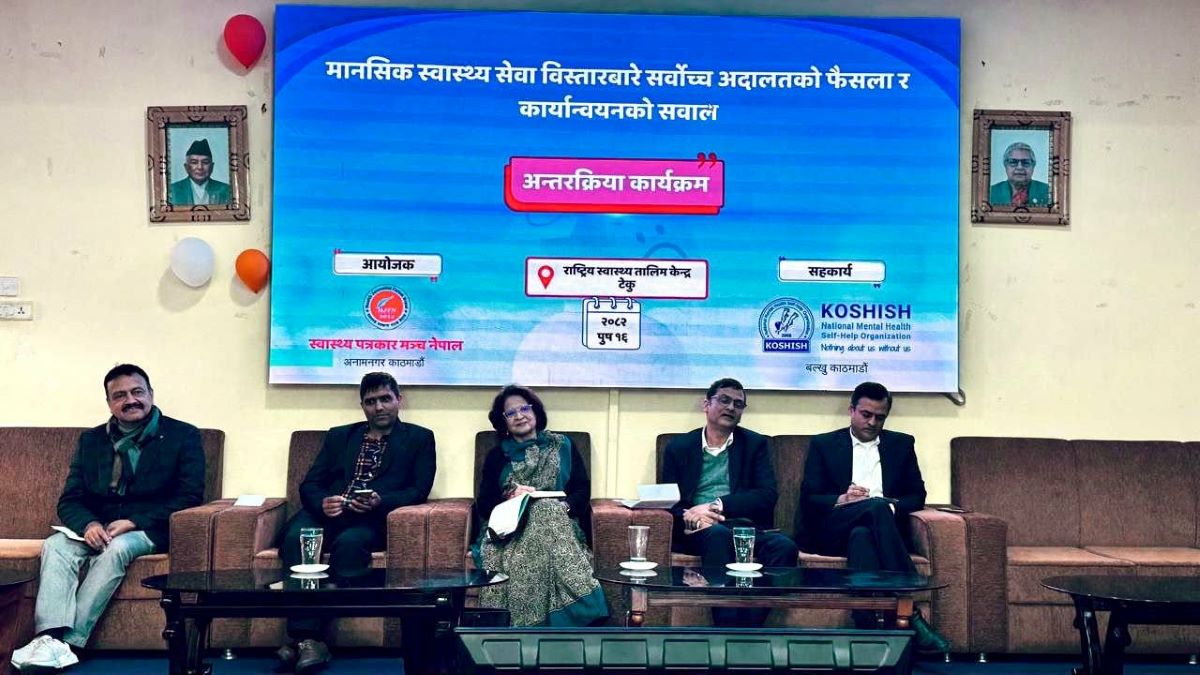
An interaction programme, focusing on the Supreme Court's ruling for the expansion of mental health services and its implementation issues, was organised by the Health Journalists Forum on Wednesday. It was supported by KOSHISH Nepal, one of the advocacy organisations working on mental health services for over two decades.
Matrika Devkota, the Executive Director of KOSHISH, and Sharmila Parajuli, an advocate and mental health activist, had filed a case demanding the implementation of the Mental Health Policy of 2052. They have been calling for the establishment of a mental health division at the federal level, a department at the provincial level, and a unit at the local level. Furthermore, KOSHISH has raised 12-point demands to expand mental health services nationwide.
Following these rights-related concerns, the Supreme Court issued a mandamus ordering the government to establish a Mental Health Division to ensure the right to health. Similarly, the Supreme Court also issued a directive to reinstate the Mental Health Policy-2052, which has been inactive in recent years.
Devkota, an activist, emphasised that a multisectoral coordination is crucial for expanding mental health services, as the government has not implemented the mandamus issued by the Supreme Court months ago.
“In recent times, mental health issues have been increasing rapidly. However, the action plans adopted by the government are not sufficient. To deal with mental health issues, the government must implement the Supreme Court mandamus. Above all, a high-level or multisectoral coordination is essential to establish an effective mechanism,” said Devkota.
However, Dr. Sudha Gautam, the Minister for Health and Population, stated that the government will implement the mandamus issued by the Supreme Court. "The Ministry of Health and Population will draft a mental health policy in the near future, and my team is preparing its draft," said Minister Dr. Gautam.
“As mental health is considered a crucial issue in recent times, we are committed to expanding mental health services across the country. In the meantime, psychosocial counselors have been deployed at the local level. However, structuring a mental health division will not be possible in the near future.”
According to Dr. Pomawati Thapa, Head of the Non-Communicable Disease and Mental Health Section, the government has initiated some significant plans in accordance with the constitution. Referring to a research study, Dr. Thapa said that mental health issues have become increasingly critical, as suicide cases have risen.
She also informed that 11 out of the 98 types of free medicines provided by the government are designated for patients with mental health issues. She further expressed concern that suicide cases have been increasing due to mental health issues, citing data showing that at least one out of eight people struggles with mental health problems. Similarly, at least three out of 10 adults in Nepal are facing mental health challenges.