- Saturday, 2 May 2026

Where Did We Take Wrong Turn?

Sometimes our experiences teach us more than the best literature does. Democracy used to be hailed as the most legitimate means for exploring the quiddity of justice and equality. We read ample literature eulogising its glory. It sounds amazing to imagine a society where everyone enjoys freedom to do what they want, when they want. Can the institutions of government claim unrestricted liberty in the name of democracy? Can individual in a democratic institution exercise their fundamental rights without any bridle? What, then, are rights? These are just a few of the questions you may encounter if you truly care for your country. This article seeks to analyse the democracy practiced in Nepal and repudiates the classic notion of democracy as experienced in Nepal since the 1990’s.
It is pertinent to mention the concept of Plato’s “criticisms of democracy” depicted in the Republic. Plato is often acknowledged as the first philosophical critic of democracy and is largely taken as a paradigm of an anti-democratic work. While it is true that Plato objected to much about the democracy of his own time because of the execution of his guru Socrates, his political theorising reveals an immense interest in improving democratic institutions. Three key themes of Plato are taken to understand the nuance of our democracy. Firstly, Plato emphasises that rulers should be knowledgeable to govern and he claims that most people are politically incompetent and cannot deliver wise decisions and leads country to tyranny.
Public rhetoric
Secondly, he criticised the use of oratory and public rhetoric, which can corrupt and lead to the rise of demagogues by exploiting the emotions and prejudices of the masses; thirdly, Plato's use of democratic institutions in the Laws reflects his interpretation of democracy suggests that some democratic practices should be abandoned, some reformed, and some adopted. The beginning of 1990 witnessed the democratisation of our country by proclaiming the reestablishment of democracy. The first general election for House of Representative (HoR) was held in 1991. Nepali Congress (NC) got the majority to rule the country. Girija Prasad Koirala became the Prime Minister. People had high expectations from the newly elected government.
Unfortunately, Koirala government failed to sketch any vision and policies for the betterment of the people. Because of party’s internal strife and government’s alleged connections in many scandals, Koirala was asked to resign from his position. He didn’t resign but recommend the king for the dissolution of parliament and declared the midterm general election. People did not mandate for early election as NC was given a majority to rule the country for full term. The first wrong turn proved Plato’s concept that democracy prioritises wealth and personal freedom over wisdom and virtuous government. The excessive personal freedom lead to moral decay and corruption at the expense of common good.
The midterm general election in 1994 had changed the political scenario and the Communist Party of Nepal (Unified Marxist–Leninist) became a largest party to form a minority government. The coalition government, headed by Manmohan Adhikari, was formed. It was unfortunate that the government faced several crises within six months of its formation. Adhikari dissolved the House of Representative (HoR) to go for fresh poll to achieve new mandate for governant. The choice for dissolution of HoR was revoked by the decision of Supreme Court. The HoR was restored but become the playground to make and break the governments. Since then, democracy was made to legitimise unrestrained freedom, understood as “giving everyone the license to do what someone wants.” Democratic institutions have been completely paralysed.
This happened because we allowed people to wield power without the guidance of enlightened leaders. The manifestation resulted in chaos and the rise of tyrants. The wrong turns further triggered when the country was dragged into bloody war that took more than 17,000 lives in the name of Maoist insurgency from 1996 to 2006, the royal palace massacre of 2001, abolition of monarchy in 2008, and the 2025 Gen Z movement. These are the incidents we have already witnessed in our troubled times, as the country fast slides toward a cliff's edge of non-existence. The last one is more lethal. Therefore, Plato viewed unchecked democracy as a flawed system that could bring tyrants and demagogues to rise to power.
Rise of demagogues
The repercussion of Gen Z protests has created a favourable ground for demagogues to spread their tentacles. Demagogues are surreptitious leaders who exert power by appealing to the emotions and prejudices of the masses, often through manipulative and deceitful tactics. In a democracy, where the power lies with the people, demagogues exploit the desires and fears of the populace to gain control.
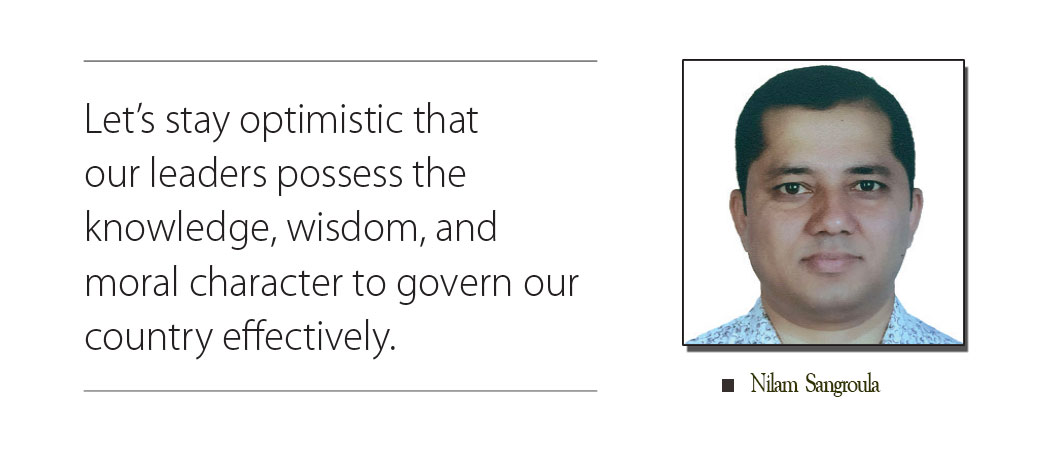
Being critical of democracy doesn’t mean rejecting the freedom of the people. It is a call for a balance between personal freedoms and social order. Plato also believes that unchecked freedom could lead to chaos and tyranny, but that a well-ordered society, led by wise and virtuous rulers, fosters prosperity for communities. Let’s stay optimistic that our leaders possess the knowledge, wisdom, and moral character to govern our country effectively. To achieve this, framing a workable constitution is pertinent where democratic forces are combined and moderated to strengthen democratic institutions.
(A PhD Scholar (NIU-INDIA), Sangraula is the Research Director at the Gomendra Multiple Campus, Jhapa)
-square-thumb.jpg)