- Saturday, 2 May 2026

Gen Z And Politics
 Swaansh Mahat
Swaansh Mahat
Swaansh Mahat
For a long time, Nepal’s youth was described as disengaged, distracted, and uninterested in politics. That narrative no longer holds. In recent months, Gen Z has emerged not as a silent observer but as an active political force by organising, protesting, questioning, and asserting a voice that refuses to be ignored.
We’re no longer just the generation of memes, mental health conversations, and digital rebellion. We showed up on the streets. We shouted slogans that our parents once whispered. We held placards, faced batons, filmed accountability, and refused to be dismissed as “too young to understand.”
After years of being told politics was dirty, dangerous, or pointless, young people are finally claiming it as personal. For decades, Nepali politics felt inherited, not chosen. Power circulated among the same surnames, the same parties, the same promises recycled every election cycle.
Young people were often expected to vote quietly or campaign obediently and accept disappointment sugarcoated as a civic duty. Questioning leadership was labelled immaturity and demanding transparency was framed as disrespect. Disengagement became our unspoken protest. But that silence has broken.
The recent Gen Z–led protests marked a turning point. They weren’t organised by traditional parties or driven by ideological loyalty. They were fueled by frustration against corruption, inefficiency, unemployment, and leaders who speak of revolution while living comfortably removed from its consequences. What emerged wasn’t chaos; it was clarity. Young people weren’t asking for perfection. They were asking to be taken seriously.
This generation understands politics differently. We don’t separate policy from lived experience. Inflation isn’t an abstract concept; it’s the reason degrees feel useless, and futures feel delayed. Digital literacy has made us more informed, but also more impatient. We fact-check speeches in real time.
We remember promises. We archive hypocrisy. Critics say Gen Z is emotional, impulsive, and unserious. But history shows that every meaningful political shift begins with discomfort. The youth movements of today may not look like those of the past, but they are no less political. They are decentralised, intersectional, and deeply rooted in accountability. We don’t want saviours. We want systems that work.
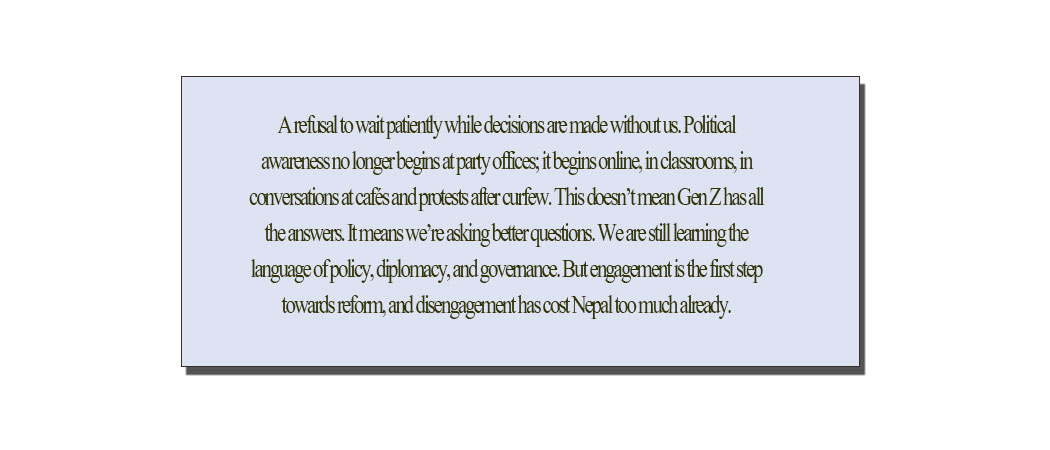
What’s threatening about Gen Z isn’t rebellion but refusal. A refusal to glorify leaders without scrutiny. A refusal to romanticise struggle while normalising suffering. A refusal to wait patiently while decisions are made without us. Political awareness no longer begins at party offices; it begins online, in classrooms, in conversations at cafés and protests after curfew. This doesn’t mean Gen Z has all the answers. It means we’re asking better questions. We are still learning the language of policy, diplomacy, and governance. But engagement is the first step towards reform, and disengagement has cost Nepal too much already.
Nepal’s political future will not be decided only in parliament halls. It’s being shaped on pavements, timelines, and protest grounds where young people are learning their power collectively. The challenge now is whether institutions will listen or attempt to outwait us. This generation is not apolitical. We are politically awakened. And once a generation learns to speak, it rarely agrees to be silent again. Not after this. Not now.
-square-thumb.jpg)
-original-thumb.jpg)