- Saturday, 2 May 2026

A school children like more than their home
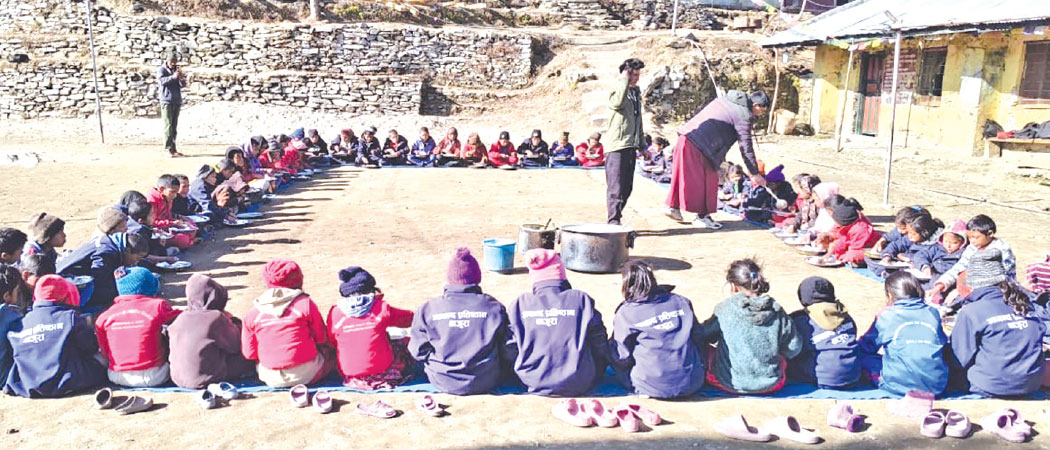

By Sher Bahadur Sarki,Bajura, Feb. 15: Children studying at the Siddheshwari Orphaned, Underprivileged and Dalit Janajati (Indigenous) Residential School in Dapka of Budhinanda Municipality-9 have begun to like their school more than their homes.
Located in the north-eastern part of Bajura, the school has been providing poor Dalit and Indigenous children with proper food, accommodation and care. As a result, many children now feel safer and happier at school.
Nanglalet Thapa, a Grade 4 student at the school, said the regular meals, snacks and morning-to-evening classes have made a big difference. “I like school more than home now,” he said.
“Earlier, when I stayed at home, I did not feel like coming to school. Since last year, after studying here, this school has become dearer to me than my home.”
He added that he used to struggle just to pass exams. “Now, after studying properly while staying at school, I often come second or third in class. At home, there was no one to help me study, but here, teachers teach us in the morning and evening. My studies have improved a lot.”
The school currently offers classes up to Grade 5. Thapa, who is in Grade 4, said it would be much easier for students if education up to Grade 10 were available at the same school.
This is the only school in Bajura that provides residential education for poor Dalit, Indigenous, disabled and orphaned children. It is located in a very remote area where winters are extremely cold. During winter, clouds often bring heavy snowfall, and snow can remain on the ground for nearly a month after it falls.
Despite these harsh conditions, locals have worked together to run the school, which is now recognised as a model school in the district. The school also accommodates children who have no parents or guardians.
A few years ago, the school was in very poor condition. “Through joint efforts by teachers, parents and various organisations, we have been able to improve it,” said Principal of the school, Tula Bahadur Rawat. He credited School Management Committee chairperson Prem Singh Gurung for his major contribution to the school’s progress.
“At present, 63 children live in the school hostel and study here full time,” Rawat said. “Because of this residential system, their academic performance has improved significantly.”
Most families in Dapka belong to the Bhote Janajati community and the nearest alternative schools are far away. Chairperson Gurung said the school was established in Dapka itself to address this problem. “Today, it is known as a model school in the district,” he said.
According to him, around 200 students study at the school, of whom 63 are from poor and underprivileged families and live on campus.
Livestock farming, especially sheep and goats, is the main occupation of local residents. During winter, parents often migrate to lower areas to escape the cold, taking their children with them. This used to deprive many children of regular education.
“Now that we provide hostel facilities, those children stay here and attend school regularly,” Gurung said. Earlier, the school used to be almost empty in winter. That has changed, he added.
-original-thumb.jpg)