- Sunday, 3 May 2026

Two schools rebuilt in Sindhupalchowk with China's support
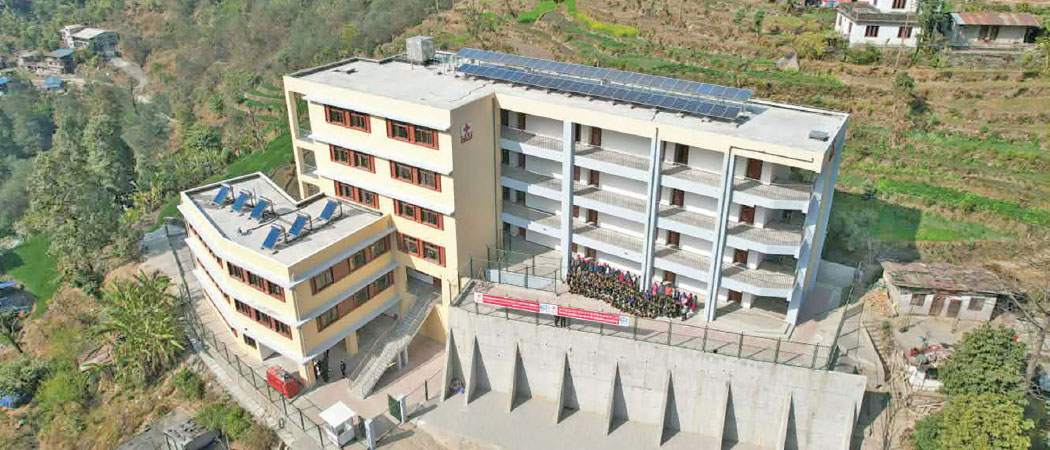

By Chitra Kumar Mijar,Sindhupalchowk, Feb. 13: Two secondary-level school buildings in Sindhupalchowk district have been reconstructed with financial support from China. The projects include Ugrachandi Secondary School in Listi of Bhotekoshi Rural Municipality-1 and Sunkoshi Secondary School in Budepa of Karthali, Barhabise Municipality-2.
Both school buildings were completely destroyed by the devastating earthquakes of April 25 and May 12, 2015. The reconstruction was funded by the Agency for International Economic Cooperation of China’s Ministry of Commerce, which provided US$ 6.95 million (around Rs. 1 billion). The reconstruction work was carried out by China Railway First Group Co. Ltd.
The construction work began on December 8, 2022, and was completed on December 31, 2025, despite geographical challenges and natural disasters, said Chinese project manager Liu Chao. He added that the school buildings will be formally handed over to Nepal’s Ministry of Education this month.
At Sunkoshi Secondary School, a building covering 2,455 square metres has been constructed, housing 13 classrooms. The classrooms are spacious and child-friendly, serving around 400 students. Facilities such as a hostel, canteen, playground, boundary wall and gate have also been built.
Similarly, Ugrachandi Secondary School now has 12 spacious classrooms, a separate hostel, canteen, playground, and a compound with a wall and gate. The school serves about 350 students.
As Listi is a remote Himalayan area, a hostel has been constructed to accommodate students who come from distant villages. The school complex covers an area of 2,126 square metres.
Dorje Lama (Haude), a social activist from Listi, said the reconstructed school has brought significant benefits to local communities, especially children in this remote mountain settlement, by providing better facilities for study and accommodation.
A total of 26 Chinese workers have been living in Listi and Barhabise for the past three years for the project. About 50 per cent of the construction materials were brought from China, while cement, sand, timber and food items were procured locally in Nepal.
In addition, 210 Nepali workers have been employed throughout the three-year construction period and have been paid fair wages on time. Once the buildings are handed over, nearly 800 students will be able to study in well-equipped and modern school facilities.
-original-thumb.jpg)