- Sunday, 3 May 2026

Painkillers prove poisonous for vultures
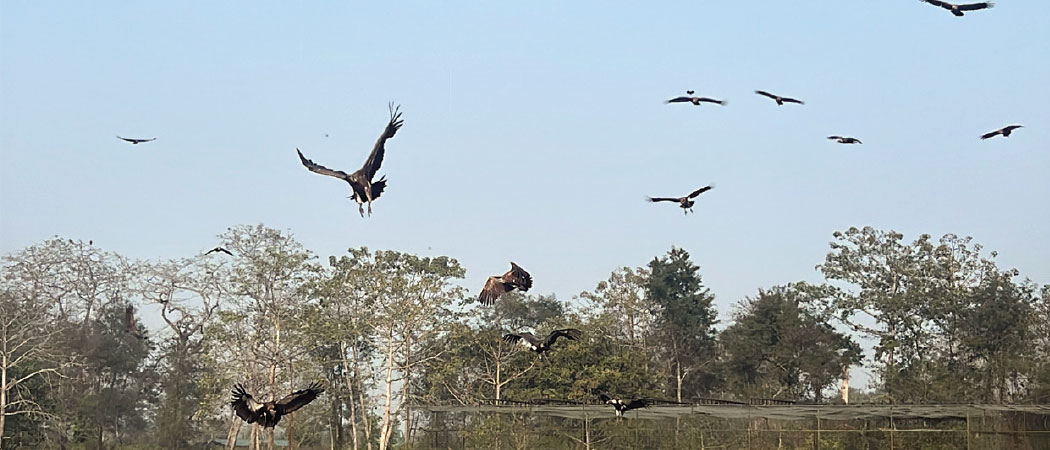

By Bomlal Giri,Nawalpur, Jan. 10: In April 2021, as many as 70 vultures were found dead at Jitpur in Ramgram Municipality-4 of Nawalparasi district. The birds died after feeding on a dog carcass.
Among them were four vulture species, including two listed as Critically Endangered by the International Union for Conservation of Nature (IUCN) -- the White-rumped Vulture and the Long-billed Vulture.
Two years earlier, six vultures died after eating the carcass of a jackal along the Lokaha stream in Kawasoti-11, Nawalpur. In another incident near the Kerunge stream close to the district headquarters, four endangered vultures were found dead. Many others were injured and are still undergoing treatment. These are just a few examples.
Stakeholders have expressed concern that the rapid deaths of vultures, often called nature’s cleaners for their role in keeping the environment clean, have created new challenges for vulture conservation. They stress the urgent need to control poisonous veterinary drugs, identified as the main cause of vulture mortality. Dr. Sharmila Kumal, chief of the Veterinary Hospital and Livestock Service Expert Centre in Nawalpur, said that painkillers and fever-reducing medicines such as aceclofenac, ketoprofen, nimesulide and diclofenac given to sick livestock are proving deadly for vultures.
She said diclofenac is already banned in Nepal and India and stressed that the other drugs should also be prohibited. As there are many safer alternatives to treat pain and fever in animals, imposing a ban on these medicines would not cause problems, she added.
By the mid-1990s, the vulture population, once estimated at around 50 million, had plummeted to near zero due to the widespread use of diclofenac.
According to the State of India’s Birds report, after India imposed a ban on diclofenac for veterinary use in 2006, vulture deaths declined in some areas.
Bhupal Nepali, project officer at Bird Conservation Nepal, explained that if the animals treated with these drugs die during treatment or within seven days, the toxic residue passes to vultures that feed on the carcasses. This increases uric acid levels in the birds’ blood, causes kidney failure and ultimately leads to death.
Ornithologist DB Chaudhary, Chairperson of the Jatayu Restaurant Management Committee, said that despite major successes in vulture conservation achieved through long-term efforts, poisonous veterinary drugs still remain a serious threat.
He said Nepal’s achievements in vulture conservation have drawn global attention, prompting countries such as India, Pakistan and Bangladesh to agree on banning these drugs.
He urged the Nepal government to act decisively, saying that the Department of Drug Administration can impose a ban on the use of these drugs on the government’s recommendation.
Improvement in vulture numbers
Chaudhary said Nepal has achieved a significant success by changing public attitudes towards vultures, banning diclofenac and increasing vulture populations. At present, there are 804 recorded vulture nests across the country, including 158 in Nawalpur alone. Recent data show that more than 20,000 vultures have now been counted nationwide.
When the Jatayu Restaurant, a safe feeding site for vultures, came into operation in Nawalpur in 2005, only 72 vultures of seven species were recorded. By 2023, the number had risen to 517 vultures of eight species.
Vultures are counted each time food is provided. In the last week’s count, 220 vultures were recorded -- 183 Long-billed Vultures, 32 Himalayan Vultures, three Griffon Vultures, and one each of the White-rumped Vulture and the Red-headed Vulture.
According to Chaudhary, the recent increase is due to the diclofenac ban, improved habitats and easier access to food. As a result, Gandaki and Lumbini provinces -- home to the largest vulture populations -- have been declared Vulture Safe Zones, said project officer Nepali.
Contribution to the environment
Vultures play a vital role in the ecosystem. By consuming animal carcasses, they help keep the environment clean and are often referred to as nature’s sanitation workers.
According to Bird Conservation Nepal, a single vulture contributes services worth about US$ 11,000 through carcass disposal. Vultures are therefore considered key to maintaining ecological balance and the food chain.
Of the nine vulture species found in Nepal, four are listed as Critically Endangered by the IUCN. They are: the Slender-billed Vulture, Egyptian Vulture, Long-billed Vulture and White-rumped Vulture. The Himalayan Vulture, Bearded Vulture and Red-headed Vulture are also close to being threatened, Chaudhary said.
The population of the Long-billed Vulture, which had been declining in Nepal since 2002, began to recover after 2012 and is now estimated at around 2,000. In the 1980s, Nepal was home to up to 1.6 million vultures. Today, just over 20,000 have been recorded.
Following the dramatic and unexpected decline in vulture numbers across Nepal and South Asia, scientists in 2003 identified diclofenac -- used in livestock treatment -- as the main cause. In response, the Nepal government banned the drug on June 5, 2006. Conservationists say that if other harmful veterinary medicines are also banned, vulture numbers could increase further.
-original-thumb.jpg)