- Sunday, 3 May 2026

‘Stand Up For A New Course’

Even first cousins in Europe lift their hands in united strength: enough is enough. From day one after his January 20, 2025, inauguration at the White House as the president of the United States, Donald Trump has come to believe that he is ordained to correct the wrongs he perceives as having been done to others and the free ride many industrial nations are having at the cost of the US.
Now leader of Britain’s Liberal Democratic Party, Jonathan Devey, the other week rained a cascade of no-nonsense criticisms at the British Commons. He said what other prominent leaders in Europe or, for that matter, anywhere else have summoned energy to stand up to reckless behaviour. A cabinet minister in the Lib-Lab-plus coalition cabinet, Davey described Trump as the “most corrupt president the United States has ever seen”, who thinks he can grab anything he wants, and “using force, if necessary.”
For a man who takes electoral defeat as a systematically “rigged” result, the Davey blows must have sent him off balance. He was never blasted that way—that too from a major European power that is in the exclusive club of “Five Eyes”, whose white majority speaking populations have English as their official language.
Overbearing pattern
British Prime Minister Keir Starmer was halted midway through a sentence when Trump, the host, called time’s up, and rudely signalled that the press meet was over at the White House in 2025. The US president has on several occasions dismissed as “stupid” suggestions by European leaders that his demands on foreign policy priorities, resource mobilsation and exceptional concessions to American business interests on all fronts.
Social media posts originating in the United Kingdom have called for “stopping transatlantic trade and intelligence sharing” with the US until the “outrageous demands” and “provocation without justification” stop from the “bully”.
Davey pressed for a new course, meaning that Britain cannot let things go unbridled. Preparations are needed for a fallback position rather than overly relying on a single nation that may begin to bite sharply and deeply. European leaders seemed to have lost the appetite for not speaking out their mind, sound, proper, and prompt. That might change now.
Fellow MPs from across the floor might have showered congratulations on Davey for the remarks he made—comments they shrank from issuing themselves. Even their media did not cross the imaginary “red line” they drew—in other words, self-censorship. They would have ceaselessly mauled other executive heads who dared to say and do what Trump is engaged in with unpredictable frequency. The Trump camp might have been uneasy about the British parliamentarian’s uttering that might trigger a trend.
Europe is the largest trading bloc, which could spell setbacks that the Trump team might not measure in their tariff tactics. Trust deficit reached a drastically dangerous level. The most serious aspect is that Washington has distanced all countries, and American elites from the cross-section of society have not come out with critical comments on its foreign policy.
For that matter, the so-called cream of society elsewhere, too, is mute, if not blind, to the goings-on. Sanctions, deportations, visa denials, and the like are tools employed against those who step out of the line demarcated without declaration.
In a hard-hitting denunciation of Trump’s casual attitude toward neighbours and Europe, Canada’s Prime Minister Mark Carney at the World Economic Forum in Davos last month called for putting a check on “hegemons”. He warned that the world order “is not coming back” and “nostalgia” does not serve any strategy. The enthusiastic responses he was accorded by his peers demonstrated a confession that he told what they had long hesitated to utter.
Although Trump hit back at the overnight political star Carney the next day at the annual gathering, he received hardly any support of note from either prominent American analysts or political leaders from other countries. That spoke of a deepening consensus in the Western world, too, of a fast-emerging new world order.
Despite Trump’s denial, Europe warns his “new colonialism” and hounding of Greenland risk the unity of the NATO alliance. After French President Emmanuel Macron mocked US Treasury Secretary Scott Bessent’s support for Trump’s craving for the self-governing Arctic territory, an angered American president threatened to impose 200 per cent tariffs on French wine and champagne.
Pointer of suspicion
Macron dismissed the American president’s invitation to the “Board of Peace”, supposedly to supervise war-torn Gaza’s reconstruction. Joining the Board entails an initiation fee of $1b, with the US president as its head. Macron’s government announced that it did not intend “to answer favourably” to the invitation. Paris concludes that the proposed Board’s charter envisaged as its work area “beyond the sole framework of Gaza”. Germany, too, might drag its feet over the US plan.
Some of Carney’s key allies seem to agree with him on the need for all middle powers to get together and resist Trump. An instant political star, the Canadian prime minister had his political stock rocket last year when he steered the Liberal Party to victory. Prior to the 2025 elections, opinion polls early last year had shown the party trailing behind the main opposition, but he turned the situation around by taking a firm stand against Trump, who had been taunting Canada to become the 51st state of the US. “Canada is not for sale,” declared Carney in a sharp rebuttal to the newly elected president next door.
Maintaining the tone and tempo right up to the election day, Carney snatched victory and has not let voters down on this score at all. His widely applauded statement at the Davos meet should raise a few more points in public approval ratings.
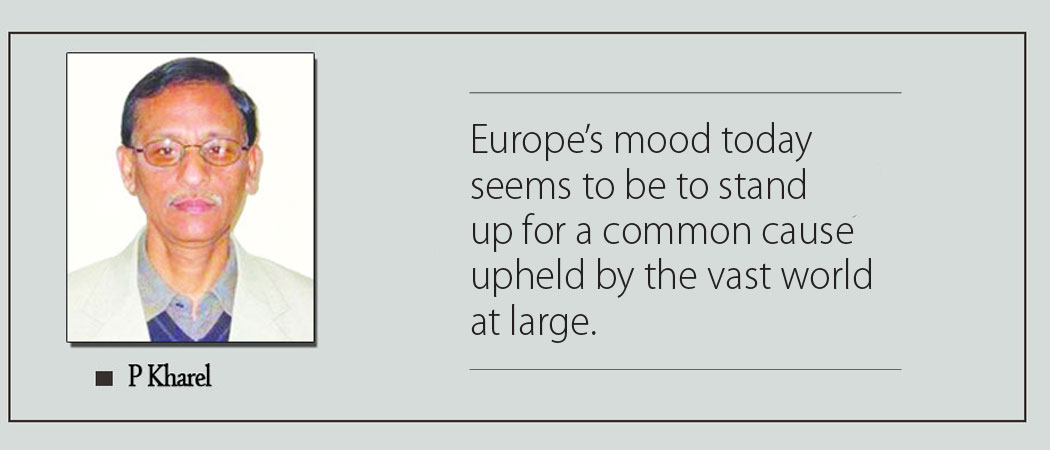
Brazil’s President Luiz Inácio Lula da Silva describes Trump’s Board of Peace as an imperial palace. One may add: dominated and dictated by Trump. Europe’s mood today seems to be to stand up for a common cause upheld by the vast world at large. A united front would send the message to the White House that there is a limit to everything.
(Professor Kharel specialises in political communication.)

-square-thumb.jpg)


-original-thumb.jpg)