- Monday, 8 June 2026

Learning Politics As A Game Of Survival

Nepalis’ability to read between the lines of the political world helps them to survive in its game, craft adaptive strategies and struggle to shape choices prioritising survival and progress. Democratic leaders are supposed to break the wall of silence to debate, define and judge the right course of action to cope with internal and external challenges so that the vision of the people is not heartlessly refuted. In this game, Nepali leaders have to define pathways to navigate the pressure-ridden situation, accumulate human and non-human resources and shore up ideas to shape public policies and institutions of political socialisation, mobilisation and integrity for worthy initiatives.
This process helps to strengthen a community of common concerns, the Nepali state. It enhances trust in society and improves social indicators — education, health, the economy, infrastructure, community welfare, and jobs. Ironically, Nepali leadership’s consensus and adoption of a consumer economy that no longer produces even to meet survival needs is only consuming what the ancestors have bequeathed. As a result, there is a deficit of normative order of a just society and able to meet survival needs, self-realisation and mutual recognition of people as co-equal with reasonable survival prospects.
Social justice
The provisions of social justice, security and protection enshrined in Nepali constitution serve as vital social indicators. An improvement in these indicators enables Nepali people to exercise power to shape their destiny and survive in the competitive game of politics by harnessing adaptive response to changing times. They equally give an impetus to upscaling knowledge and skills and rebound even in times of existential crisis. It is difficult to democratise Nepali society without curtailing poverty, malnutrition, illiteracy, health crisis and job loss and preventing penetration of geopolitical predators.
Alleviation of these malaises enables Nepalis to ensure survival and run off a life void of meaning and any wisdom of dawn. Politics is deemed a public sphere and a system of modernity with its own logic of rationality justified by popular consent. It benefits Nepalis not from the logic integral of global market processes which habitually escapes democratic regulation and sovereignty but a choice to survive and compete in the power processes through the means of national self-determination.
The purpose of governance is to maximise public welfare and guarantee the wellbeing of people. Historical search of Nepalis to escape from the pre-social condition of the state of nature is not only to ward off the crisis of livelihood, external determinism, blind political passion and social prejudice but also to relish freedom for the nation and people and underline the rules of personal conduct and national statecraft. Their enlightenment, enriched from metaphysical experience of nation’s intellectual tradition, therefore, refuses to submit to a state of anarchy which is self-destructive and exiles them from the gift of civilization.
The dawn of democracy in Nepal has awakened natives to human equality and prompted them to defy that they are indolent, fatalistic and inept. In a varied society like Nepal with diverse needs and aspirations, only the availability of public goods can coordinate their behaviour, choices and strategies and prevent alienation from the competitive game of politics. Three major choices Nepalis entertain are: political, constitutional and ethical. The coordination of these is vital to conquer necessity and achieve political stability through a post-traditional solidarity. Political choice backs the desire of Nepalis for timely change in the quality of politics with shifting times and garners political legitimacy to rule.
The constitutional choice is essential to promote peaceful adjustment of competing conception of good life. The ethical choice is indispensable to shun violence, reconcile the preference of all and their rights so as to relish freedom and autonomy of public and private life. It is a source of durable political order and an edifice of civic maturity vital for survival fitness. The rationalistic conception of politics practiced in Nepal is, however, a different game where rival leaders often indulge in antagonistic cant to elevate themselves and spoil the community spirit of a win-win outcome. Their strategies to maximise gains at the cost of others remove the stake of counterparts in the public institutions of the polity.
It turns the losers of the political game ill-tempered with the ability to subvert institutions and the constitution and harms the wisdom of compromise. The survival game of politics in Nepal is a golden mean between self- interest of leaders and the common good and its art lies in balancing the process of cooperation, negotiation and compromise. It shuns radicalism, fanaticism, orthodoxy and instrumental politics that exploit the cultural differences of the nation to enlarge political constituencies. Nation building requires the pooling of loyalties of Nepalis beyond their pre-social instinct and sub-human existence.
Nepalis have learned to cooperate with others in matters of mutual interests despite enormous diversity. It gave continuity to this nation and society. The indomitable zeal of Nepal’s each political movement in various phases of history that began with the promise of great political transformation and expansion of the elite base of democracy has, however, bungled within a decade or so as critical masses which provided energy to them suffered division into several factions, melted like molten lava or catapulted into power. Nepali leaders performed the logic of power without filling popular desire for change thus affirming the belief that system has changed, not the condition of people.
The other factor is the moral decay of many sections of leadership and the loss of public-spirited character vital for a civic culture. But the ethical struggle for political renewal has not died down. This reflects a sense of optimism. Nepalis need time to habituate with democratic praxis and realise the best outcome of political participation to ease their survival. The effect of deceitful politics is cascading now, which neither cares nor imagines the fate of future generations. It drains long-term investment in the productive sector of the economy to spawn opportunity for jobs and subsidise national self-reliance so as to make the state and civic institutions autonomous of interest groups and deep state agents.
As a result, Nepalis are suffering from the fear of the misery of polity and releasing emotional outbursts against the political and economic conditioning of their lives, determinism and inertia, as these processes offer them only narrow choices. Nepali leaders are thus reeling under high pressure in politics and seeking to leverage their muscle in the political and electoral race. One obvious predicament of old politics in Nepal is how leaders regain imagination of the national situation and abolish the culture of impunity. For the new forces, the challenge is how to gain political wisdom beyond leveraging modern technologies promising media freedom and good governance.
One critical issue in Nepal is to protect leaders from the ferocity of rival cadres and bring them under the code of the constitution and election. This is vital to regulate politics within normative bounds, not make it a game of free ride where the survival of the poor is at stake, leaving an escape to the global labour market as the only option for survival. Bottom-up learning of social shifts is essential for Nepali leaders to identify with the mood of the people and add stamina to their survival means. Efficient coordination of political activities cannot be left to either market forces, civil society or political parties but the state, which only holds the legitimate monopoly on power.
But now it is weak to create order in society, implement the constitution and offer survival goods to the people. Elections allow people to shape a political life of choice, not overall development, which requires strong political will, apt public policies and rational executing agencies. Regular civic education, not just electoral information, can enable Nepalis to know about national policies, leaders, ideologies and democratic principles, de-intoxicate voters from hyperbolic promises and free them from misinformation, false awareness and misbegotten belief. It opens them to democratic values, theories, rights and leadership.
The logic power without public reason to ensure the well-being of people cannot endure long, even if it is backed by an overwhelming number of legislators. A series of revolts in Nepal has shown how Nepalis have stripped the illusion of power and brewed the tragic antinomy of the political game. The poor Nepalis can exercise limited choice in the market, although they are legally and politically equal. They, therefore, prefer welfare benefits as a precondition of their freedom. This is vital to break free from parochialism, apathy and self-isolation and exercise their rational approach in voting.
Leaders’ adaptability rests on learning from the feedback from the people, their ability to cope with sustained pressure for demand fulfillment and acquiring civic competence for survival and progress. The democratic potential of Nepali civil society also demands countering authoritarianism, as it cuts the possibility of people surviving in economic and political games. It stifles the hope of social energy for transformation.
The transformation of Nepali people into citizens is a must for a robust legal order.
False illusion of communication
But so long as leaders’ responsibilities to people are cloudy, the spirit of political society nauseates infecting the possibility of justice and dignity for Nepalis. Ironically, the politics of Nepal resembles a gyrating treadmill with full speed but heading in reverse. Crowd mobilization by leaders only symbolizes monologue and a false illusion of communication, not dialogue, where leaders can converse with the people and build a reasoned kind of listening and cooperative action.
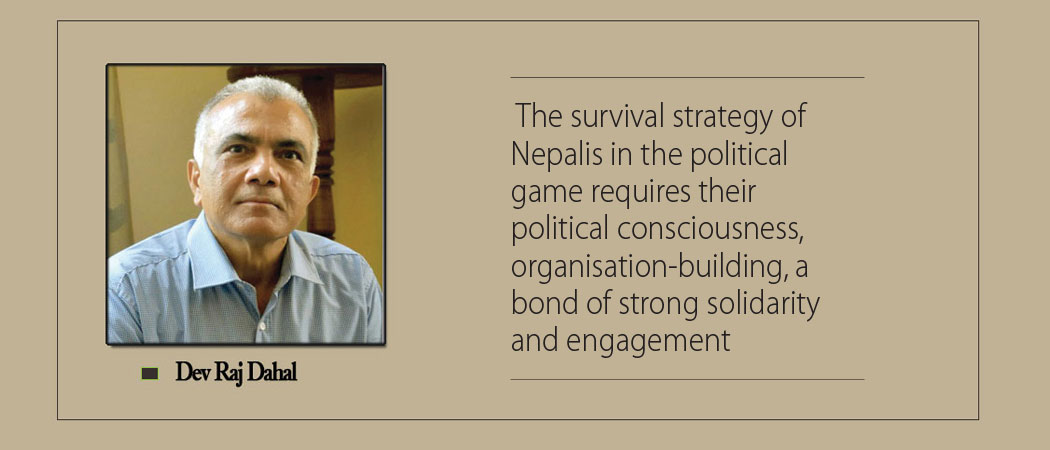
The survival strategy of Nepalis in the political game requires their political consciousness, organisation-building, a bond of strong solidarity and engagement in shaping policy priorities. In a contractual regime, Nepali political parties only listen to the collective power of the poor, not their atomic fragments. In this sense, political means of coming to an understanding by Nepali leaders concerning justified options can ensure political survival, progress of all and effective use of social, intellectual and ethical use of political power for individual and national survival.
(Former Reader at the Department of Political Science, TU, Dahal writes on political and social issues.)