- Thursday, 11 June 2026

Polarisation, Populism And High Hope

The countdown to the March 5 House of Representatives elections has already begun. The political atmosphere is getting charged up as the leaders have already started campaigning. In the electoral history of Nepal, this election is going to be the most unique. It has polarised the general public as never before. The voting age population is clearly divided between two camps -- the supporters of the old political parties, which have remained in power for a long time, and those who want a paradigm shift in the political system by electing new and young leaders with zeal and a clear vision and mission for social, political and economic development.
The Gen Zers, whose revolution fizzled out without any substantive outcome, except toppling the KP Sharma Oli-led government, are in the mood to grab this opportunity to elect young leaders. To this end, there is an unchecked free flow of propaganda, misinformation and disinformation on Facebook, X, Instagram and other social media, and algorithms have become tools for the tug of war on the internet between the political rivals to promote themselves and defame others. The digital media has dawned the era of populism.
Competing narratives
Sixty-eight political parties are contesting this election. However, it seems to be centered mainly on two competing narratives, i.e. the continuation of, hitherto, political establishment vs. change in this establishment. There are two iconic figures who are pushing these narratives. First, CPN-UML chairman Oli, who has become the prime minister for four times. Second, Balendra Shah, ex-rapper and ex-Mayor of Kathmandu Metropolis, and currently a contender from Rastriya Swatantra Party (RSP).
The populist politics in Nepal has reached the zenith as Balendra Shah has been made an iconic figure largely by the young population, as well as the sizable population of middle and old age voters. He is being received and cheered by thousands of people like a celebrity. He is considered to be “clean” in his character as he was not found to be personally involved in any type of corruption when he was a mayor; and more so, he did some daring tasks that involved high political risk and backlash. He won the hearts and minds of the people living not only in the valley, but also across the country and among the Nepali diaspora.
In a state marred with rampant corruption, disorder and lawlessness, small steps taken towards improvement and betterment in Kathmandu metropolis drew the attention of a large public so much so that they want to see him as a future PM. He has become a “poster boy” and a star campaigner for RSP. He is contesting with the ex-PM Oli from constituency- 5 of Jhapa district, the home district of Oli. It makes this election even more interesting because the ousted dispensation with Oli as its pm has alleged Shah being involved in instigating the Gen Z uprising from behind the curtain while he was a mayor.
In response, the ex-mayor along with other political and non-political entities have accused the ousted pm of not taking the responsibility for the death of 76 people on September 8, 2025. Although high hopes are impinged on a new face, and a new party, the outcome may not be as expected. Its first reason is, the RSP is not a new party in the sense that it has already contested election in the past and secured 21 seats to become the fourth largest party in the parliament that was dissolved after the Gen Z movement.
Unlike Shah, who joined RSP just few days before his nomination for election, Rabi Lamichhane, who is the president and founder of RSP, has faced many legal court cases, for his involvement in cooperative finance scam, and the cases are still sub judice. Lamichhane also held the portfolio of home ministry in December 2022 in the coalition government when a legal case of dual citizenship and passport was filed against him since he had not surrendered his American passport and citizenship, after he returned to Nepal and founded RSP. The other prominent figures in this party are mainly those who have left other parties for their personal reasons. The recent new entrants are mostly from diverse backgrounds such as journalism, trade and commerce, entertainment, as well as academia, with a little or no political experience.
This image of RSP itself could be an impediment on the path of RSP victory, because the voters who are neutral and are yet to decide, or swing voters, take these factors into consideration. The second important reason is that, in a parliamentary democracy, the government formation is a number game. A political party with a simple majority forms a government. Under this mixed electoral system, so far, no single party has been able to get a simple majority of 138 seats in the two general elections held in 2017 and 2022.
Second, even if the RSP takes a quantum leap from its fourth position to the first, securing the maximum number of seats, it is not a guarantee that Shah will become the PM. It is because, in this second scenario, a hung parliament will be formed and the RSP will need the support of another party to form a government. In this case much unexpected political equations could be formed to grab power.
Glaring example
There is a glaring example that Sher Bahadur Deuba, the parliamentary party leader of the Nepali Congress, which became the largest party in the HoR, following the 2022 general election, could never become the PM, whereas Pushpa Kamal Dahal Prachanda of CPN-Maoist Centre, whose party was the third largest with 32 seats, became pm for 19 months in a coalition government. Hence, it can be concluded that, as long as some Articles in the constitution are not amended, especially those related to the electoral system, impinging high hopes and dreams on a single individual or a party will prove to be a futile expectation.
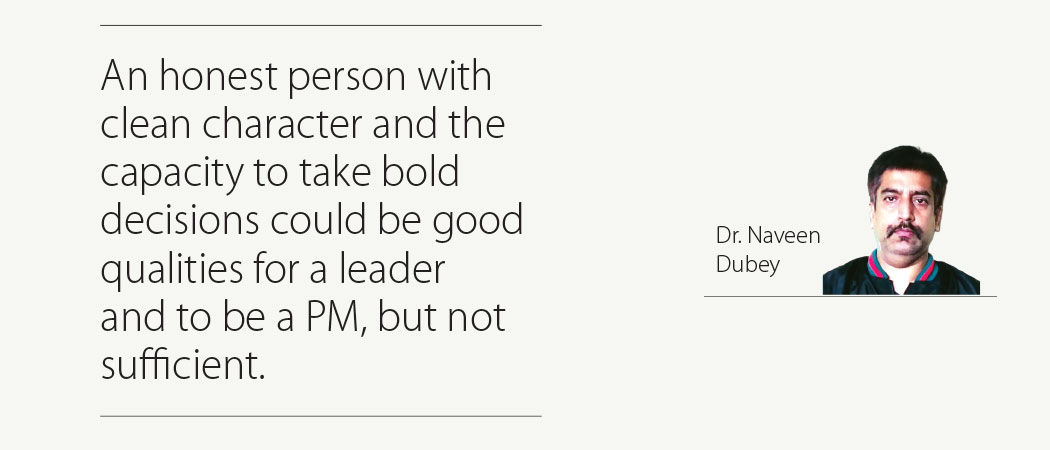
Even the bigger pressing issue that the common people should bear in mind is that no single individual becoming the PM could bring about a drastic change in the state polity within five years period when the state’s institutions are marred by institutionalised corruption, cartelism and middlemen meddling in the government’s affairs, which requires a complete overhauling of the state’s machineries. An honest person with clean character and the capacity to take bold decisions could be good qualities for a leader and to be a PM, but not sufficient. Only a seasoned politician in a PM seat, who could garner support, cooperation and confidence from across the broad political spectrum, could deliver a substantive result.
(The author is a Kathmandu-based freelance researcher.)