- Sunday, 3 May 2026

Degrees Sans Direction
 Swaansh Mahat
Swaansh Mahat
Swaansh Mahat
In Nepal, education is often presented as a guarantee. Work hard, earn a degree, and life is supposed to fall into place. For many young people, it has not. Universities are crowded, results are published on time, certificates pile up, yet the road ahead feels uncertain. Effort keeps increasing. Outcomes do not.
Many graduates step out of university carrying knowledge that sounds impressive on paper but feels misplaced outside the classroom. Courses lag how work actually happens. Practical skills are sidelined. Internships exist, but are often unpaid or out of reach. Jobs ask for experience that most graduates never had the chance to gain. Access matters more than ability. Slowly, frustration steps forward. Not because young people failed, but because they followed the rules and still ended up waiting.
Entry-level jobs demand experience, while gaining that experience usually depends on access and connections. The result is familiar and frustrating. A growing number of young people are qualified, willing, and underemployed, despite doing everything they were told was necessary.
This gap is rarely addressed honestly; instead, it is personalised. “If you are struggling, then you did not work hard enough. If your degree is not working, you chose poorly”. Structural shortcomings are reframed as individual failure. Shame replaces analysis. Silence replaces reform.
Over time, education has turned into a holding pattern. Many students enrol not to learn, but to wait. To delay unemployment. To justify the time passing. Degrees begin to represent effort rather than agency. Classrooms become spaces of postponement instead of preparation, where the momentum slows down rather than building up.
This is not a failure of students, but this is the failure of alignment. Education systems cannot remain static while societies change around them. When learning no longer reflects lived realities, frustration grows. Young people begin to see education as an obligation rather than empowerment. Motivation fades away even for those who are actively capable.
The irony is hard to miss. Nepal is a source of talented and hardworking graduates who, when given the opportunity in systems that recognise and reward their skills, can excel and thrive abroad. Meanwhile, they find it very difficult to establish themselves in their country of origin. This does not show that these individuals lack intelligence or that they are not hardworking.
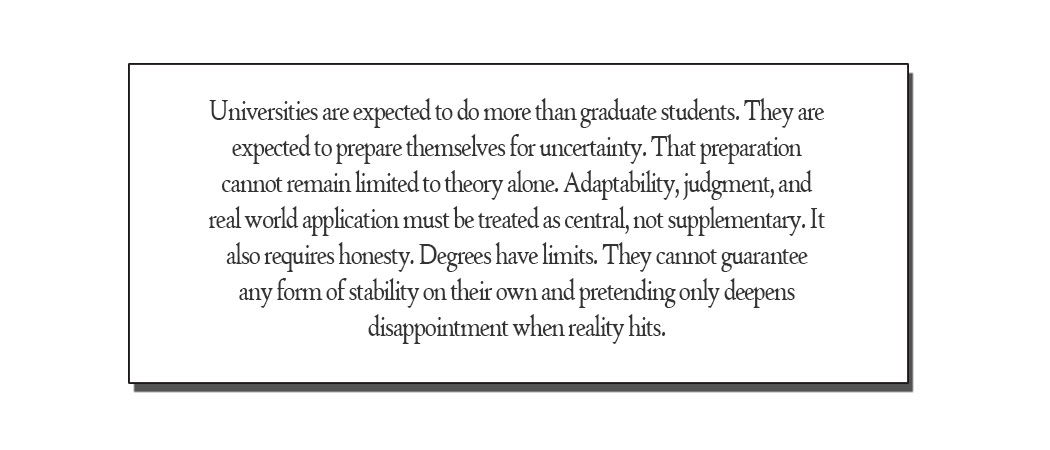
Universities are expected to do more than graduate students. They are expected to prepare themselves for uncertainty. That preparation cannot remain limited to theory alone. Adaptability, judgment, and real world application must be treated as central, not supplementary. It also requires honesty. Degrees have limits. They cannot guarantee any form of stability on their own and pretending only deepens disappointment when reality hits.
Education should open doors, not create unrealistic expectations. Until learning reconnects with purpose, relevance, and possibility, young people will continue to feel suspended between potential and reality, prepared on paper but unsupported in practice. A generation trained only to wait will eventually stop waiting. Many already have. Not because they lack commitment, but because waiting stopped making sense.
-square-thumb.jpg)
-original-thumb.jpg)