- Sunday, 3 May 2026

Make Extended Health Service Affordable

When the Nepal government introduced Extended Health Services (EHS) in government hospitals, the idea sounded thoughtful and promising. It was meant to improve the quality of public healthcare and make services easier to access for those who could afford to pay a little more. At the same time, it aimed to reduce the growing practice of government doctors working extensively in private hospitals after office hours.
Under this system, doctors working in government hospitals are allowed to provide additional services within the same hospital after regular working hours. People who wished to avoid long queues and delays could receive quicker services by paying higher fees. In theory, everyone benefited: patients received timely care, doctors earned extra income, and government hospitals strengthened their services.
Good intention
The government drafted a detailed procedure for EHS in 2077 BS. According to the guideline, hospitals are allowed to charge up to 200 per cent more than regular service fees. Doctors are paid rates similar to private practice, and a special management committee is formed in each hospital to regulate the service. Of the collected amount, 80 per cent goes to doctors and supporting staff, while 20 per cent is deposited into the Hospital Development Fund.
On paper, the system appears balanced and well planned. EHS was meant to use existing government hospital equipment and infrastructure to provide quality care without pushing patients towards expensive private hospitals. In cities like Kathmandu, the service became popular very quickly. Yet popularity does not always mean fairness.
Many people are now confused about EHS. Is it really affordable? Is it meant to support public health, or has it become another costly service wearing a government label? Because EHS is provided through well-known government hospitals, people trust it. They believe that even if the cost is higher, it will still be reasonable. Unfortunately, this trust is slowly weakening.
In many hospitals, charges are extremely high, and patients have no clear idea how these prices are decided. There is no representation of patients or consumers in the hospital management committees. Decisions are made only by hospital authorities. As a result, EHS increasingly feels less like a public service and more like a private business operating inside government hospitals.
Last month, I spent almost a week at Lumbini Provincial Hospital in Butwal while caring for my mother, who was admitted to the ICU. During that time, I did not just sit beside her bed I listened. I listened to worried family members, tired patients, and frustrated visitors. Many shared the same complaint. They spoke about long waiting lines for regular services and about being told that there was “no quota” available. Again and again, people said they were advised to take EHS instead. Some felt it was a suggestion; others felt it was pressure.
What shocked many patients was the cost. For the same treatment, by the same doctor, EHS in a government hospital was sometimes more expensive than treatment in private hospitals. This was unfair and confusing. Government hospitals were supposed to be more affordable, not more expensive. I also heard concerns that some doctors were rarely seen during regular service hours but were always present during EHS hours. Whether fully true or not, this perception alone is damaging. It creates the feeling that regular patients often poorer and more vulnerable, are being neglected.
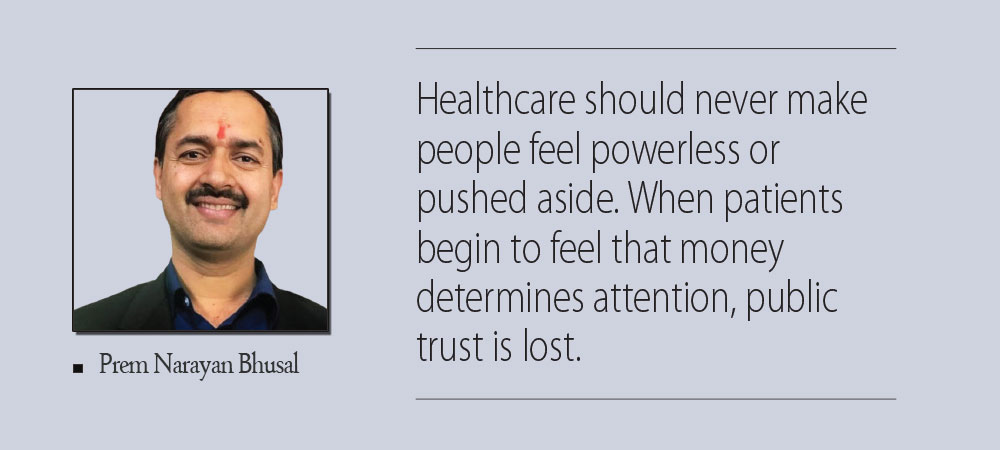
Healthcare should never make people feel powerless or pushed aside. When patients begin to feel that money determines attention, public trust is lost. Many family members of patients quietly raised similar concerns. They questioned whether EHS was slowly replacing regular service instead of supporting it. Doctors are not just service providers; they are guardians of life and dignity. When financial incentives start to outweigh professional values, the entire system suffers. Patients feel cheated, families feel helpless, and hospitals lose their moral authority.
Needs to change
EHS was never meant to burden people. It was meant to provide choice. But choice disappears when regular services become weak and paid services become the only option. Extended Health Services should not be abolished but they must be corrected. Strong regulation is essential. Prices must be transparent and reasonable. Regular services must remain strong and accessible. Most importantly, no patient should ever feel forced to choose EHS.
Hospital management committees should include representatives from outside the hospital—local government officials, civil society members, or social workers so that patient voices are heard. Above all, the government must urgently review the EHS procedure and ensure it truly serves the public interest. Today, countless families enter government hospitals with hope and trust. That trust must be protected. So the question remains: Extended Health Services for whom, are they really meant? If this question is ignored, the cost will not only be financial, it will be human.
(The writer is a psychological counselor.)
-square-thumb.jpg)
-original-thumb.jpg)