- Sunday, 3 May 2026

Preserving Heritage
 Devendra Gautam
Devendra Gautam
Devendra Gautam
Basantpur, Kathmandu. Women and girls clad in Newari attire (Haku Patasi) are taking part in a colourful musical procession, with the glory of their cultural heritage painted on their faces and highlighted in banners as tourists and strollers look on with curiosity. Granted, that the vibes coming from the celebrations are positively infectious but then what is the celebration all about? Shouldn’t we try to know more and more about the unique cultures and traditions of ours and the rest of the world, and pass them on to newer generations?
Of course, we should. So, what is the harm in asking a few questions to the processionists imbued with festive joy? None. Overcoming the inertia, this questioner approaches a processionist amid the collective beat of cymbals and drums, and receives a gem of information.
Apparently, the eighth day of the dark half of Magh (which fell on January 11 this year) turns out to be a big day in the divine scheme of things. Per the woman, this procession, which celebrates Nrityeshwar (the lord of dances, literally), a manifestation of Mahadev (the god of gods), is held every 11 years. The procession taken out from the lord’s temple in Thamel culminates at the temple after passing through the main thoroughfares of Kathmandu, including Basantpur. As the celebratory beats fade, it’s time to move on. But where to go from here? Perhaps to Kumari Chhen (the house of the Living Goddess) just a few paces away!
At Kumari Chhen, a considerable crop of tourists have poured in from different parts of the world, hoping to get a glimpse of the goddess, who, according to ancient literature, is a manifestation of Goddess Taleju, who has a commanding presence at a majestic temple close to the Nautale Durbar (the nine-storey palace).
From a window, a chitaidar (an aide) scans the crowd at the courtyard below even as a police officer and another assistant urge one and all to stay quiet and to keep their cameras in their pockets, lest they take pictures.
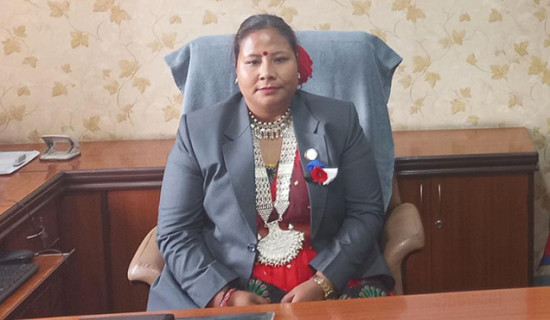
In the interregnum, in response to some of my questions, the assistant explains about the wood carvings of Kumari Ghar, what deities they represent and what they mean. An ancient world lies unexplored here, but we do not want to know about it, he says, highlighting a crying need to know more about our heritages, take pride in them and preserve them. And then the goddess appears at the window as a very young girl, assisted. Clad in red and with the third eye on her forehead, she briefly looks at the crowd, smiles, and vanishes like that divinely human smile into her chamber, meaning it’s time for all of us outsiders to leave.
Through a hairline, this sapien moves westward, leaving behind the European-style Gallery Durbar, Swetbhairav, Kalbhairav, Maju Dega, Uma-Maheshwar and coming halfway across the statue of Garud in namaskar mudra, who, with his left knee folded, seems to have been waiting for ages for his lordship Vishnu, the preserver of the world in the divine scheme of things, to take him around a tour of the world and beyond at Garud-speed for stock taking of problems and their swift redressal.
At Kashthmandap, does Guru Gorakhnath still come a-visiting? Does a playful Ganesh still come to his roofless abode—Maru Ganesh—when no one’s watching, after, most probably, taking a bath at Maru Hiti, which has turned into a trickle, leaving behind a memory of gushing waters? Don’t the good and the evil still fight in Kathmandu?
Sad, isn’t it, that Goddess Taleju doesn’t play pasa with Jayprakash Mallas of our times anymore, that Kalbhairav punishes the wrongdoers no more, even in this day and age of systemic breakdown, that the Bhimsen of Bhimsensthan no longer has the strength of a thousand elephants?
Further southward (on the way to the Vishnumati, a couple of old houses made of raw bricks and mud struggle to stand with their modern, soaring neighbours, while some others stand no longer. One of the sturdy walls of a modern house bears a public notice requesting that all concerned contact a certain number if they need to demolish their old dwellings and other structures. Amid the urban sprawl, a crucial question looms.
How can we better preserve our heritages, for ourselves and for the rest of humanity? As the last of the decades-old structures struggle to stand in this and several other neighbourhoods in Kathmandu and beyond, the time to think long and hard, and act with urgency for heritage preservation has indeed come.
-square-thumb.jpg)
-original-thumb.jpg)