- Sunday, 3 May 2026

Why Young People Are Choosing Protest

In early December, Kenyan environmental activist Truphena Muthoni made history by hugging a tree for 72 hours straight. The goal was not only to raise awareness of the growing threats posed by climate change and deforestation but also to highlight the limits of conventional advocacy in driving meaningful policy change. Muthoni’s protest reflects a broader global shift.
From climate strikes in Europe to student protests in Latin America, youth movements gained momentum in 2025, signaling a growing refusal among younger generations to accept incremental policy responses to systemic challenges. Across Africa, Gen Z-led demonstrations last year transcended national borders and political systems. In Kenya, young people took to the streets following the death of a blogger and teacher in police custody; in Madagascar, frequent water and power outages sparked public unrest; and in Morocco, outrage centred on preventable maternal deaths during childbirth.
Governance failures
Crucially, these protests were not driven by isolated incidents, but rather by deep and persistent governance failures, with demonstrators calling for systemic responses to longstanding problems such as rising living costs, high youth unemployment, unreliable public services, and entrenched inequality. Far from fringe concerns, their demands were widely shared, which explains why labour unions and other influential players joined youth-led mobilisations in countries like Madagascar.
Youth protests have, in effect, become proxies for broader public discontent. This raises two critical questions: Why have young people turned to protest as their primary means of political engagement? And under what conditions does protest translate into policy? The protest wave of 2025 made clear that formal channels for youth engagement are failing. Although countries like Kenya, Madagascar, and Morocco have established national youth councils and other advisory bodies, young people's political participation remains constrained by structural and systemic barriers.
Consequently, many young people feel unrepresented and unheard, eroding trust in public institutions. These perceptions are reinforced by capacity constraints, as young people often lack the skills, training, and resources to navigate complex policy systems. At the same time, the leaderless nature of many contemporary protest movements excludes them from formal negotiations and decision-making processes.
Even so, last year’s youth protests influenced policymaking in three important ways. First, widespread public outrage forced governments to reconsider existing priorities and confront issues that had long been sidelined, such as deaths during childbirth, corruption, and limited access to digital technologies. Public commemoration of those who lost their lives to police violence also served as a warning that inaction could trigger renewed unrest.
Second, the protests underscored the profound disconnect between policy commitments and implementation, with demonstrators drawing attention to political corruption and misallocation of public funds. In Morocco, for example, public anger focused on heavy government investment in sporting facilities while essential social services such as health and education remained underfunded.
Third, the protests called attention to the real-world consequences of policy decisions. Disruptions to electricity and water supply offered a stark example: poorer communities were particularly vulnerable because most households lack viable alternatives to public services, while wealthier households and large firms could rely on private services. Youth activism has helped bring these inequalities into sharper focus.
Whether youth mobilisation leads to lasting change depends on several factors. Non-violence is particularly important. When demonstrations turn violent, they risk losing legitimacy and public support. In fact, research consistently shows that peaceful movements are more likely to achieve their stated goals. Moreover, while protest movements tend to focus on broad objectives, success often depends on articulating clear demands and winning the support of powerful actors. In Madagascar, for example, the protests gained traction when support from the military shifted the balance of power, intensifying pressure on political authorities and leading to the ouster of President Andry Rajoelina.
Policymakers’ responses also play a decisive role in shaping outcomes. Rather than openly linking reforms to protesters’ demands, officials often acknowledge underlying issues while distancing themselves from the movements that brought those issues to national attention. To be sure, young people’s limited understanding of how power and resources are distributed weakens their political influence. Despite their demographic weight and technological fluency, they often struggle to compete with entrenched interest groups or identify points of leverage.
If governments want young people to see policymaking as a credible alternative to protests, they must offer genuine opportunities to engage directly with decision-makers. That engagement, in turn, needs to be accompanied by practical tools that help young people understand how policy is made and where leverage can be exercised. Morocco’s proposal to expand political participation among citizens under 35 represents one promising model.
But engagement must translate into tangible improvements in people’s lives. Increased investment in health and education, such as Morocco’s proposed 16 per cent budget increase, should be paired with dedicated funding for youth-led initiatives and reinforced by robust monitoring and evaluation mechanisms. Lasting progress will also require comprehensive public-sector reforms. A citizen-oriented approach, supported by a capable and accountable civil service, could improve service delivery, rebuild trust, and reduce reliance on protest as the primary channel for political expression.
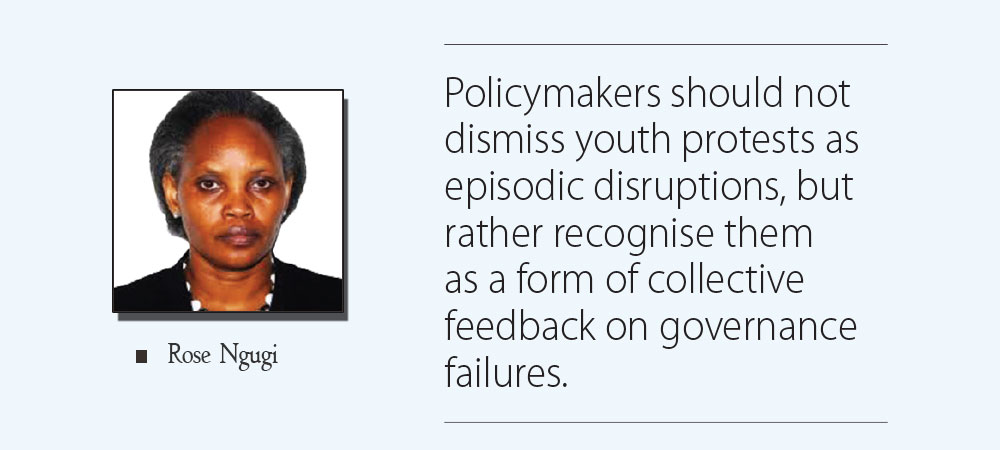
Policymakers should not dismiss youth protests as episodic disruptions, but rather recognise them as a form of collective feedback on governance failures. When formal participation channels break down, protest becomes the norm. Ignoring these signals risks deepening public distrust and stoking recurring unrest. By contrast, governments that respond with genuine reforms, sustained dialogue, and tangible improvements in service delivery can transform youth activism from a source of instability into a foundation for more inclusive and resilient governance.
(Ngugi is a former executive director of the Kenya Institute for Public Policy Research and Analysis.)
-Project Syndicate
-square-thumb.jpg)

-original-thumb.jpg)