- Sunday, 3 May 2026

Fast Fashion Hits Planet
 Bipyum Chaulagain
Bipyum Chaulagain
Bipyum Chaulagain
When one thinks of “fast fashion,” one immediately thinks of companies like Fashion Nova, H&M, Zara, etc. These companies are at the forefront of the fast fashion industry, which is characterised by low prices, flashy designs, and mass quantity. The system behind the industry depends on mass output of inexpensive, poor-quality items, pushing buyers to quickly replace their clothes. To be particular, the accessibility factor is what makes it so attractive to customers.
When trendy products are available at the push of a button and at low prices, customers are intent on purchasing them. The companies involved in the industry further incentivise such buying practices with the introduction of frequent discounts and sale schemes. Fast fashion cynically plays upon the desire for consumerism in individuals. In an economy that primarily runs on the production and then the consumption of the same goods, the proliferation of consumerism is a strategic tool for manufacturers. Manufacturers aim for a quick run cycle of the goods that are in hype or are in fashion.
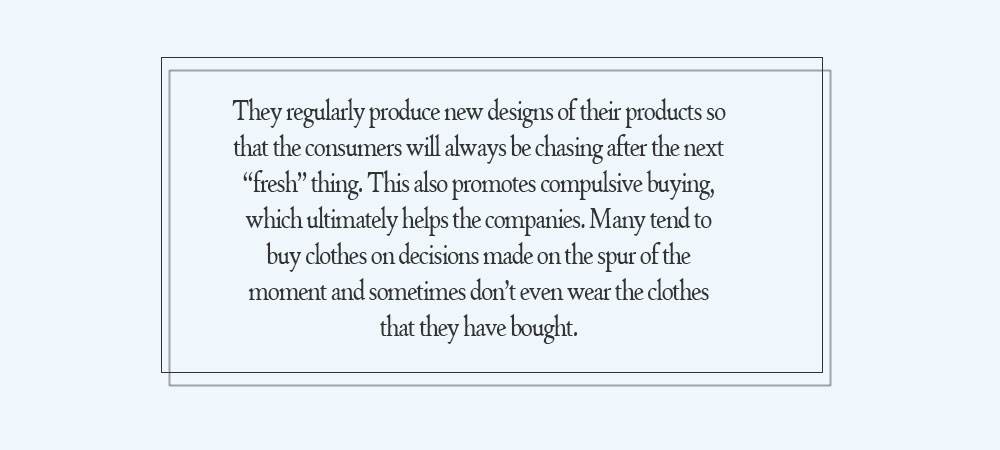
They regularly produce new designs of their products so that the consumers will always be chasing after the next “fresh” thing. This also promotes compulsive buying, which ultimately helps the companies. Many tend to buy clothes on decisions made on the spur of the moment and sometimes don’t even wear the clothes that they have bought.
As the key factor of the industry consists in the quick production of goods, it involves the running of factories and other components at a higher rate than in other industries.
Data from the UN Environment Programme shows that the fast fashion industry is responsible for about 10 per cent of the world’s carbon emissions every year. This goes to show that our day-to-day choices have impacts that far outweigh our concerns about appearance and keeping up with the trend. Likewise, the industry consumes a lot of water for the production of clothes and contributes to being one of the world's leading consumers of water. Similarly, the waste generated by the industry is also huge and forms a significant part of the synthetic waste produced yearly on earth.
With all these negative implications attached to fast fashion, it is necessary to ask oneself before deciding to purchase anything produced in such a manner. The moral implications should outweigh the superficial concerns of human beings in their decisions. It is with small decisions made by each individual that a large-scale change is possible. Because a boycott might seem unrealistic and also should not be aimed at due to the mountainous effort that it takes, a serious consideration of individual choices must be made by everyone.
Sustainability should be the prime factor in the production of goods that are used on a day-to-day basis. This relates not only to clothes but also to other essentials such as shoes, bags, etc.
Brands should explore other alternatives, such as the incorporation of cultural elements into their production, so that their products can be long-lasting and at the same time appeal to the audience. The companies responsible for the proliferation of such culture must strategically shift their focus to the production of long-term goods even though it might hurt their profit margins in the short term. While that might seem ludicrous from a purely business perspective, it is necessary for the responsible individuals to consider the damages that their businesses are causing to the planet and their impact on the population as a whole.


-square-thumb.jpg)



-original-thumb.jpg)