- Thursday, 30 April 2026

Is Exodus Inevitable ?
 Swaansh Mahat
Swaansh Mahat
Swaansh Mahat
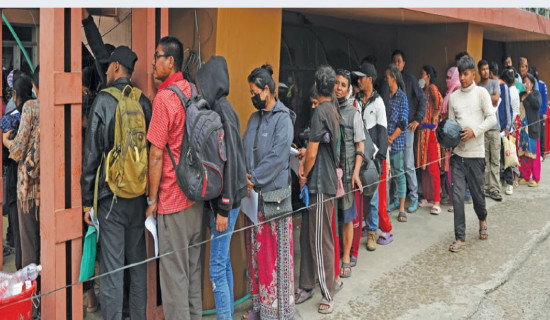
Quiet decisions are being made every single day. However, they do not appear in parliamentary debates or policy briefings. They seem to be appearing in visa appointments, language test registrations, and farewell conversations nationwide – all of which are becoming increasingly ordinary. Young people are not leaving Nepal because they reject their own land. They are leaving because they no longer trust its systems to respond to their effort.
For a long time, migration was framed as ambition, but today, it feels closer to necessity. Our educational degrees accumulate while opportunities remain uncertain. They demand experience but without clear pathways to acquire it. Patience is praised while timelines stretch indefinitely. For many young Nepalis, leaving becomes the only choice that feels deliberate rather than delayed.
This shift is often misunderstood. It is not driven by a desire for luxury. It is not shaped by cultural escape, nor steered by exhaustion. Exhaustion from unstable governance, delayed career progression, and institutions where merit often feels secondary to access. Patriotism is frequently framed as emotional loyalty, but rarely supported with any form of practical dignity.
What is most concerning is not the departure itself, but detachment. When young people stop imagining futures within Nepal, disengagement follows. This is how innovation slows, civic participation weakens, and reform begins to feel symbolic rather than achievable. The loss is not only economic; it is institutional and psychological.
This is not a youth issue alone anymore, but also a national one. The sooner we realise this, the better we may be able to address it. Every skilled individual who leaves carries with them years of public investment and unrealised contribution. The conversation often turns toward guilt. Why do young people not stay and serve the nation? Because loyalty cannot be demanded where systems fail to reciprocate commitment.
Retention does not require emotional appeals, but rather structural change. Predictable governance, transparent recruitment, fair wages, and professional growth are not incentives; they are basic foundations for citizens to stand on and continue with their lives. Without them, calls for national responsibility ring hollow.
The irony is clear. Many young Nepalis succeed abroad in environments that are able to recognise and reward their skills. Ironically, they feel constrained in their own country. Their success abroad exposes a difficult but harsh truth: The issue is not a lack of capability or ambition, but a lack of opportunity and institutional support at home. When the same talent struggles locally yet thrives elsewhere, then the problem does not lie with the individual; it lies with the systems that fail to create space for merit to grow.
Leaving Nepal does not always mean abandoning it. It often means grieving the very gap between promise and reality. Now, until the time that the gap is properly acknowledged and addressed, the outward movement will progressively continue – quiet or loud. And the country will keep wondering where its future went, even throughout upcoming generations.
-original-thumb.jpg)