- Thursday, 14 May 2026

Uncertainty looms over fate of Nepali migrant workers in war-torn Middle East

Kathmandu, Mar. 8: The tension that began in West Asia (or Middle East) with Israel and the USA attacking Iran has entered the eighth day on Saturday.
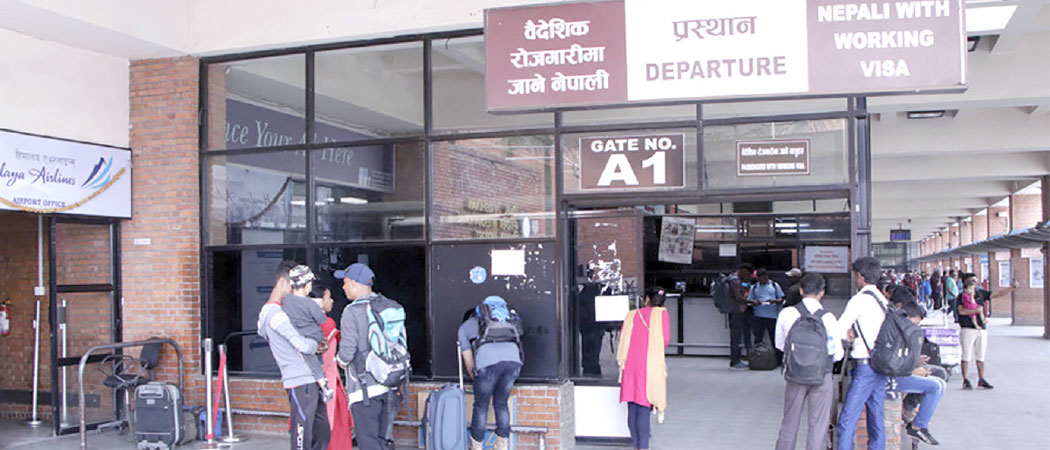
As the conflict has shown no sign of waning and no immediate solutions being offered by both the parties, concerns to the safety and security of more than 1.72 million Nepali migrant workers in 13 countries in the region have been troubling the stakeholders back home.
According to the Ministry of Foreign Affairs (MoFA), Nepalis in Iran, Israel, Egypt, Oman, Qatar, Kuwait, Jordan, Bahrain, Saudi Arabia, the United Arab Emirates (UAE), Lebanon, Iraq and Cyprus are or likely to be affected by the ongoing war that has affected about half a dozen countries in West Asia. Cyprus is a European country while Egypt is in northern Africa.
The largest number of Nepalis are in the UAE with a presence of 478,144, followed by Saudi Arabia at 383,865, Qatar at 357,000, Kuwait at 175,000, and Iraq at 30,000. There are only six Nepali citizens in Iran and 500 in Egypt. What is leaving the authorities at the MoFA, Ministry of Labour, Employment and Social Security and other concerned departments like the Department of Foreign Employment (DoFE), Foreign Employment Board (FEB), and Department of Consular Services (DoCS) perplexed is no established mechanism for rescue and repatriation of Nepalis from West Asia.
In the past, the country had sought support from India and a couple of international agencies in rescuing and repatriating Nepalis from the conflict-affected countries such as Afghanistan, Bahrain and Lebanon.
One Nepali, Diwas Shrestha from Gorkha, was killed in an attack in a residential area in the UAE. As the situation is critical, the government is waiting for a favourable time even to repatriate his body. In another incident, two Nepalis were injured but they are already discharged from hospital following treatment.
Nepal has less than a dozen aircraft including the flag-carrier Nepal Airlines Corporation, Himalaya Airlines and Buddha Air. It would take more than a year even if all those were deployed for the rescue operation.
Rescue plan in offing
Spokesperson of the MoLESS Pitambar Ghimire said that the government doesn't have any plan yet to conduct rescue works and bring Nepalis back home. "The government is finalising the rescue plan. Until then, through a dedicated online system, details of Nepalis and applications for any support are being collected," he said.
Immediate response has also been restricted by the closed airspace in various Gulf countries including Qatar, Kuwait and the UAE.
Ghimire said that the MoLESS has conducted virtual meetings with the labour attaches deployed at the Nepali mission in West Asia.
The MoFA and MoLESS are coordinating with eight Nepali embassies and two consular offices in the region. The missions are issuing various notices, requests and travel advisories for Nepalis in those countries as well as abroad. The Ministry had also issued an advisory to remain indoors as far as possible, stay alert and take necessary precautions as suggested by the governments of the respective countries. It has also suggested to avoid unnecessary travel without prior approval from the relevant authorities, stay in regular contact with their families and Nepali missions.
The government has formed an Emergency Response Team (ERT) which is led by Foreign Secretary Amrit Bahadur Rai and includes representatives from the ministries of Home Affairs; Finance; Law; Tourism and Civil Aviation; Education; and Labour and Employment, and DoFE, DOCS, Department of Immigration and Civil Aviation Authority of Nepal.
Likewise, the Emergency Control Room (ECR) established at the MoFA has become fully operational.
It is providing round the clock hotline service, email response, necessary coordination and preparation of situational reports. The ECR can be reached via telephone numbers 9744441227, 9744441228, 9744441229 (including WhatsApp, Viber, and Botim) and email emergency@mofa.gov.np.
However, the DoFE is clueless about the entire process. A senior officer of the department said that they are just an executing agency and function under the directives of Foreign or Labour Ministry.
Similarly, President of the Nepal Association of Foreign Employment Agencies, Bhuwan Singh Gurung, the employers don't take the responsibility for the rescue and repatriation.
He also said that the Nepalis in critical situation and their families contact the manpower agencies seeking help, following which the latter reach out to the Nepali missions abroad and seek help from the DoFE, MoFA, MoLESS and FEB. But Gurung said that Nepal has an experience of rescuing its citizens from various regions including West Asia, Libya and Afghanistan which can be useful in formulating a new mechanism as well as plan to support Nepalis in the conflict-hit areas.
Earlier on Thursday, Prime Minister Sushila Karki held a telephone conversation with Prime Minister and Minister for Foreign Affairs of Qatar Sheikh Mohammed bin Abdulrahman bin Jassim Al-Thani to discuss the safety and welfare of Nepali citizens residing in Qatar.
On the same day, Foreign Minister Balananda Sharma also held a telephone conversation with his Bahraini counterpart Dr. Abdullatif bin Rashid Al Zayani and discussed the security situation of the region, the security strategies adopted by the Government of Bahrain, and the safety of Nepalis, among other things.
Labour permits suspended
The DoFE has suspended the labour permits for the West Asian nations since March 1.
"All concerned parties are hereby informed that the issuance of labour permits for employment in the aforementioned countries by this Department and its subordinate agencies has been suspended until the publication of a subsequent notice," read a notice issued by the Department's Foreign Labour Permit Branch in Tahachal, Kathmandu.
A ministerial-level decision of the MoLESS has decided to suspend individual and institutional labour permits for foreign employment in the West Asian countries—specifically Saudi Arabia, the UAE, Qatar, Kuwait, Bahrain, Oman, Iraq, Yemen, Jordan, Lebanon, Turkey, and Israel—until further notice.
However, the conflict has impacted Nepalis who have already obtained the labour permit to go to these countries for employment and those who are in the process to obtain the permit.
It also has a repercussion on the business of the manpower agencies. In the last Fiscal Year 2081/82, Nepalis obtained work permit to work in about 151 countries while about 959 manpower agencies sent Nepali migrant workers abroad. With some exceptions like Israel and South Korea where workers are sent through the government-to-government contract and some individual work permits, most of the workers go abroad through the agencies.
According to the statistics of the Department of Foreign Employment (DoFE), in the month of 2082 Magh (mid-January to mid-February), 15,137 Nepalis obtained labour permit to work in the UAE, 11,592 for Saudi Arabia, 11,580 for Qatar, 5,443 for Kuwait, 148 for Cyprus, and 813 for Bahrain. The numbers are including the re-entry permit.
Two months earlier in Mangsir (mid-November to mid-December), 14,191 obtained work permits for Saudi Arabia, 11,943 for Qatar, 7,707 for the UAE, 3,395 for Kuwait, 1,050 for Oman and 771 for Bahrain.
Feeling is intense for family
Nepalis in the UAE and Israel have said that they are safe and less worried. "We also got a notice from the embassy to update our details to the portal if we need to be rescued. It's good that the government has contacted us," said Tikaram Dhakal, who works as a manager in a multinational company in Dubai.
The Embassy of Nepal in Abu Dhabi has notified Nepalis in the UAE and requested them to fill their personal details in the portal created by the DoCS.
Likewise, talking to The Rising Nepal, six Nepalis in Israel and Saudi Arabia said that although there is a feeling of risk, they don't feel the need to be repatriated.
However, their relatives in Nepal are more affected psychologically by the conflict and are worried about the safety of their relatives. Ajay Sunar, a taxi-driver in Kathmandu, is one among them. His wife is working in Kuwait. Although she has assured the family about her safety there, the family members in Nepal are less assured.
A senior journalist's son is working in a hotel operated by an international-chain in Dubai. He also expressed his worries that being at risk away from home is more worrisome.
However, a Nepali youth in Israel said that the information and security system there is at an advanced level and people are informed to move to safe bunkers before any bomb-strike. "I am never worried about my safety here, but my family in Nepal is."