- Tuesday, 2 June 2026

Minister Ghising unveils 100-day progress report
-(1).jpg)
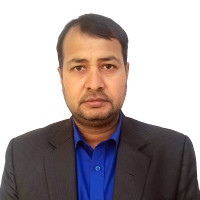
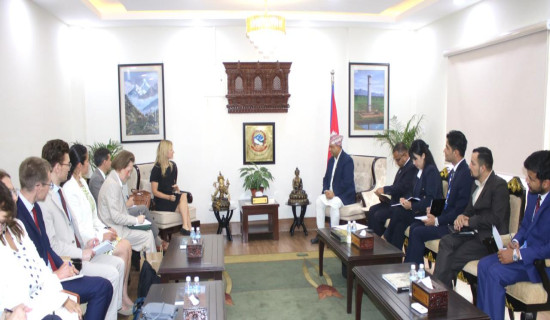
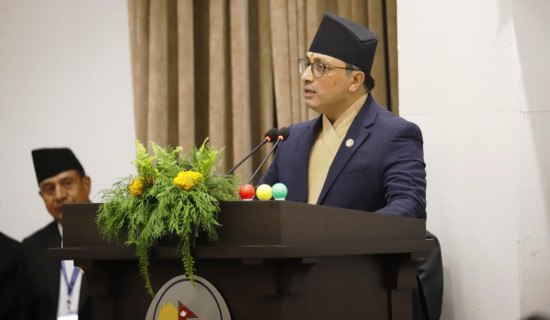
Kathmandu, Dec. 25: Minister for Energy, Water Resources and Irrigation Kul Man Ghising has made public a list of works completed in 100 days after assuming office.
He also holds the portfolio of the Ministry of Physical Infrastructure, Transport and Urban Development in the electoral government formed on the foundation of the Gen-Z movement.
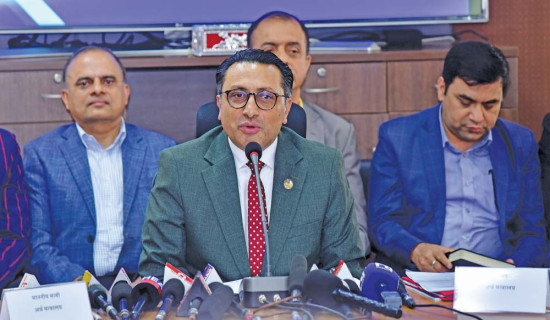
Organising a press meet at the ministry on Wednesday, he made public a list of 101 works completed in 100 days across the three ministries.
While unveiling his achievements, Minister Ghising said that being entrusted with the responsibility of three important ministries directly related to the lives of common people in a government formed under difficult and challenging circumstances following the movement was both a mark of trust and a heavy responsibility.
“During this period, I have tried to fulfil my responsibilities not as a minister, but as a servant who holds the trust of the people,” he said. “Although these 100 days are short in terms of time, they are very heavy in terms of responsibility.”
He said that he has been carrying out his duties without fearing criticism, without bowing to pressure, and without compromising with wrongdoing.
“The main demand of the Gen-Z movement regarding good governance has been firmly implemented in the ministries under my responsibility,” he said. “Priority has been given to work and visible results rather than speeches.”
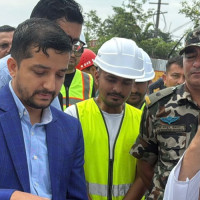
Minister Ghising also said that he has adopted a style of direct engagement by visiting project sites to understand the real problems of development projects, rather than remaining confined to the ministry. He said he has held direct dialogues with project management teams, consultants, construction entrepreneurs, and local communities.
“Efforts have been made to listen closely to the voices of passengers suffering due to incomplete roads and bridges, farmers forced to leave their fields fallow due to a lack of irrigation, and others, and to accelerate project implementation,” he said.
“A situation where even a bridge cannot be constructed for 14 years is unacceptable,” he added.
Among the 100 works listed, Minister Ghising said that the recovery of premium arrears from dedicated and trunk line users has been initiated in instalments.
Similarly, the publication of a special weather bulletin has also been included in the list.
He said that during this period, the investment modality for the 1,200 MW Budhigandaki Reservoir Hydropower Project, with an estimated cost of around Rs. 374 billion, has been finalised and forwarded to the Ministry of Finance for approval to be constructed using domestic investment.
Likewise, the investment modality for the 1,063 MW Upper Arun Hydropower Project, estimated to cost Rs. 213 billion, has been prepared and sent to the Ministry of Finance for approval. The project will be built with domestic investment, ensuring participation from Non-Resident Nepalis (NRNs), Nepalis working abroad, project-affected people, and the general public.
He said that a term sheet has been signed with banks and financial institutions for the financial management of the 210 MW Chainpur Seti Hydropower Project. Similarly, the 102 MW Madhya Bhotekoshi Hydropower Project, constructed under the leadership of the Nepal Electricity Authority and its subsidiary Chilime Hydropower, has been completed, connected to the national transmission line, and has started commercial electricity production.
The Nepal Electricity Authority and the Power Grid Corporation of India Limited have signed a joint venture and shareholder agreement to jointly construct the Dodhara (Lamki)–Bareilly and Inaruwa–Purnea 400 kV cross-border transmission lines between Nepal and India.
This agreement ensures that these transmission lines will be completed by 2030, creating an environment for importing and exporting an additional 5,000 MW of electricity between Nepal and India. The proposal to issue 20 per cent shares of the Nepal Electricity Authority to the public has been sent to the Ministry of Finance for approval.
Similarly, electricity worth Rs. 19 billion has been exported to India and Bangladesh.
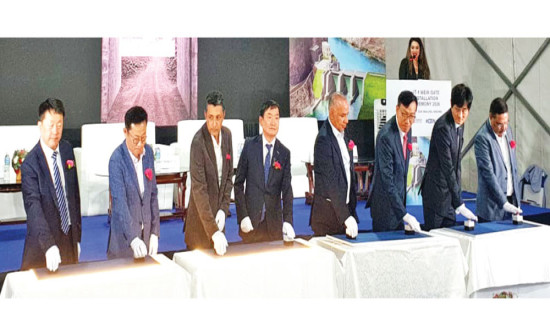
On the physical infrastructure front, a loan agreement worth 34.49 billion yen has been signed with the Japanese government for the improvement of Koteshwor Chowk Junction.
“The problem of chaos in the capital was addressed by halting waste disposal at Bancharedanda, the obstacle to bringing Melamchi water to Kathmandu was removed, the border with the northern neighbour China was reopened by restoring the Tatopani–Kodari road, and the BP Highway, damaged by the monsoon, was temporarily brought into operation on time, easing people’s lives,” he said.
In the absence of bridges of strategic importance, citizens have been forced to take risky journeys of one and a half hours to travel distances that would normally take just five minutes, he said.
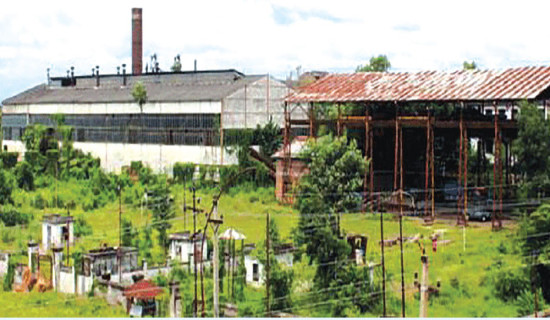
“I have come to the conclusion that the main reasons for this situation are the tendency to evade responsibility, unnecessary pressure and interference, and a lack of strict enforcement of the law. Efforts have been made to discourage the practice of holding development projects hostage. To end the tendency of leaving projects unfinished for years and to deliver direct benefits of development to the people, the process of terminating sick contracts has been initiated,” he said.
Accordingly, 40 sick contracts have already been terminated, while others are in the process of termination.
About 40 non-performing contracts worth around Rs. 3 billion under the Department of Roads have been terminated during this period, including the Kankai Bridge in Jhapa, which had been abandoned for 14 years. About 150 other sickly contracts are in the process of termination.
The Sunkoshi Marin Multipurpose Project, a national pride project, which had achieved only 10 per cent progress despite 60 per cent of the contract period having elapsed, has also had its contract terminated. Likewise, 22 sickly contracts worth Rs. 14.22 billion under the Department of Water Resources and Irrigation have been terminated.
Four sickly contracts under the Ministry of Urban Development have also been terminated.
“This step is not limited to terminating contracts alone. The process of awarding new contracts has already begun, with a clear decision not to let the terminated projects fall into neglect again,” he said.
The achievements also mention that reconstruction of government physical structures damaged during the Gen-Z movement has been accelerated, and that the reconstruction of 140 ‘green-stickered’ buildings—structures that sustained minor damage—under the ministry has been largely completed.On the proposal of the Ministry of Urban Development, the Council of Ministers has approved the master plan of the Kirtipur Cricket Stadium, and the process of securing resources for the second phase of construction, estimated at Rs. 10 billion, has been taken forward.