- Tuesday, 9 June 2026

Gen Z movement losses strain public finances
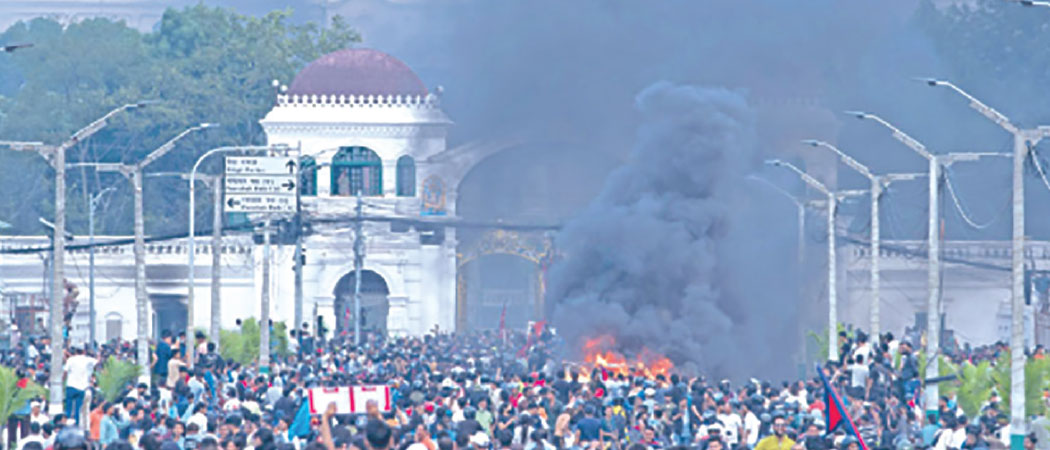
File Photo: TRN/ Sagar Basnet Vandalism and arson took place at Singha Durbar, Kathmandu, on the second day of protests organised by Gen-Z group.

Kathmandu, Feb. 18 : The nationwide protests on September 8 and 9, led primarily by youth groups, have resulted in significant human, physical, and economic losses, with long-term implications for governance, economy, and social systems.
The Ministry of Finance has estimated total damage to public and private property at Rs. 84.45 billion. This amount represents 1.38 per cent of Nepal’s Gross Domestic Product (GDP) and approximately 4.30 per cent of the current fiscal year’s national budget.
The size of Nepal's economy reached Rs. 6,107 billion in the current fiscal year 2024/25. The government had presented a budget of Rs. 1,964.11 billion for the current fiscal year on May 29, 2025.
Of the total damage amount, 53 per cent is from the public sector, 40 per cent from the private sector, and 7 per cent from the community and other sectors.
Based on the nature of the damaged property, there was arson and vandalism in public buildings and in vehicles.
Provincially, the highest amount of damage was reported in Bagmati Province, said the Ministry.
Of the total damage, the public sector suffered losses worth Rs. 44.93 billion. This includes 66 per cent of the federal government, 10 per cent of the provincial government, 21.8 per cent of the local government, and 2.2 per cent of the public corporations.
Similarly, the private sector suffered losses worth Rs. 33.54 billion. This loss was obtained from the assessment of the damage to private establishments and households. Of this, private establishments suffered losses worth Rs. 27.49 billion and households suffered losses worth Rs. 6.58 billion.
The community and other sectors suffered losses worth Rs. 5.97 billion. This includes the assessment of the damage to political party offices, community organisations, and structures and property.
The unrest also led to an estimated Rs. 13.87 billion loss in goods and services production.
In terms of employment, 2,999 people have been directly affected, and out of them, 2,353 people have lost their jobs completely.
According to the reconstruction action plan prepared by the National Planning Commission, a total of Rs. 36.3021 billion is estimated to be spent on the reconstruction and repair of damaged buildings in the public sector and the purchase and repair of vehicles and other physical assets.
Of these, around Rs. 19.98 billion is estimated for the reconstruction of buildings, Rs 6.16 billion for the purchase/repair of vehicles, and Rs. 10.1442 billion for the purchase and repair of other physical assets.
Impact on public finance management The protests have created considerable pressure on public finance management, said the Ministry of Finance.
The government must now mobilise additional resources for relief and rehabilitation of affected families, medical treatment for the injured, reconstruction and repair of public and community infrastructure, support for private sector recovery and employment recovery initiatives.
However, no prior budget allocation was made for such emergency expenditures in the current fiscal year, forcing the government to reprioritise limited resources.
The Ministry said that the task of finding alternative ways to obtain resources is challenging as the expected amount has not been deposited in the Infrastructure Reconstruction Fund established by the government. Around Rs. 93 million has been deposited in the Infrastructure Reconstruction Fund so far.
There is a need to identify additional resources for the implementation of sustainable social security programmes for the maintenance and livelihood of the families of Gen Z martyrs and the injured. As the available resources are used for the reconstruction of buildings and the purchase of vehicles, resource allocation in the productive investment sector is low, said the ministry.
According to official records, 77 people — including 73 men and 4 women — lost their lives during the protests. Among the deceased, 39 were youths aged 13 to 28.
A total of 2,429 individuals were injured, including 1,433 youths, highlighting the heavy impact on the younger population.
Of the 53 people who died in the movement, a total of Rs. 79.5 million has been provided financial assistance at the rate of Rs. 1.5 million per person, according to the ministry. As immediate relief for the injured, Rs. 36.4 million has been provided to 2,429 people.
Out of the total injured who have been classified as eligible for financial assistance as per the procedure approved by Council of Ministers, a total of Rs. 71.14 million financial assistance has been provided till mid-July 2026.
The "Integrated Business Revitalisation Plan, 20820" has been implemented to immediately resume industries, commercial and professional establishments and economic activities affected by the agitation.
The government, in accordance with the decision of the Council of Ministers, has allocated Rs. 4.9 million for the inquiry committee formed.
Similarly, around Rs. 129 million has been provided for the repair of prisons damaged by the Gen Z movement and the management of other essential facilities.
Revenue collection challenges
The activities of private and public institutions affected by the damage have slowed down, which has also affected revenue mobilisation.
Revenue mobilisation has also been affected due to damaged businesses claiming tax cuts for losses, potentially reducing income tax collection, loss of wage-based income tax from unemployed workers and reduced imports of consumer goods, industrial raw materials, and machinery
A 50 per cent customs duty and excise waiver on capital goods imported for reconstruction, lowering import-based revenue
Due to this, the Ministry of Finance has revised the revenue mobilisation target from Rs. 1,480 billion to Rs. 1,298 billion for the current fiscal year.
The Gen Z movement has had far-reaching consequences beyond immediate physical damage. The economic shock, reduced business confidence, revenue shortfalls, and increased reconstruction liabilities pose serious challenges to fiscal stability and long-term development planning.