- Sunday, 3 May 2026

Book on Dalit arts, indigenous knowledge launched
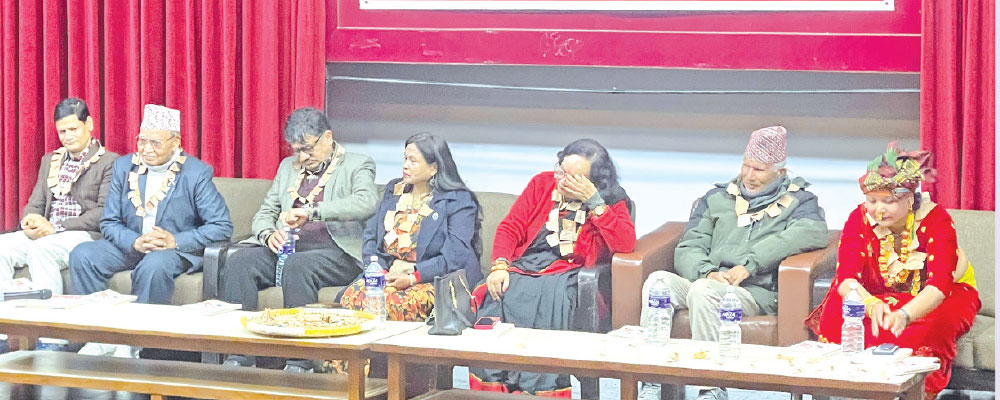

By A Staff Reporter,Kathmandu, Dec. 23: A comprehensive book documenting the artistic, technological and cultural contributions of Nepal’s Dalit community was launched at the Nepal Tourism Board (NTB) Hall in Kathmandu on Friday.
Titled Dalits' (Shilpees') Glorious Arts and Artefacts Under Socio-cultural Shackles, the book is jointly authored by scholar Dr. Govinda Sarki Nepali and social activist Indira Ghale, with editing by Fraid Kalantari. The publication is the outcome of more than three decades of extensive field research and documentation.
Speaking at the programme, Dr. Nepali said the book challenges conventional narratives that have historically marginalised Dalits and the book presents them as pioneers of indigenous knowledge, craftsmanship and technology. He stated that the Dalit community has played a foundational role in shaping Nepal’s civilisation through skills in metalwork, leather craft, music and ritual practices, yet their contributions have remained largely unrecognised.
“The irony of our social structure is that while many cultural rituals depend on Dalit skills, there is no proper mechanism to acknowledge their value in national heritage,” Dr. Nepali said, adding that the book seeks to establish Dalit artistry as an integral part of Nepal’s cultural identity and future.
Co-author Ghale said the publication aims to contribute to social transformation by recognising Dalit artisans as knowledge holders rather than passive subjects of study. She noted that the erosion of traditional skills has accelerated due to the lack of documentation and preservation, a gap the book attempts to address.
Offering remarks, educationist Prof. Bidya Nath Koirala criticised long-standing political and academic portrayals of Dalits as merely disadvantaged communities. He said the book repositions Dalits as “Bishwakarma”, the creators and architects of society, and restores their historical and cultural standing.
Researcher Dr. Sunita Sharma highlighted the scientific relevance of the indigenous technologies documented in the book, stating that many traditional techniques developed by Dalit artisans surpass the understanding of modern science. She credited Dr. Nepali for creating a vital archive of tangible and intangible heritage.
The book is divided into ten sections covering household utensils, ornaments, musical instruments, ritual objects, production systems and indigenous technologies. Based on research conducted across the Himalayas, Hills and Tarai, the study draws on information from 237 key informants and includes archaeological assessments.
The publication also features extensive visual documentation, with hundreds of photographs of rare arts and artefacts collected and preserved by Dr. Nepali in a dedicated museum, offering a rare insight into Nepal’s indigenous craftsmanship.