- Sunday, 3 May 2026

Human-elephant conflict intensifies in Morang
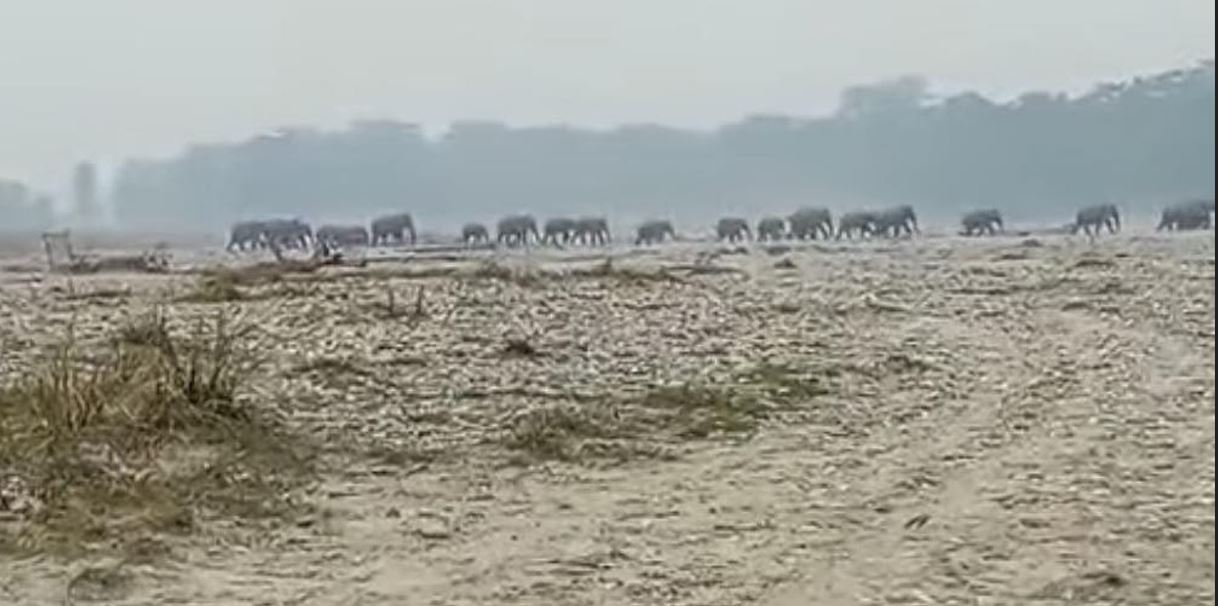

By Hari Prasad Koirala,Urlabari, Dec. 10: Fear of wild elephants has increased over the past week in Belbari- 8 and 10, and Kanepokhari - 7 of Morang district.
Elephants spend the day in the northern forests but enter nearby settlements in groups after nightfall, creating panic in villages bordering the jungle.
According to Chharan Gurung, Ward Chair of Kanepokhari-5, around 24 to 25 elephants are currently staying in the forest north of Bhaunne in Belbari-10. He said elephants have caused major damage to sugarcane, paddy and banana crops in Ward No. 5, where banana cultivation is widespread.
Gurung said herds of elephants have destroyed banana farms belonging to Hemanta Bishta, Kumar Bishta, Keshar Gurung and Hari Adhikari. They have also damaged Bambahadur Rai’s sugarcane and paddy fields. The house of Kumbhakarna Sarki has been completely destroyed, while two other houses have suffered minor damage.
“We have not yet been able to determine the full scale of the damage. We collected details this morning, but more damage continues to occur at night,” he said. Losses are estimated to have already exceeded Rs. 2.5 million.
Elephant disturbances have also increased in Kanepokhari Bazaar, which lies along the East-West Highway. Elephants have been targeting fruits displayed for sale at the market.
Fruit sellers now cover their produce at night, as elephants come almost daily to eat them. Storing fruits indoors carries even greater risk, so traders have not adopted stronger protective measures.
Fruit and vegetable vendor Meena Sah said elephants have been troubling the market continuously for the past week. On Tuesday night, elephants destroyed a field of yams grown by Dinesh Limbu of Chhathare Tole in ward No. 7.
Although locals stay vigilant throughout the night and light fires at different points to prevent elephants from entering the settlement, the animals still enter the village and cause destruction, Thami said.
According to Shailendra Yadav, Associate Professor and Head of the Department of National Parks, Recreation and Wildlife Management at the Institute of Forestry, Hetauda, elephants frequently come to Morang for breeding. Nepal’s forests may provide a safer environment for breeding than India’s, he added.
A study last year found that two elephants gave birth and raised calves in the forests of Morang. He said forests are now primarily viewed as resources to meet human needs, rather than being conserved for eco-tourism and biodiversity, which has contributed to elephants entering settlements.
He added that Nepal has three distinct elephant zones -- Mechi to Bagmati, Bagmati to Dang, and Dang to Shuklaphanta Wildlife Reserve. If the same herd remains in one area for long periods, it leads to genetic problems. Therefore, biological corridors that allow movement between all three zones are essential, even if it requires relocating human settlements to create elephant routes.
Elephants are highly intelligent animals, Yadav said. Studies have shown that a mother elephant may attack or kill a mahout if she realises he has abused her calf. This is why elephants tend to cause greater damage where their natural routes have been obstructed. Elephants moving in groups usually do not cause harm, solitary elephants tend to be aggressive.
Yadav added that methods commonly used in Nepal -- lighting fires, blowing sirens and throwing stones -- do not reduce elephant conflict and may even worsen it. He urged communities to be especially cautious of elephants that have separated from their herds.