- Saturday, 2 May 2026

Exception To US Exceptionalism

Days after Donald Trump said he preferred diplomacy to other means of resolving issues and within hours after Iran’s Foreign Minister said that a deal with the United States was “within reach”, American forces launched air strikes on Tehran that killed at least 160 people, including school students. The Shia Muslim-majority oil-rich country’s supreme leader since 1989, Ayatollah Khamenei, is reported dead in the high-precision US-Israeli attack Saturday.
Washington made unsubstantiated claims of Iran developing nuclear weapons, and Israel’s stake was an “existential threat” that ostensibly drove the two to tango against the country that has been in a running dispute with Washington since the last Shah Mohammad Reza Pahlavi was overthrown from his throne in 1979 in the wake of months of mass uprising across the country.
Barack Obama, the first African American black president, who served two terms at the White House, recently warned that the US is “dangerously close” to slipping into autocracy. If the same statement were to be made by others, especially foreigners seeking a student visa to the US today, that person’s social media postings would be scrutinised for rejection.
The rigour that the fingers on the trigger entail is a double-edged sword. One needs to recall how the US promised independence if a new constitution allowed it the right to maintain military bases in Cuba, a decade and a half before the First World War. And Washington secured the right to set up a military base.
Fingers on the trigger
Real or false, crying wolf won’t work the wonders Washington might have anticipated from past experiences. That is because you can’t threaten all the people all the time and get away with it.
Times change; they have to. History tells us so, and so will the cycle go on as long as civilisation survives on Planet Earth, which is 4.5 billion years old. Amidst the deaths and destruction of the Ukraine war, the world has learnt vital lessons: not to put all apples in one basket. That is, not to rely willingly or heavily on one country, but to tap any opening for alternatives for rainy days, for concurrent invocation as a shield against a big bully or a yet-to-be-tested alternative. Options often help.
In November 1979, an Iranian student force, identified as Muslim Student Followers of the Imam’s Line, held 52 hostages at the American embassy in Tehran for 444 days when Jimmy Carter was the United States president seeking a second term at the White House. Originally, there were 63 hostages but more than a dozen women and children were released after a fortnight.
During the 1980 election campaign, Carter was seen as a weak president who could not deal effectively in securing the safe release of hostages in Tehran. In public opinion polls, he trailed behind the Republican candidate and retired Hollywood actor Ronald Reagan. Carter’s administration did not even have the consolation of seeing the hostages released before Reagan was inaugurated. In fact, the captives were freed when Reagan was taking his oath of office.
Trump's brinkmanship turned the reverse gear on his Greenland takeover threat. His verbal boast and bluster united Europe’s major powers to band together and put their feet down in all seriousness. He then decided to back off. In Venezuela, President Nicolas Maduro was kidnapped in a dramatic raid that brought off some local security personnel and made off with the man Washington so intensely disliked for spurning its wishes on that country’s oil production and prices.
War means the use of weapons of death and destruction that enrich their manufacturers—a paradise for profiteers, whatever the consequences on the killing fields. Armed conflicts mean more money for the five-star generals of the weapons industry. Shedding crocodile tears is a familiar act no one pretends to believe in any longer. Afghanistan’s fate is a recent example. What was the result? Back to square one, 20 years after the NATO invasion, prolonged painfully for Afghans on false pretexts.
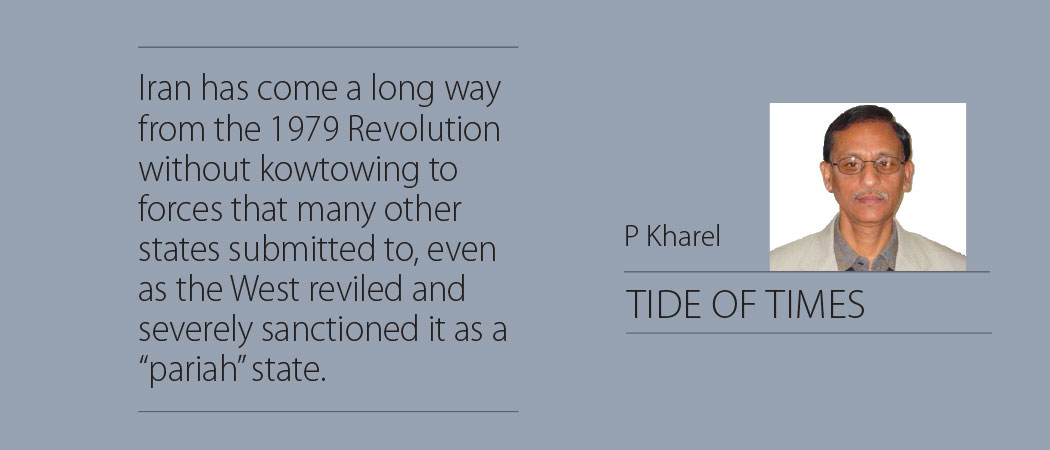
Hence, Iran has come a long way from the 1979 Revolution without kowtowing to forces that many other states submitted to, even as the West reviled and severely sanctioned it as a “pariah” state. In the Ukraine war, Tehran supplied Russia with several hundred drones and other weapons that President Vladimir Putin gratefully received, even if to the bitter regret of prominent NATO partners.
Trials and tribulations
Iran withstood Washington’s sanctions for four and a half decades. Yet it built research and infrastructure that are the envy of most non-Western powers. The tag “pariah” did not blow it off balance. It was like the “blood thirsty capitalists” tag that communist China blared in retaliation for the “cruel Chinese communist tactics” ping-ponged in the 1960s and mid-70s.
Washington had claimed that its bunker-busting bombs in June 2025 had done serious damage to Iranian efforts at nuclear weapons. But it was Trump’s predecessor Joe Biden who first derailed the nuclear deal with Iran.
In 1950, the democratically elected Prime Minister Mohammad Mosaddegh wanted Iran to gain control over oil wells, which the British, since the late 18th century, had been hogging by paying pennies for sterling pounds, and repatriating the riches home. The US feared that communism would take over the strategically placed country.
London and Washington imposed sanctions; the press was extensively bribed against the elected government; and mass rallies were well funded by foreign forces. The popular prime minister was put under house arrest in 1953 until he died four years later.
The Shah was reinstalled but with autocratic powers to ensure that the oil wells were run smoothly by British companies under London’s profiteering terms. The restored all-powerful ruler was hailed as a moderniser, the best in West Asia but, of course, next only to Israel. On Saturday, the son of the late Shah, “Crown Prince” Reza Pahlavi, rejoiced that the US had intervened in Iran. As he declared that the “final victory” was near for “democracy”, his hopes of returning to the Peacock Throne were apparent, if not explicitly expressed.
(Professor Kharel specialises in political communication.)
-square-thumb.jpg)