- Sunday, 24 May 2026

Good Governance Key To Democratic Polity

Good governance is a chief condition of the exercise of legitimate authority at multi-layered institutions. It increases the capacity of public and private institutions to set policy goals, implement them, and create orderliness of life through binding decisions. The ability of governance to sustain the normative order of goodness of society demands fair outcomes of progress for diverse Nepalis. Inclusive economic growth and the synergy of its multi-structural economy are its vital canons.
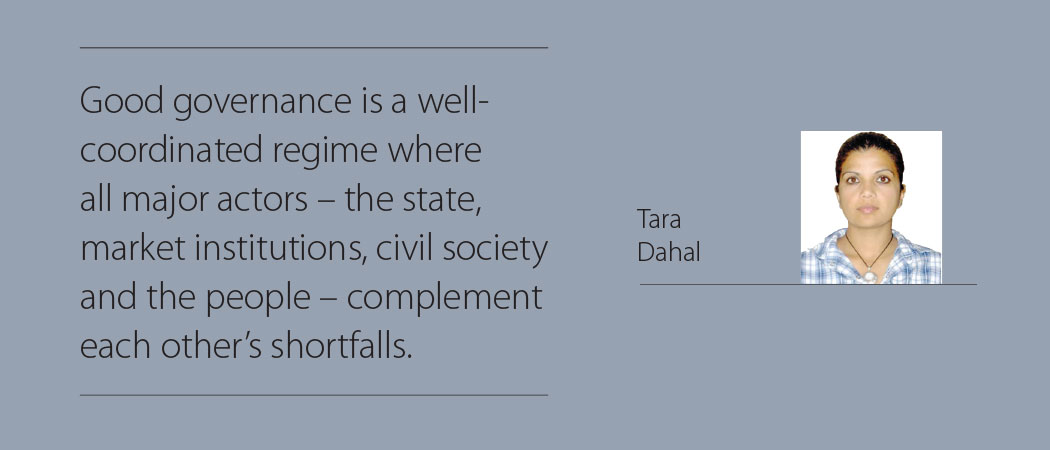
The synergy builds the capacity for public sector management to realise Nepalis' constitutional rights and their rightful place in society. Its purpose is to define procedures to enhance cooperation among all actors of society, engage in a free conversation to define the shape of public policies and muster popular consent for rule, power, leadership and authority. The efficiency of good governance wards off negative externalities and arbitrary use of authority and resources. Obviously, good governance is a well-coordinated regime where all major actors – the state, market institutions, civil society and the people – complement each other’s shortfalls.
Constitution
The Nepali constitution purports to create an egalitarian society where cultural, social and income differences do not matter for coexistence. No governance actor is allowed to violate its jurisdiction. The work of each marks a shift in politics from greed and corruption to compassion and cooperative action. What matters is the resolution of vices of society, enabling Nepalis to relish personal security, rule of justice, voice, reaping of productive and intellectual pursuits and public goods. It affirms the mores of inclusive change. It is essential to improve the life of Nepalis and move society, economy and politics in an accountable and transparent pathway as per the constitution and international laws, rules and institutions of which the nation is a member.
In Nepal, good governance is synonymous with democratic rule. It rests on constitutional rules of the game without the use of force, provides each person equal opportunity and a level playing field to enhance life choices, even for the poor. Corruption drains social surplus for welfare investments and perpetuates vicious poverty. A lively public sphere is vital to mirror public opinion in public policies and expose malfeasance. The self-regulating rationality of the public sphere is independent of power, authority and expertise. Any supposition of good governance does not amount to a political status quo that blocks the social mobility of people and disfavours equitable progress.
The vision of the constitution justifies the struggle of people to claim, negotiate and realise their priorities on education, health, livelihood, information and infrastructures. It makes survival imperative, non-negotiable and allows the participation of each generation in ecological, social, economic and political spheres. Governance scope increases if people can fairly share governance outcomes and are empowered to bear its costs through local tax efforts. It keeps a balance between the demand and supply of public goods and prevents the stealing of resources.
Nepal’s governance promises social justice. It means no discrimination of people based on their social, caste, ethnic, gender and cultural distinctions. The constitution upholds many virtues of good governance, such as social inclusion in all the institutions of governance, social security, proportional representation, popular sovereignty, etc., which are essential preconditions to create the stake of people in governance and realise their life prospects. It has granted many sectoral rights for labour, women, Dalits, children, senior citizens, people of remote areas so that no one is left out of the laws and policies outreach. This enables diverse shades of Nepalis to embrace a collective vision and muster the institutional capacity of this nation to realise all constitutional and human rights. The positive side of good governance is to overcome scarcity and conflicts arising out of adversarial politics that respect no opposition where the loser of political games lose interest in governance.
Nepal has formulated the Good Governance Act to make public administration pro-people, accountable, transparent and inclusive based on rule of law, corruption–free and smart public administration, financial discipline and efficient management of public work and resources to create a situation for providing public services speedily and cost-effectively. This act is necessary but not sufficient to bring democratic change to improve the performance efficiency of public administration and business. Politics is patronage-based, not meritocratic and social discipline is not strong enough to keep control of administrative and political vices, rent-seeking and the influence of consultants, contractors, middlemen, and even advisors who extract undue charges for their services to the people.
Good governance
Three factors vitiate the nation's policy culture—lack of social discipline, impunity for the powerful and laxity of anti-corruption and criminal laws. The regulatory weakness has also impaired the core of good governance and the structural foundation of peace. Nepal does not lack institutions of national integrity. What it lacks is a strong political will to build the nation’s infrastructures, use national resources in productive sectors, upgrade health, educational, communication and livelihood-related infrastructures in the best interest of the people.
The core of good governance can be built on the edifice of peace from the local bodies. The right of Nepalis to deliberate on policies and programmes, bear ownership, control over planning and resources and share the outcome of development requires monitoring the entire cycle of democratic progress. It enables people to dynamically learn from both successes and failures. The coordination of priorities among the donors, government and people can enforce mutual accountability. In Nepal, aid alignment to national priorities is not effective. The duplication of projects and discontinuity of policies with the change of government have delayed performance outcomes, increasing the cost of development. The sustainability of development indicators and quality of democracy alone spur good governance.
(Dahal holds an MA in Peace and Conflict from Otto-Von Guericke University, Germany)