- Saturday, 2 May 2026

Nationwide security rings in effect for polls
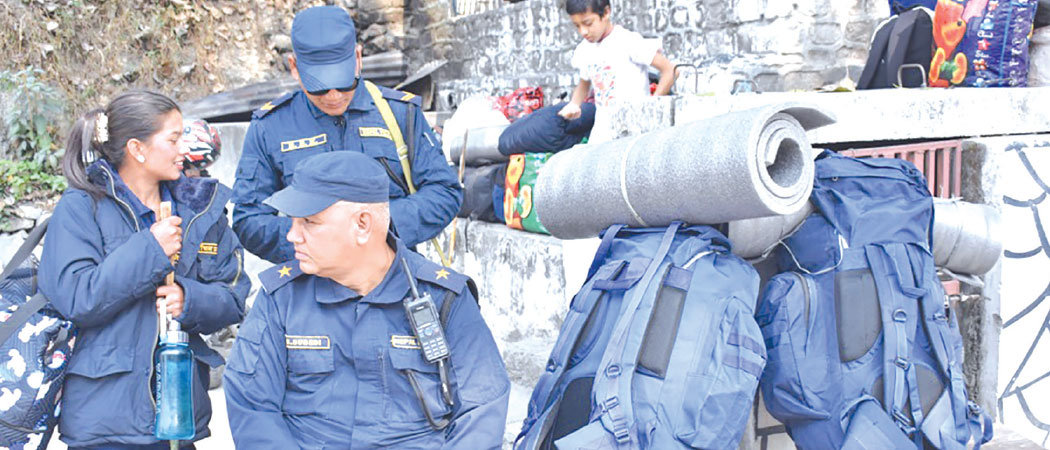

By A Staff Reporter,Kathmandu, Mar. 3: The Election Commission of Nepal has deployed more than 550,000 personnel across the country to ensure smooth and secure conduct of the House of Representatives election scheduled for March 5.
Polling will take place from 7:00 am to 5:00 pm, with over 215,000 officials, from chief polling officers to polling assistants, assigned to oversee voting operations.
In addition, approximately 339,000 security personnel have been mobilised nationwide.
The security contingent includes members of the Nepali Army, Nepal Police, Armed Police Force Nepal, the National Investigation Department, and specially designated election security units or temporary police.
Three-tier security strategy
As usual, the government has implemented a three-layered security strategy covering the period before, during and after the polling day.
According to the Ministry of Home Affairs (MoHA), the integrated security plan endorsed by the Central Security Committee has already been put into operation, with forces deployed to the field.
Election Commission’s Spokesperson Narayan Prasad Bhattarai said that all necessary personnel for both administrative management and security arrangements have reached their assigned locations. He said that the Commission remains focused on ensuring voting is conducted safely, orderly and in a fear-free environment within the stipulated timeframe.
Coordination is being carried out at multiple levels, from the central Commission to local polling stations.
A High-Level Election Security Committee, led by Election Commissioner Sagun Shumsher JB Rana, is working in close collaboration with government agencies, informed Bhattarai.
Parallel mechanisms have also been activated --- the Central Security Committee under the Home Minister, the Central Election Command Centre led by the Home Secretary, Provincial Election Command Centres in all seven provinces under chief secretaries, Provincial Security Committees under provincial Internal Affairs Ministers, and District Security Committees headed by Chief District Officers.
Nationwide voting infrastructure
The election will determine 275 seats in the House of Representatives, 110 under the proportional representation system and 165 through first-past-the-post system polling.
A total of 3,135 candidates from 63 political parties are contesting under the proportional system, while 3,404 candidates from 65 parties are competing in direct constituencies.
According to the Commission, 18,903,689 voters are registered nationwide. Of these, 9,663,358 are men, 9,240,131 are women, and 200 are listed under other gender categories.
Voting arrangements have been made at 23,112 polling centres located within 11,110 polling stations. Of these, 10,967 are permanent polling stations and 143 are temporary.
Risk-based deployment
Based on updated security assessments, 4,414 polling stations have been categorised as highly sensitive, 4,442 as sensitive, and 2,254 as normal in terms of security risk, according to the Home Ministry.
Security deployment has been determined through a detailed risk evaluation process, taking into account voter numbers, geographical terrain, candidate density, the level of political competition, past election-related incidents and broader security challenges, according to Joint Secretary and Spokesperson for the Ministry of Home Affairs, Ananda Kafle.
Under the four-layer perimeter system, the Nepal Police will form the innermost security ring at polling stations and centres. The Armed Police Force will constitute the second layer, while the Nepali Army will provide the third perimeter.
The National Investigation Department has also activated its mechanisms accordingly. Election police units have been assigned supportive roles at polling sites.
With administrative and security frameworks fully mobilised, authorities express confidence that Thursday’s polls will proceed in a stable and well-coordinated manner, reflecting a significant national effort to safeguard democratic participation.
-square-thumb.jpg)