- Saturday, 2 May 2026

World leaders urge return to talks after attack over Iran
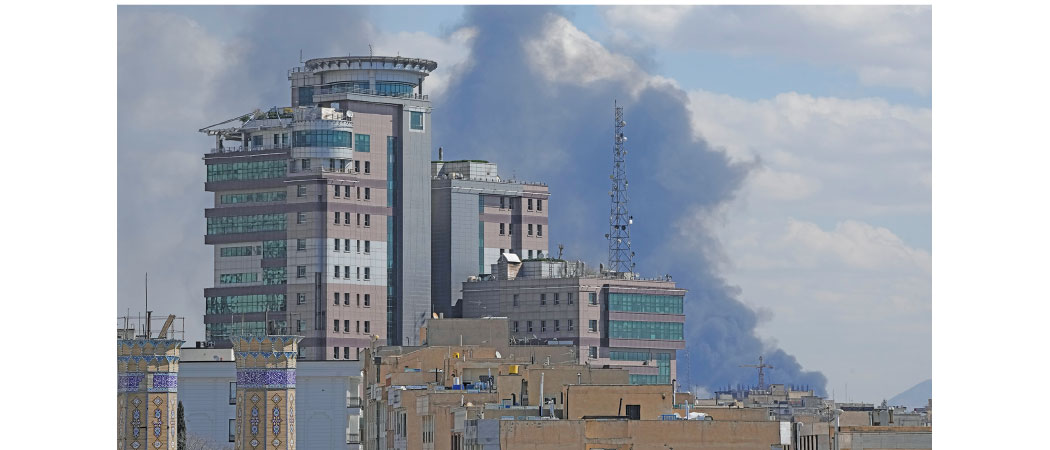

Brussels, Mar. 5: World leaders urged peace and a return to talks as the military strikes by the United States and Israel on Iran raised concerns about whether the violence could spread across the region and tensions rose with Iran vowing devastating blows after the killing of Iran's Supreme Leader Ayatollah Ali Khamenei.
A massive explosion rocked the Iranian capital on Sunday morning as the Israeli military said it was targeting the "heart" of the city after stating it cleared the path to Tehran the day before. Meanwhile, Iran pressed on with its retaliation campaign: Qatar, Kuwait and Bahrain said they intercepted a barrage of missiles.
Oman, which served as an interlocutor between Tehran and Washington in recent nuclear talks, said an oil tanker in the strategic Strait of Hormuz came under attack and its port at Duqm, used by the U.S. Navy as a logistical hub and capable of hosting aircraft carriers, was targeted in a drone attack.
The demise of Khamenei, who had no designated successor, will likely throw Iran's future into uncertainty and exacerbate already growing concerns of a broader conflict.
Top diplomats from the 27 European Union nations are holding an emergency meeting Sunday to discuss the situation around Iran and the next steps for the bloc. The United Nations Security Council met late Saturday.
Perhaps cautious about upsetting already strained relations with Trump, many nations, including several in the Middle East, refrained from commenting directly or pointedly on the joint strikes but condemned Tehran's retaliation.
Other countries were more explicit: Australia and Canada expressed open support for the U.S. strikes, while Russia and China responded with direct criticism.
The United States and Israel launched a major attack against Iran on Saturday, and Trump called on the Iranian public to "seize control of your destiny" by rising against the Islamic theocracy that has ruled the nation since 1979.
During the U.N. Security Council on Saturday, the U.N. chief and many countries urged a halt to attacks and a return to negotiations to prevent the conflict from expanding further into the region and beyond.
Secretary-General António Guterres told the council that everything must be done to prevent an escalation. "The alternative," he warned, "is a potential wider conflict with grave consequences for civilians and regional stability."
Guterres said the U.S. and Israeli airstrikes violated international law, including the U.N. Charter. He also condemned Iran's retaliatory attacks for violating the sovereignty and territorial integrity of Bahrain, Iraq, Jordan, Kuwait, Qatar, Saudi Arabia and the United Arab Emirates.
The Security Council meeting was tense as the U.S. and Iranian ambassadors traded warnings and direct rebuffs.
Further calls for de-escalation came from across the Middle East and Europe.
"Return to your senses ... and deal with your neighbors with reason and responsibility before the circle of isolation and escalation widens," Anwar Gargash, an adviser to the United Arab Emirates' president, told the Iranian theocracy on Sunday.
In recent years, the UAE sought to de-escalate tensions with Iran despite its longtime suspicions of its northern neighbour.
The 22-nation Arab League called the Iranian attacks "a blatant violation of the sovereignty of countries that advocate for peace and strive for stability." That coalition of nations has historically condemned both Israel and Iran for actions it says risk destabilizing the region.
"The Iranian regime's indiscriminate attacks against its neighbours carry the risk of dragging the region into a broader war and we condemn this," said EU foreign policy chief Kaja Kallas as she announced the bloc's meeting on Sunday. "It is essential that the war does not spread any further. The Iranian regime has choices to make."
British Prime Minister Keir Starmer, French President Emmanuel Macron and German Chancellor Friedrich Merz called on the U.S. and Iran to resume talks in a statement on Saturday, saying they favored a negotiated settlement. The three countries have led efforts to reach a negotiated solution over Iran's nuclear program.
"We condemn Iranian attacks on countries in the region in the strongest terms. Iran must refrain from indiscriminate military strikes," they said. "Ultimately, the Iranian people must be allowed to determine their future," they said. (AP)