- Monday, 8 June 2026

Monetary Implications Of Digitalisation

We are living in the digital world affecting all spheres of economic activities and daily life. With the process of digitalisation, the new digital economy has emerged. The digital economy refers to economic activities that are promoted by digital technologies, especially the internet, mobile networks, and online platforms. The digital economy is, in fact, a broader economic system that emerges from widespread use of digital technologies. It has changed the ways goods and services are produced, exchanged and consumed in the economy. Almost all economic activities have been digitalised in recent times in various degree.
The digital economy can boost economic growth by reducing transaction costs, providing information and expanding market access. It increases inclusion in the economy by facilitating market access from national to global. Moreover, it helps drive innovation to create new products, services, and methods. On the downside, it raises questions about data privacy. All of these digitalization and the emergence of the digital economy have also changed the ways we carry out banking and finance, having implications for monetary policy.
Crypto currencies
Digitalisation has changed banking and financial transactions by making them faster and more accessible. Customers can perform banking transactions anytime through mobile apps, internet banking and ATMs; no need to visit physical branches. Especially payment process has become faster, cheaper, and more robust. Digital platforms reduce operational costs. New digital technologies such as advanced encryption, biometric authentication, and AI-driven fraud monitoring can improve banking security.
More importantly, digital transformation in finance has laid the foundation for cryptocurrencies by enabling decentralised, secure, and borderless financial systems. Cryptocurrencies are a type of digital currency that uses blockchain technology to enable secure, peer-to-peer transactions without relying on central banks or traditional intermediaries, based on encryption and decentralised networks to verify transactions. It has created a serious challenge to traditional legal tender issued by the central banks. However, Nepal has been banning the use of cryptocurrencies so far.
Digitalisation has had several implications for monetary policy and its management. Such implications should be looked from multiple dimensions such as how final goals of monetary are going to be impacted and the how the monetary policy can be transmitted in the economy because of change in payment and banking methods. Digitalisation is changing the way money is created, distributed, and used. In fact, the digital innovation has been altering the landscape in which monetary policy operates.
Digitalisation, especially the proliferation of private cryptocurrencies, and the potential creation of Central Bank Digital Currency (CBDC) seems to make the new structural shift for monetary policy. While generating efficiency, speed, and expanding financial inclusion, this new technological advancement fundamentally challenges the central bank's traditional control over the money supply, the stability of the banking system, and the efficacy of its monetary policy transmission.
The proliferation of private digital currencies has created a challenge to maintain national monetary sovereignty. If widely adopted, they could erode the central bank's capacity to control the domestic money supply, set independent interest rates, and maintain macroeconomic stability. These unbacked crypto assets introduce new sources of high volatility and systemic risk for financial stability, compelling central banks and regulators to come up with new strategies globally.
However, digitalisation has been helping to maintain price stability, which is the main goal of monetary policy. Digitalisation lowers production costs by increasing productivity, reducing transaction costs, and enhancing market efficiency. Automation and digital tools boost output with fewer resources. Online platforms allow consumers to compare prices easily, creating a competitive environment. Digital payments and e-commerce reduce overhead costs. Moreover, real-time data and logistics tracking reduce delays and waste.
As digital payments and private currencies grow, many argue that tools like interest rate adjustments and reserve requirements may lose influence over spending and saving behaviour. Monetary policy traditionally influences the economy through interest rates, credit availability, and expectations. These channels may not work in a new situation. Fintech firms and digital wallets have already been challenging traditional banks, potentially weakening the interest rate and bank lending channel.
Major concern is that cryptocurrencies operate outside central bank control, raising concerns about monetary sovereignty and financial stability. A stable financial system is necessary for smooth monetary transmission. In response, though central banks are working on developing CBDC, it may bring several challenges and risks to monetary operations and transmission. CBDCs allow households and businesses to hold direct claims against the central bank, expanding the coverage of reserve money. CBDCs will also impact the fractional reserve system by changing how liquidity is held and managed in the economy.
Real-time digital data
Despite emerging complications, real-time digital data allows central banks to monitor economic activity more precisely in the digital era, enabling more targeted interventions and timely monetary policy decisions. Central banks can use big data, AI, and machine learning to improve economic forecasts and obtain information of the economy. Big data from sources like transaction records, online searches, and social media can provide central banks with real-time data that improves economic forecasting. Moreover, e-money can strengthen monetary policy by increasing financial inclusion, leading to stronger pass-through of policy decisions.
At the end, given the rapid changes happening through digitalisation with several known and unknown monetary implications, Nepal Rastra Bank (NRB) needs to proactively research the emerging situation and its likely impact on the overall banking system and the conduct of monetary policy. The digitalisation of finance is happening rapidly that demands innovative approach from NRB and the banking communities. New situation seems to demand a complete reassessment of policy framework and instruments.
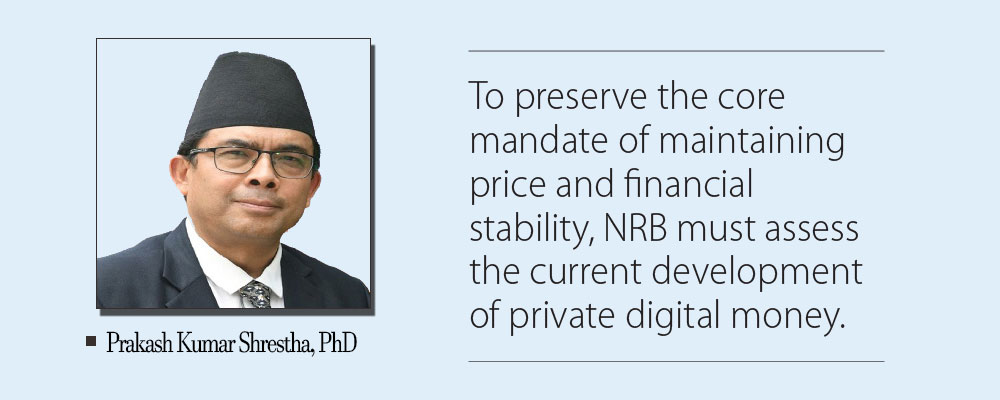
To preserve the core mandate of maintaining price and financial stability, NRB must assess the current development of private digital money while carefully designing CBDCs to maximise policy effectiveness without destabilising the foundation of the existing financial system. Controlling the use of cryptocurrency for a long time may not be the right way to follow in the era of digitalization.
(Dr. Shrestha is a former member of the National Planning Commission. praks.shrestha@gmail.com)

-square-thumb.jpg)