- Thursday, 16 April 2026

Festive Fare Round The Year

Festivals and other cultural manifestations contribute to the continuity and connectivity with the community that celebrates them. The occasions remind us how generations of the past observed festivities in their own style, depth, and affordability, through an evolutionary process guided by time and circumstances.
One of the first acts of a triumphant Prithvi Narayan Shah when arriving at Kathmandu’s Hanuman Dhoka on Indrajatra day more than 250 years ago was to pay obeisance to Kumari, the Living Goddess. The action turned out to be of strategic significance, even if perhaps not by design but by religious fervour that won him the local population’s hearts and minds, generating trust and enabling a smooth transition to a new order of national unity.
All heads of government and state have maintained this laudable legacy with faithful reverence, whatever the ups and downs in the landscape and vicissitudes of regime-fate down the centuries. This has remained an uninterrupted feature of Nepal’s cultural heritage. It also serves as a treasure trove of one of the world’s oldest existing countries and the only South Asian nation to have never been colonised.
Things might change but the spirit should not be distorted. The unifying characteristic of a festival carries a welcome feature with significant impact. Age is no barrier. Men, women and children participate in accordance with the time-honoured tradition. Community participation differs sharply from individual or group participation when celebrating job promotion, salary increment, choicest posting, class upgrading in academic career, birthday, new year fare marking different eras, religious events and what have you.
Cultural profile
Nepal’s cultural profile is an impressive range of festivals with a matching spate of activities carrying a rich tapestry handed down since the hoary past. Nepal stands as a living example of social harmony, a treasured tradition prized at home and envied elsewhere. One of the most remarkable features of its cultural landscape is the presence of at least 124 languages—a monumental legacy the scale of which only a few countries can boast.
Hardly a week progresses without a festive event in one community or another. Celebratory moods that emit soothing, pleasant offer occasions not only for gaiety and merriment, accompanied as they are by a spring well of religious fervour. Indeed, festivities are sources of relief from the complexities and complications of life, which could infuse a sense of prepared mindset to confront existing or incoming challenges. Their religious connotations generate a sense of duty done and perhaps satisfaction secured from the rituals, including personal prayers and chanting befitting an occasion.
During his visit to Nepal in 1811, William Kirkpatrick, the first British envoy to Nepal, described Kathmandu as having more idols than men and more temples than houses. He could have added that Nepal had more festivals than the number of weeks in a calendar year. Towards the last lap of the summer rains, an array of festive occasions unfolds in quick succession, heralding the busiest part of the year. By the time autumn sets in, some of the biggest cultural fairs unfold across the length and breadth of the country with great gaiety and religious reverence. Dashain is easily an outstanding occasion for rites and rituals, marked by devoted meanings decoded for those who believe. After all, faith of any denomination is based on conviction.
From the wee hours, the ringing and ding-dong of temple bells, sounding of conches, beating of miniature drums and playing of harmoniums amidst chanting of prayers by priests and people alike, Dashain progresses during its ten-day course. Barely a fortnight later comes Tihar, the festival of lights unfolds a fortnight later with all its attendant paraphernalia. An oft-repeated saying is associated with the Dashain’s intensity and the inherent financial costs it entails: Dashain arrives beating drums and departs, leaving behind the burden of loans on the revellers.
That is something yours faithfully has been hearing and reading about since school days, more so since the time this scribe’s career in journalism commenced in the last few days of summer in 1973. One just has to go through the country’s oldest newspaper, Gorkhapatra’s opinion pages in the September-October editions of the 1970s and ’80s for reconfirmation.
Dashain means more expensive air travel because of a spurt in demand. Land travel meets a similar fate, particularly in the interiors, if not the major highways. Millions of people working or studying away from home would like to return for family union and gathering with relatives as well as other close ones, friends and neighbours. But public transportation costs pinch their pockets deep at a time when prices of consumer goods in general also record a steep rise.
Pocket pinching
In fact, festive occasions are automatic targets for traders and service providers to drive the prices of their wares up. Generally accepted economic principles do not work when shortage is not the cause of a price boost. Goods are well-stocked. Trade folks plan weeks to reach retailers and expand the network for the sale of their wares and services. Another aspect of Dashain and Tihar in Kathmandu concerns constant complaints from shopkeepers about “lack of business”. This, too, is not anything new or a development of recent decades.
My own observation points to the mushrooming of shops in all streets, lanes and bylanes of the capital whose bourgeoning population’s demand keeps rising. Underemployment has led people to spread shops too densely and too deeply. It is not the trade volume and related ratio but the existence of too many shops, stalls and service centres that contribute to the “business is down” syndrome. With more people and a larger number of stalls and shops on all corners of towns and suburbs, competition turns very stiff. If the purchase and sales records were, however, to be computed, the sales volume and value would show a hike. Festivals like Dashain and Tihar are occasions for family reunion and rejoicing, with children chirping, ambling and gamboling all over the place, adding to warmth, reinforcing bonds.
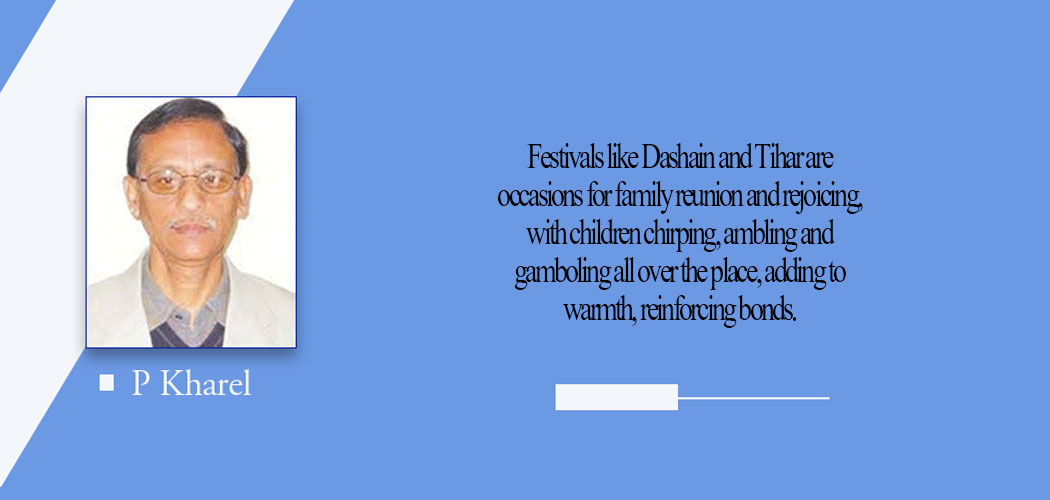
(Professor Kharel specialises in political communication.)
-square-thumb.jpg)
-square-thumb.jpg)
-square-thumb.jpg)